Enhancing Student Engagement through Vertical Non-Permanent Surfaces and Random Grouping
This presentation by Peter Liljedahl explores innovative strategies to improve student engagement and learning outcomes in the classroom. By implementing Vertical Non-Permanent Surfaces (VNPS) and Visibly Random Groups (VRG), students showed increased enthusiasm for mathematics, reduced social barriers, and greater collaboration in learning. The findings highlight how these methods can enhance task engagement, knowledge mobility, and overall classroom dynamics. Discover actionable insights, effective assessment practices, and adaptable problem-solving approaches to redefine your teaching strategies.

Enhancing Student Engagement through Vertical Non-Permanent Surfaces and Random Grouping
E N D
Presentation Transcript
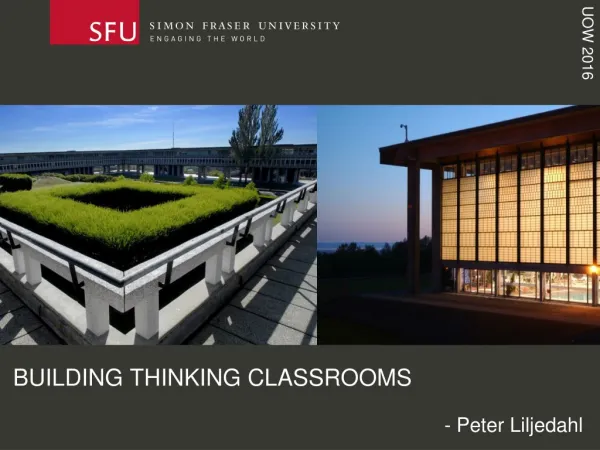
building thinking classrooms - Peter Liljedahl
n=32 STUDENTING catching up on notes (n=0) NOW YOU TRY ONE
don’t keep up n=16 don’t n=3 yes n=3 don’t use notes n=27 THE LESSON: TAKING NOTES
don’t keep up n=16 don’t n=3 yes n=3 don’t use notes n=27 USE NOTES TO STUDY THE LESSON: TAKING NOTES
tasks • hints and extensions • how we give the problem • how we answer questions • how we level • room organization • how groups are formed • student work space • how we give notes • assessment • … THINGS I (WE) TRIED
levelling • assessment • flow • answering questions • oral instructions • defronting the room • good tasks • vertical non-permanent surfaces • visibly random groups FINDINGS – BIGGEST IMPACT
levelling • assessment • flow • answering questions • oral instructions • defronting the room • good tasks • vertical non-permanent surfaces • visibly random groups FINDINGS – BIGGEST IMPACT
PROXIES FOR ENGAGEMENT • time to task • time to first mathematical notation • amount of discussion • eagerness to start • participation • persistence • knowledge mobility • non-linearity of work 0 - 3 EFFECT ON STUDENTS
students become agreeable to work in any group they are placed in • there is an elimination of social barriers within the classroom • mobility of knowledge between students increases • reliance on co-constructed intra- and inter-group answers increases • reliance on the teacher for answers decreases • engagement in classroom tasks increase • students become more enthusiastic about mathematics class EFFECT ON STUDENTS
levelling • assessment • flow • answering questions • oral instructions • defronting the room • good tasks • vertical non-permanent surfaces • visibly random groups WHAT NEXT?
THANK YOU! liljedahl@sfu.ca www.peterliljedahl.com/presentations #VNPS