Economic Transformations of the 1920s: Prosperity, Challenges, and Cultural Shifts
400 likes | 518 Vues
The 1920s marked a significant era of economic transformation in the U.S., characterized by a booming business sector and a struggling agricultural industry. The end of wartime contracts led to a recession, but by 1922, businesses rebounded with rising consumer demand and the spread of electricity. The automobile industry flourished, significantly impacting manufacturing wages and boosting related industries. Despite increased wages, economic disparities persisted, particularly affecting marginalized groups. Union membership declined amid management-hostile environments, while political leadership reflected pro-business policies.


Economic Transformations of the 1920s: Prosperity, Challenges, and Cultural Shifts
E N D
Presentation Transcript
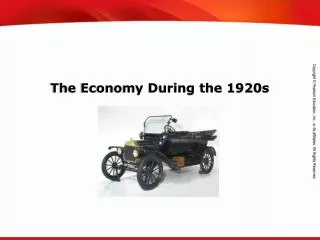
Booming Business, Ailing Agriculture • Recession hits when wartime defense contracts end • But by 1922 business bounces back • Age of electricity brings new consumer goods- by 1925 60% of households have electricity • Automobile was the major industry- by 1930 60% of families have a car • Ford led in the beginning, then GM, back to Ford • Automobile industry accounts for 9% of all wages in manufacturing and stimulates many other industries
Rising stocks reflect the speculative nature of Wall Street • Business boom stimulates capitalist expansion overseas • corporations built facilities abroad • U.S. investors loaned European nations money to repay WWI debt • Private investment abroad increases five-fold
Economic nationalism prevails- high protective tariffs • Fordney-McCumber Tariff (1922) and Smoot-Hawley Tariff (1930) • http://www.youtube.com/watch?v=dxPVyieptwA • As a percent of GDP U.S. exports fell • However, manufactured goods rose to 61% of exports by 1920s
Even though wages did rise in the decade, workers benefitted unequally • North faired better than the South • Women, blacks, Mexicans, and recent immigrants faired the worst • For farmers, grain prices plummet • Government purchases end, European agriculture is revived, farm exports slow • Farm income falls by 60%
New Modes of Producing, Managing, and Selling • The assembly line boosts output by 40% • Managers discourage individuality, etc. – “Fordization of the face” • The assembly line doesn’t foster pride in skill or provide opportunity for advancement • However, this created American industrial might • Business consolidation continues after the war
Giant corporations begin setting up divisions within the company, making day-to-day oversight highly complex • The gradual increase in wages came because leaders recognized that higher wages would improve production and consumer buying power • Ford paid his workers $5 a day • New systems of delivering goods developed • Dealer networks in the automobile industry; Chain stores and department stores (air conditioning helps popularize these stores)
Advertising takes off • Buying on credit soars • Installment plans with fixed payment schedules • Was mostly confined to big ticket items • Accounts for 75% of automobile sales by 1929
Women in the New Economic Era • Cigarettes for women as “torches of freedom” • Cosmetics were “hope in a jar” • Male workers dominated the manufactoring plants • The number of working women increased to 2 million, but their number as a percent of the total female population hovered at 24% • Women went to work in corporate offices • Medical schools even capped female admissions
Struggling Labor Unions in a Business Age • Union membership fell from 5 – 3.4 million during the 20s • Why? • Overall wage rates climbed • Older craft-based unions were ill suited for the new mass-produced factories • Management hostility • Anti-union campaign (employee associations) • Welfare capitalism
Stand Pat Politics • Republican dominance of the 1920s • Northern farmers, corporate leaders, businesspeople, native-born white-collar workers and some blue-collared workers • Warren G. Harding • Bland with a soothing appeal • Known for his womanizing and his poor cabinet appointments
Scandals • Charles Forbes (head of the Veteran’s Bureau) – a draft dodger who stole funds fled the country • Harry Daugherty (Attorney General) – influence peddling; escaped two criminal trials • Albert Fall (Sec. of Interior) – leased government oil reserves for a $400,000 bribe. The Teapot Dome Scandal; went to jail
Republican Policymaking in a Probusiness Era • Congress lowers taxes and inheritance taxes for the wealthy (supported by Sec. of Treasury Andrew Mellon) • Supreme Court overturns business regulatory laws • Coolidge opposes government assistance to other groups – 1927 Mississippi flood victims or a price-support plan for farmers (McNary-Haugen bill) • This does move some farmers to the Democratic Party
Independent Internationalism • U.S. refuses to join the League or its International Court of Justice • Washington Naval Arms Conference • Specific ratio of ships amongst the world powers (reduced tonnage: U.S., GB, Japan, Italy, France) • Kellogg-Briand Pact- 60 nations and purely symbolic
Women and Politics in the 1920s: A Dream Deferred • Polling places shift from saloons to schools and churches • Women’s Join Congressional committee lobbies for child-labor laws, protection of women workers, and federal support for education • Sheppard-Towner Act (1921) – funded rural prenatal and baby care centers staffed by public health nurses • However, the 19th Amendment had little political effect • Reformers could not go so far as to get an ERA- felt it would undermine gender-based law protecting women • Those who continued to “push buttons” were labeled communist • Women expressed their liberation through consumption
Immigration Restriction • National Origins Act of 1924- 2% of each nation’s 1890 representation in America • “America must be kept American” • The law excluded Asians and South Asians as person ineligible for citizenship but place no restrictions on immigrants from the Western Hemisphere • Need for large scale, low-paid migratory workers in growing agribusiness sector • Mexican American found little support from the Catholic Church
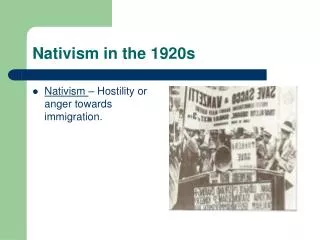
Nativism, Anti-Radicalism, and The Sacco-Vanzetti Case • Red Scare and A. Mitchell Palmer • “Those anarchist bastards”
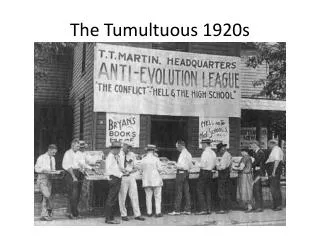
Fundamentalism and the Scopes Trial • John T. Scopes • Dayton, TN • ACLU • William Jennings Bryan • Clarence Darrow • H.L. Menken of the American Mercury
KKK and the Garvey Movement • 1915 revival and Birth of a Nation • Membership drive- expansion to 5 million • Dismal end • Garvey and the UNIA • Unpopular with mainstream black organizations • He eventually served prison time and was deported
Prohibition • Rural vs. urban values; anti-immigrant; impact of women’s movement; continuance of WWI conservation and anti-German sentiment • 18th Amendment • Volstead Act • By 1929 alcohol consumption was at about 70% of prewar era
Election of 1928 • Al Smith (D) – Catholic and a wet from NY vs. Herbert Hoover (R) – brilliant, professional with wartime service • Business and conservatism wins • There is a fear of the pope • Election began a new political realignment • Some in the Midwest abandon Republicans due to Coolidge’s insensitivity; Democrats begin to carry the biggest cities
Herbert Hoover’s Social Thought • Hoover did not believe in cutthroat capitalism; he sought a more rational approach, welcoming welfare capitalism • He encouraged corporate consolidation and cooperation- some 250 conferences • Supported the 8-hr workday and higher wages to increases purchasing power • However, his belief was that capitalists would embrace such policies because of ethics
Cities, Cars, and Consumer Goods • By 1930, 40% of African Americans lived in cities • Electricity meant women spent less time on household chores • Food prep declined and fresh food was available all year • Automobile and all its impact for both city and farm life; pricing • Advertising • Chain and department stores
Soaring Energy Consumption • Electrification and autos impact the nation’s natural resources • Electrical use triples; by 1929 20 million cars on the road • Need for oil • U.S. access to Mexican oil • Plays a role in Teapot Dome • Triggered wildcats • Did it help or hurt the conservation movement? • Sierra Club and Audubon Society kick in • Hoover actually create a National Conference on Outdoor Recreation to set national recreation policies
Mass-produced entertainment • Light reading for diversion • Saturday Evening Post and Reader’s Digest • Book of the Month Clubs and Literary Guilds • Radio • NBC formed in 1926, followed by CBS a year later- this is standardization of radio • Amos ‘n’ Andy • Movies • Chaplin, Pickford, Valentino, Jolson, Steamboat Willy • MGM, Warner Brothers, and Columbia