Download
1 / 29
300 likes | 452 Vues
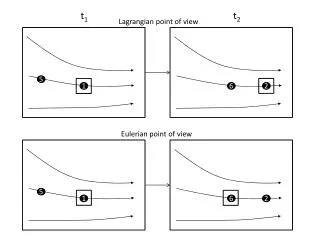
This article explores the distinct methodologies of the Lagrangian and Eulerian perspectives in computational fluid dynamics (CFD). We delve into the mathematical frameworks and physical interpretations of both approaches, emphasizing their applications in analyzing particle movements and fluid flows. The discussion includes the significance of world space coordinates, neighbor interactions, ray tracing techniques, and surface properties concerning light reflections and refractions. An understanding of these perspectives is crucial for accurate modeling of complex fluid systems in various scientific and engineering fields.

E N D
t1 t2 Lagrangian pointofview 5 1 6 2 Eulerian pointofview 5 1 6 2
(-1,1) (0,1) (1,1) y x Offset (-1,-1) (-1, 0) (-1, 1) ( 0,-1) ( 0, 0) ( 0, 1) ( 1,-1) ( 1, 0) ( 1, 1) (-1,0) (1,0) not evaluatedpairswithcellson oppositeside (0,0) evaluatedpairs (-1,-1) (0,-1) (1,-1)
h h neighbors potential neighbors no potential neighbors
worldspaceparticlepositions worldspacecorneroffsets worldspacebillboards / triangles clipspacebillboards
cornersharedwithprecursoredgesharedwithprecursornewcornernewedgecornersharedwithprecursoredgesharedwithprecursornewcornernewedge
viewray image plane pixelcentre eyepoint
rayexit stepsize rayentry / first sample point
current sample point C refinementsample points: 2 halfway L-C 3 1 halfway 1-C 2 1 halfway 1-2 3 isosurface last sample point L
worldspace texturespace 5 1 1 0.6 0.6 5 3 3 0.6 3 7 1 0.52 1 0.6 5 3 3 0.43 3
common plane surface normal incidentray reflectionray θi θr = θi surfacecut
n l r cos θi θi θr b sin θi a
surface normal common plane incidentray θi ni surfacecut nt θt refractionray
n l cos θi sin θi θi ni sin θt sin θi nt a x θt cos θi cos θt b -l y t -n
light (s-polarised) medium withlowindexofrefraction reflections surface refractions medium withhighindexofrefraction
medium withlowindexofrefraction refractions critical angle surface reflections light (s-polarised) medium withhighindexofrefraction
viewray isosurface n1 θi1 -n1 θr1 refraction1 θt1 -n2 reflection1 n2 reflection2 airni waternt refraction2(ifpossible)
volumetexture (1, 1, 1) exit entry viewray (0, 0, 0)
+y - +z -x +x -z -y
*: texture z slice index 1514131111109876543210 instanceindex 43210 * render target particlepositionz
… …