Advanced Drug Diffusion Measurement Using a Side by Side Cell Spectrophotometer
This study investigates drug diffusion characteristics using a side by side cell spectrophotometer equipped with a thermostatic unit and magnetic stirrers. The focus is on the modeling of powder dissolution and drug permeation between donor and receiver chambers with various membrane configurations. Key measurements include drug solubility, diffusion coefficients, and the impact of stagnant layer thickness on drug release rates. A case study on the diffusion of theophylline and alginates illustrates practical applications of the theoretical models developed, adhering to Fick's laws.

Advanced Drug Diffusion Measurement Using a Side by Side Cell Spectrophotometer
E N D
Presentation Transcript
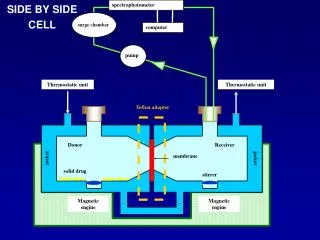
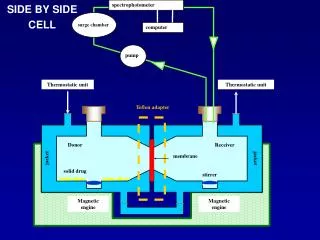
SIDE BY SIDE CELL spectrophotometer surge chamber computer pump Thermostatic unit Thermostatic unit Teflon adapter Donor Receiver membrane jacket jacket solid drug stirrer Magnetic engine Magnetic engine
2 - DRUG DIFFUSION MEASUREMENT TEFLON ADAPTER DONOR CHAMBER RECEIVER CHAMBER THERMOSTATIC JACKET MAGNETIC STIRRERS
2 - MODELING POWDER DISSOLUTION DRUG PERMEATION DONOR RECEIVER jacket jacket DRUG CONCENTRATION INCREASE STIRRER
SOLID SURFACE VARIATION: MONODISPERSED PARTICLES SYSTEM SOLID DRUG Particles initial surface area
FICK LAW 1st stagnant layer membrane 2nd stagnant layer
SIMULATION: NO DISSOLUTION Vr = Vd H = Stagnant layer thickness *hm Dm = 5.3*10-6 cm2/s *hm *hm D1 = 8.8*10-6 cm2/s *hm D1 = D2 Kp = 0.8 hm = 100 mm S = 10 cm2
SIMULATION: PROFILE CONCENTRATION S = 10 cm2 Vr = Vd Dm = 5.3*10-6 cm2/s D1 = 8.8*10-6 cm2/s D1 = D2 Kp = 0.8 hm = 100 mm h1 = h2 = 0.5*hm
SIMULATION: DISSOLUTION Vd = 100 cm3 Vr = 800 cm3 h1 = h2 = hm=100mm Kp = 0.8 Dm = 5.3*10-6 cm2/s D1 = 8.8*10-6 cm2/s D1 = D2 Kd = 10-6cm/s A = 5000 g/cm2 Cs = 12495 mg/cm3 S = 10 cm2
SIMULATION: STEADY STATE APPROXIMATION For t ∞ Cd = Cd0 (constant drug concentration in the donor) Cr = 0 (sink conditions in the receiver) FICK eq. solution (only membrane) is: Membrane Permeability
For t ∞ For a trilaminate system the solution is:
SIMULATION: LINEAR PROFILES (THIN MEMBRANES) EMPIRICAL APPROACH
3 - DRUG DIFFUSION COEFFICIENT MEASUREMENT REQUIRES THE DETERMINATION OF: 1 2 3 4 5 DRUG SOLUBILITY CS IN THE RELEASE ENVIRONMEMT DRUG DIFFUSION COEFFICIENT DW IN THE RELEASE ENVIRONMEMT DRUG POWDER DISSOLUTION CONSTANT KDP DRUG PARTITION COEFFICIENT Kp(MEMBRANE/RELEASE ENVIRONMENT) THICKNESS OF STAGNANT LAYERSSANDWICHING THE MEMBRANE
CASE STUDY: THEOPHYLLINE AND ALGINATES THEOPHYLLINE MONOHYDRATED - Carlo Erba , Milano - (C7H8N4O2*H2O); MW 198, WHITE CRYSTALLINE POWDER - DENSITY 1.49 ±01 g/ cm3 (Helium picnometer) - SURFACE AREA = 2941 cm2/g (mercury porosimeter) - U.V. PEAK ABSORBANCE 271 nm ALGINATE: - Protanal LF 20/ 60, Pronova Biopolymer, Drammen, Norway) - THEY ARE EXTRACTED FROM BROWN SEAWEED - SEQUENCE OF GULURONATE AND MANNURONATE (LF 20/60: 70% GULURONATE) - THEY FORM STRONG PHYSICAL GELS IN PRESENCE OF DIVALENT IONS (TYPICALLY Ca++)
Ca++ Ca++ Ca++ Ca++ Ca++ Ca++ Ca++ EGG BOX CONFIGURATION
DRUG SOLUBILITY CS IN THE RELEASE ENVIRONMEMT Cs = 12945± 104 mg/cm3 (DISTILLED WATER 37°C) 1 2 DRUG DIFFUSION COEFFICIENT DW IN THE RELEASE ENVIRONMEMT DW= (8.2 ± 0.6)*10-6 cm2/s (DISTILLED WATER 37°C) IDR IDR Kd = 0.62*DW2/3w1/2 *n-1/6
SEALING TAPE 3 DRUG POWDER DISSOLUTION CONSTANT KDP Donor jacket solid drug Magnetic engine
t = 0 t > 0 DISSOLUTION Rp Rp0 PARTICLES SURFACE Md = drug amount in the donor (soluble) Mp = solid particle mass - SINK CONDITIONS - Np MONOSIZED SPHERICAL PARTICLES (Rp0 INITIAL RADIUS)
A = Particles initial surface area Mp0 = initial particles mass
4 C∞ 24 h M0 = V*C∞+Vg* Cg∞ Kp = Cg∞/C∞ DRUG PARTITION COEFFICIENT Kp(MEMBRANE/RELEASE ENVIRONMENT) Cylindrical gel V IDR Vg (DISTILLED WATER 37°C) C0 = 20 mg/cm3
5 THICKNESS OF STAGNANT LAYERSSANDWICHING THE MEMBRANE MEMBRANE Donor Receiver STAGNANT LAYER STAGNANT LAYER jacket jacket stirrer stirrer
DRUG Donor jacket stirrer hss = 60.7 mm STAGNANT LAYER
4 - RESULTS - Model - Linear approximation Experimental data Vd = 100 cm3 Dm = (5.1± 0.64)*10-6 cm2/s Vr = 100 cm3 S = 10 cm2 %P = 4
T = 25°C 2% 4% 1%
T = 37°C 2% 4% 1%