Understanding the GNC: A Framework for Seamless Cross-Border Information Exchange
The Global Network of Customs (GNC) represents a collaborative approach for Customs administrations, facilitating efficient cross-border information exchange. It aims to transition from individualized negotiation methods to a standardized process, leveraging existing World Customs Organization (WCO) instruments. By developing Utility Blocks, Members can address specific needs through information sharing, enhancing compliance and operational efficiency. The GNC architecture incorporates various business rules and protocols and is poised to evolve into an approach that includes other governmental and private sector stakeholders by 2028.

Understanding the GNC: A Framework for Seamless Cross-Border Information Exchange
E N D
Presentation Transcript
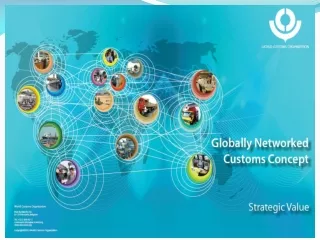
What is GNC? The voluntary arrangement between two or more Members for a seamless exchange ofcross border information at a Customs to Customs level using a standardized approach based on existing WCO instruments
How will GNC be achieved? By gradually moving away from the current individually hand-crafted method for negotiating International Agreements and using a disciplined and common methodology to industrialize the process
What is GNC based on? It capitalizes on the WCO strength of producing Standards, which are supported by Protocols and Guidelines so that Members can develop re-usable Utility Blocks delivering simplesolutions for sharing information with key trading partners in line with Members’ priorities
Definition of Utility Blocks Utility block could be defined as “a functional subset of GNC offering a tangible value proposition to Customs administrations by meeting specific needs through the sharing of information.” • Utility blocks are designed based on • Business rules, Protocols, Standards and Guidelines. • Examples: AEO, Valuation Fraud, Trade Recovery, Air Cargo Security, Origin Fraud…any area of Customs business
How is a Utility Block produced? Using a Template, and the GNC Protocols, Standards and Guidelines at least two Members take a specific part of the Customs Business and describe what is needed for information exchange, including the reasons for doing so, listing the specific data elements required, the necessary Communications mechanisms, and finally, the IT message specifications.
What else is involved? There is an overarching GNC Architecture and Business Process Model. a Legal Toolbox describes the GNC impact on international agreements. At inception, Capacity Building was included. A description of the self-financing nature of GNC, and a simulation of costs and benefits appears in the Governance model.
What next? We move to a Proof-of-Concept phase ending about 2015. The long term vision runs to 2028. On the initiative of Members, GNC can grow to include: other Government Agencies, the Private Sector, more modern methods of Communication