
Dimensional Analysis Scientific Notation
E N D
Presentation Transcript
Objectives: • Today I will be able to: • Apply scientific notation to problem solving. • Calculate multiplication and division problems using scientific notation. • Apply dimensional analysis to solving metric coversions • Informal Assessment – monitoring student interactions as they complete the scientific notation practice • Formal assessment – math assessment/scientific notation practice and exit ticket • Common Core Connection • Make sense of problem and persevere in solving them • Model with mathematics
Lesson Sequence • Evaluate: Warm-Up • Explain: Scientific Notation Notes • Elaborate: Scientific Notation Practice • Explain: Dimensional Analysis Notes • Elaborate: Dimensional Analysis Practice • Evaluate: Exit Ticket
Warm- Up • Place the following numbers into scientific notation • 0.00071m • 5200 g • 0.04 L • What is the purpose of putting numbers into scientific notation?
Objective • Today I will be able to: • Apply scientific notation to problem solving. • Calculate multiplication and division problems using scientific notation. • Apply dimensional analysis to solving metric coversions
Homework • Complete the dimensional analysis practice • Wear closed toed shoes for lab on Wednesday and Thursday
Agenda • Warm-Up • Scientific Notation Notes • Scientific Notation Practice • Dimensional Analysis Notes • Dimensional Analysis Practice • Exit Ticket
In groups, brainstorm 3 examples of things that scientists/ engineers could study that would be large enough or small enough for scientific notation to be used to describe them
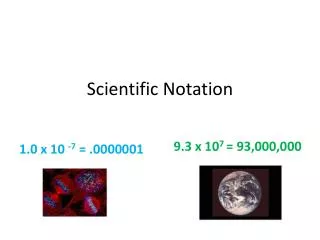
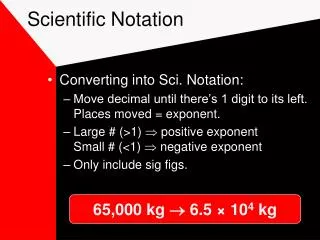
Standard Notation to Scientific Notation cont. • Examples • 489000000 (Standard Notation) • Move the decimal to the left, exponent is positive • 4.89 x 10⁸ (Scientific Notation) • Numbers greater than 1 always have a positive exponent in scientific notation • 0.000123 (Standard Notation) • Move the decimal to the right, exponent is negative • 1.23 x 10⁻⁴ • Numbers less than 1 always have a negative exponent in scientific notation
Scientific Notation to Standard Notation cont. • Examples • 3.47 x 10⁵ (Scientific Notation) • Exponent is positive, move to the right • 347000 (Standard Notation) • 7.82 x 10⁻⁴ (Scientific Notation) • Exponent is negative, move to the left • 0.000782 (Standard Notation)
Multiplying/Dividing in Scientific Notation • Multiply or divide the numbers first • (don’t include x 10exp) • When multiplying, add the exponents together • When dividing, subtract the exponents • Make sure there is only one number before the decimal place in scientific notation. You may have to move the decimal so there is only one
Multiplying/Dividing Scientific Notation cont. • Examples • (2.0 x 10⁵)(7.0 x10⁴)= • 1.4 x 10¹⁰ • (15.0 x 10⁷) / (3.0 x 10⁹)= • 5.0 x 10⁻²
Scientific Notation Practice Complete the practice at your desk. We will review selected answers as a class.
Conversion Factor 12 inches 1 foot 7 days 1 week .5 ½ • A Fraction that is equal to the number one • Two quantities that equal the same thing
Dimensional Analysis • Do these two fractions equal the same quantity? 1 dozen 12 eggs 12 eggs 1 dozen Yes!
Dimensional Analysis Problem Solving Tips Read the problem Write down what you are given, put it over 1 Write down what you are looking for List all possible conversion factors for the problem Make a road map Solve the problem
Practice Problem 1 10 hours 1 • How many minutes are there in 10 hours? • Read the problem • Write down what you are given, put it over 1 • Write down what you are looking for. • The number of minutes
Practice Problem 1 Cont 1 hour60 minutes 60 minutes 1 hour • List all possible conversion factors for the problem • We know that one hour = 60 minutes • Make a road map • Hours ? Minutes
Practice Problem 1 Cont. 10 hours . 1 hour = 10 hours 2 1 60 minutes 60 minutes • Solve the problem • We also know that when you multiply, if 2 quantities are placed in opposite corners of each other, they will cancel out • Incorrect, the units do not cancel out
Practice Problem 1 cont. 10 hours . 60 minutes = 600 minutes 1 1 hour Solve for Correct Answer!
Practice Problem 2 • How many minutes are there in 12 weeks? • 12,096 minutes Weeks Days Hours ? Minutes 12 weeks . days . hours . minutes = week day hour . 12 weeks . 7 days . 24 hours . 60 minutes = 1 week 1 day 1 hour
Practice Problem 3 • How many minutes are there in 2 years? • Years Weeks Days Hours Minutes 2 years . weeks . days . hours . minutes = 1 year week day hour 2 years . 52 weeks . 7 days . 24 hours . 60 minutes = 1 1 year 1 week 1 day 1 hour = 1,048,320 minutes or 1,051,200 minutes (365 days)
Practice Problem 4 500 mL . 1 Liter = 0.500 L 1 1000 mL How many liters are in 500 mL? mL ? L
Practice Problem 5 20 kg . 1000 g . 1000 mg = 2 x 10⁷ mg 1 1 kg 1 g How many milligrams are there in 20 kg? kg g ? mg
Exit Ticket • Activity • Find your matching partner by finding the correct standard notation and scientific notation pair • With your partner discuss the following questions: • If you could have one special superhero power, what would it be? • Would you rather have Cheetos fingers, or a popcorn kernel stuck in the back of your throat, for the rest of your life?