
Exploring Mammals: Diverse Features and Behaviors in the Animal Kingdom
E N D
Presentation Transcript
Class Mammalia • Most have an active metabolism • Endothermic • Has mammary glands that produce milk
Let's recap!! • Amphibians have moist skin. • Reptiles have scales. • Birds have feathers. • Mammals have hair!
Functions of Hair • Reduces loss of heat by radiation • Keep out coarse dust particles • Eyelashes, hair in nasal chambers, ear canals
Functions of Hair • Sex differentiation • Lions, beard and moustaches • Protects from environmental factors
Efficient respiratory and circulatory systems (4 chambered heart) Right side of heart brings in oxygen-poor blood Left side of heart brings in oxygen-rich blood
Pulmonary Circulation - Blue Pulmonary – refers to lungs Gas exchange occurs to change oxygen-poor blood to oxygen-rich
Systemic Circulation - Red Systemic– refers to the rest of the body Oxygen-rich blood is taken to top and lower half of the body.
Diaphragm helps with lungs Inhalation – diaphragm contracts, enlarging the thoracic cavity (ribcage in the chest) Exhalation – diaphragm relaxes, decreasing thoracic cavity
Reproduction • Most are born and not hatched • Internal fertilization • Embryo develops in the uterus • Uterus forms a placenta
Brain • Usually larger • Capable of learning • Care for young longer to teach them skills • Needed for survival http://serendip.brynmawr.edu/bb/kinser/Size1.html
Feeding • Teeth come in a variety of shapes and sizes that are adapted to eat different kinds of foods • Incisors and canines-shearing or tearing • Premolars and molars- grinding
Feeding • Jaws that are different from reptiles • More fused and less cranial kinesis (movement of the jaw)
Major Orders of Mammals • Monotremes • Marsupials • Placentals
Monotremes • Comes from the greek word monos (single) trema (hole). • Have a cloaca • Lack teeth as adults • Have a spur on the legs in the ankle region that contains venom (only in males) in a platypus. • Legs are on the sides of their bodies like reptiles instead of underneath the body like most mammals.
Monotremes • Platypuses and Echidnas (spiny ant eaters) • Only mammals that lay eggs • Contain yolk to nourish young • Have hair and produce milk • No nipples-glands secrete milk on stomach and the babies suck milk from fur • Found in Australia and New Guinea • Infant echidnas are known as puggles.
Marsupials • Opossums, Kangaroos, Bandicoots, and Koalas • Born very early in development and completes embryonic development while nursing • Young are held in a pouch called a marsupium • Example: The red kangaroo is the size of a honeybee at birth and is born 33 days after fertilization. • It then crawls from the exit of the reproductive tract to the pouch • Front limbs are more developed at the time of birth for climbing.
Marsupials • Reproduction • Females have 2 vaginas that lead to two separate uteruses • Females have a third canal that is used for birth • Males have a pronged penis that is only used to transfer sperm (not used for urination). • Both sexes have a cloaca
Placentals • Gets it’s name from the placenta • Organ that transfers nutrients, oxygen, carbon dioxide, and wastes between mother and embryo • Allows the embryo to develop for a longer time period inside the mother • Rats: a few weeks • Elephants: two years
12 Major Orders • Insectivores (shrews, hedgehogs, moles) • Insect eaters • Have long narrow snouts and sharp claws for digging • Sirenians (Manatees, dugongs) • Herbivores • Live in rivers , bays and warm costal waters scattered throughout most of the world • Slow, large, fully aquatic mammals
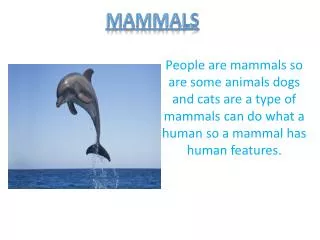
12 Major Orders • Cetaceans ( Whales, dolphins) • Live underwater but must come to the surface to breathe • Most live and breed in the ocean • Chiropterans (Bats) • Winged mammals • Only mammals that can fly • 1/5 of all mammalian species • Eat mostly fruit, insects, or nectar but some feed on the blood of other vertebrates
12 Major Orders • Rodents (Mice, rats, voles, squirrels, beavers, porcupines, gophers, chipmunks, gerbils, prairie dogs, chinchillas) • Have a single pair of long, curved incisor teeth in upper and lower jaws • Gnaw wood and other tough plant material • Perissodactyls (horses, tapirs, rhinoceroses, and zebras) • Hofed animals with an odd number of toes on each foot
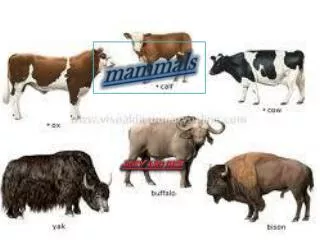
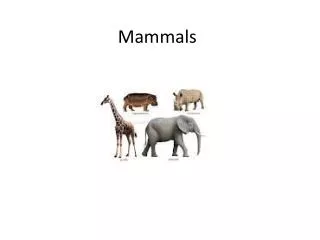
12 Major Orders • Carnivores (dogs, foxes, bears, racoons, walruses) • Stalk or chase prey by running or pouncing, then kill with their sharp teeth or claws • Some eat plants and meat • Artiodactyls (Cattle, sheep, goats, pigs, ibex, giraffes, hippopotami, camels, antelope, deer, gazelles) • Hoofed mammals have an even number of toes on each foot • Mostly large grazing animals
12 Major Orders • Lagomorphs (hares and rabbits) • Herbivores • Only have a pair of incisors in the upper jaw • Most have hind legs adapted for leaping • Xentharthrans (sloths, anteaters and armadillos) • Have simple teeth without enamel • Some have no teeth at all
12 Major Orders • Proboscideans (elephants) • Animals with trunks • Used to include mastodons and mammoths, but today we only have African and Asian elephants • Primates (lemurs, tarsiers, apes, gibbons, macques, humans) • Have a highly developed cerebrum and complex behavior
Primates • Early primates • Insectivores • Cretaceous period • Probably small and tree dwelling because they had limber shoulders to swing on trees and hands to hang on branches • Claws were replaced with nails • Sensitive, long fingers and toes • Eyes are close together in front of their face (binocular vision) • Have depth perception that helps with swinging • Increased parental care
Primates • 2 Sub orders • Prosimians “pre-monkeys” • Lemurs, lorises, pottos, and tarsiers • More like early primates • Anthropoids • Monkeys, apes, and humans • Fossils indicated they were already established in Africa and Asia 40 mya
Prosimians • Small • Nocturnal primates with large eyes adapted to see in the dark • Many have dog-like snouts
Anthropoids • Anthropoid means “human-like primates” • Branched into two based on evolutionary history • New World monkeys and Old World monkeys
Monkeys • Came to South America by raft (continents were closer together then) or by migration
New World Monkeys • Arboreal-live and swing on trees • Have long prehensile tails that coil around branches • nostrils that open to the side
Old World Monkeys • Ground dwelling and arboreal • Tail is not for swinging and the nostrils open downward • They also have tough seat pads on their behinds • Most are diurnal (active during the day) • Usually live in bands • Hominids are larger
Hominids (or “Great Apes”) • Have 4 Genera 1. Hylobates (gibbons) 2. Pongo (orangutans) 3. Gorilla (gorillas) 4. Pan (chimpanzees) 5. Humans
Hominids • Are larger than monkeys • Long arms, short legs, and no tails • All apes can swing from branches • Only gibbons and orangutans are arboreal • Gorillas and chimpanzees are very social • Apes have proportionally larger brains than monkeys • Apes behavior is more adaptable • Can walk upright and grasp with thumbs