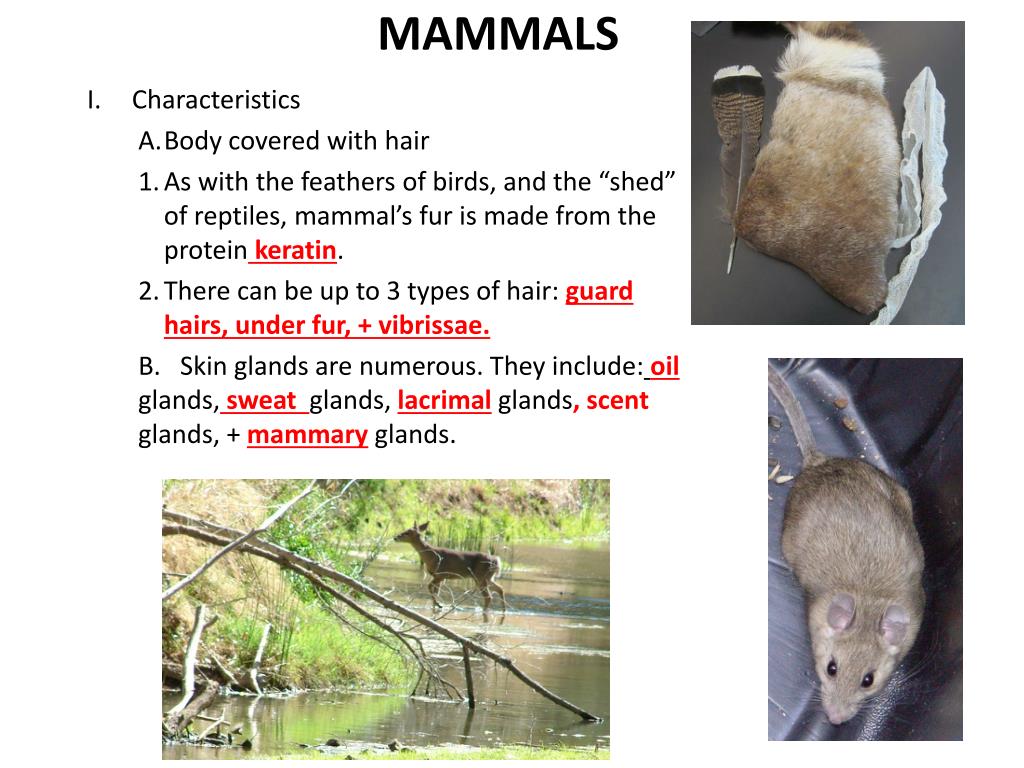
MAMMALS Characteristics Body covered with hair As with the feathers of birds, and the “shed” of reptiles, mammal’s fur is made from the protein keratin. There can be up to 3 types of hair: guard hairs, under fur, + vibrissae. B. Skin glands are numerous. They include:oilglands, sweat glands, lacrimal glands, scent glands, + mammary glands.
MAMMALS- SKELETAL FEATURES 1. Usually a relatively large brain case (cranium). 2. Generally 7 cervical vertebrae
SKELETAL FEATURES- DENTAL FORMULA Incisors-Function= Biting Canines- Function= The fangs for holding prey + tearing flesh Premolars- Function= Grind + hold Molars- Function= Grind + chew
DENTAL FORMULA- EXAMPLES 0 0 3 3 3 1 3 3 Pronghorn Antelope Mountain Lion 3 1 2 1 3 1 2 1
MORE CHARACTERISTICS D. Respiration- all use lungs, none use gills or skin. E. Circulation- Heart with 4 chambers that allow complete separation of oxygenated + deoxygenated blood.
LOCOMOTION: PATTERNS +LIMB MODIFCATIONS Ambulatory: Walk on flat feet (plantigrade) . Example- Man, Raccoon Cursorial: Legs adapted for walking + running 1. Digitigrade: Walk on toes, as the carnivores 2. Unguligrade: Walk on toenails, as the herbivores
MORE LOCOMOTION C. Saltitorial : Jumping as with the kangaroo rat. D. Arboreal: Tree climbing as with squirrels. E. Aerial: Gliding + flying as with flying squirrels. F. Fossorial: Burrowing as with prairie dogs + gophers G. Aquatic: Swimming as with the otter + beaver
THERMOREGULATION III. Thermoregulation: homeothermic + endothermic. Smaller mammals, like the pocket mouse, tend to avoid heat by burrowing or nocturnal behavior or both. B. Bighornsheep and other larger mammals can’t escape stress by burrowing. IV. Reproduction: Most mammals are viviparous.
SKULL FEATURES: PREDATOR VERUS PREY A predator, like the fox on the left, has forward facing eyes + sharp canines, molars + premolars. A prey, like the pronghorn on the right, has eyes located on the side of the head + flat premolars + molars with a large surface area.
HERBIVORE, CARNIVORE, OR OMNIVORE Herbivore: Canines inconspicuous or absent, premolars, molars are flat with large surface area . Carnivore: Sharp canines, premolars + molars. Omnivore: Sharp canines, flat surfaced premolars + molars.
ANTLER Antler formation occurs in the deer family ie. deer, moose, elk, caribou ect. With a few exceptions( caribou), they are grown by the males and use to “battle” other males for mating privileges. The growth of antlers represents some of the fastest know bone development. With most species, they are replaced annually with a even larger set.
MORE ANTLER “STUFF” High quality elk antlers can wholesale for up to $12/ pound. A mature set of antlers can easily weigh 50 lbs. Amazingly, an elk can regrow a new set of antlers in less than a year on a diet that consists of eating plants!!
HORN Horns differ from antlers in several ways. Horns, such as those in the Dall sheep, Rocky Mt. Bighorn, desert bighorn + pronghorn antelope are permanent structures, consisting of a boney core covered by a protein sheath. Typically both the male + female possess the horns, with the males obtaining a greater size.