Exploring the Restoration Colonies: From Dutch New Amsterdam to Quaker Pennsylvania
Discover the profound impacts of the Restoration Colonies on early American history. This unit traces the establishment of New Netherland, founded by the Dutch for economic profit, and its transformation into New York after British conquest. Explore the unique governance and diverse population of New Amsterdam, the rise of Pennsylvania under William Penn, and the Quakers’ quest for religious freedom. Delve into the characteristics that made these colonies pivotal in shaping early American identity and society, including their liberal land policies and commitment to religious tolerance.

Exploring the Restoration Colonies: From Dutch New Amsterdam to Quaker Pennsylvania
E N D
Presentation Transcript
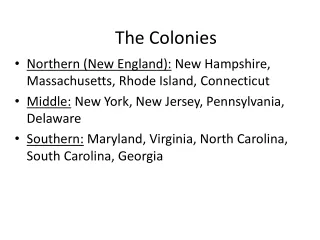
The Restoration Colonies Unit 1: Transatlantic Encounters and Colonial Beginnings to 1754APUSH Mrs. Baker
Old Netherlands at New Netherlands • 1600 • Golden Age of Dutch history. • Major commercial naval power • Challenging England on the seas. • 3 major Anglo-Dutch Wars • Major colonial power • Mainly in the East Indies
Henry Hudson’s Voyages English Voyage Dutch Voyage
New Netherlands • Founded in the Hudson River area (1623 – 1624) • Established by the Dutch West India Company for quick-profit for fur. • Company would not pay much attention to the colony. • Manhattan = New Amsterdam • Purchased by Company for pennies (22,000) acres.
New Amsterdam Harbor, 1619 • Company town run in the interests of the stockholders. • No interest in religious toleration, free speech, or democracy. • Governors appointed by the Company were autocratic. • Religious dissenters against Dutch Reformed Church [including Quakers] were persecuted • Local assembly with limited power to make laws established after repeated protests by colonists.
New Amsterdam, 1660 • Characteristics of New Amsterdam • Aristocratic = patroonships • Feudal estates granted to promoters who would settle 50 people on them. • Cosmopolitan • Diverse population with many different languages
New York Manors & Land Grants Patroonships
Swedes in New Netherlands • Mid-1600s • Sweden in Golden Age settled small, under-funded colony near New Netherland • Called “New Sweden” • 1655 • Dutch under-director-general Peter Stuyvesant attack New Sweden. • Main fort fell after bloodless siege. • New Sweden absorbed into New Netherland
New Netherlands Becomes a British Royal Colony • Charles II granted New Netherland’s land to his brother, the Duke of York, [before he controlled the area] • 1664 – English soldier’s arrived • Dutch had little ammunition and poor defenses. • Stuyvesant forced to surrender without firing a shot. • Named “New York” • England gained strategic harbor between her northern and southern colonies. • England now controlled the Atlantic coast
Dutch Residue in New York • Names – Harlem, Brooklyn • Architecture – gambrel roof • Customs • Easter eggs, Santa Claus, waffles, bowling, sleighing, skating, kolf (golf) Early 20th c. Dutch Revival Building in NYC New York City Seal
The Quakers • Called Quakers because they “quaked” during intense religious practices • They offended religious & secular leaders in England • Refused to pay taxes to support the Church of England • They met without paid clergy • Believed all were children of God • Refused to treat the upper class with deference. • Keep hats on • Addressed them as commoners • Would not take oaths • Pacifists.
William Penn • Aristocratic Englishmen • 1660 – attracted to the Quaker Faith • Embraced Quakerism after military service • 1681 • He received a grant from king to establish a colony. • This settled a debt the king owed his father. • Named Pennsylvania [“Penn’s Woodland] • He sent out paid agents and advertised for settlers • Pamphlets were pretty honest about what the trip would entail. • Liberal land policy attracted many immigrants.
Penn & Native Americans • Bought land from the Natives. • Did not simply take. • Quakers went amongst the Natives unarmed • BUT…non-Quaker Europeans flooded PA • Treated native people poorly. • This undermined the actions of the Quakers
Government of Pennsylvania • Representative assembly elected by landowners. • No tax-supported church. • Freedom of worship guaranteed to all. • Forced to deny right to vote & hold office to Catholics & Jews by English government. • Death penalty only for treason & murder • Compared to 200 capital crimes in England.
Pennsylvanian Society • Attracted many different people • Religious misfits from other colonies • Many different ethnic groups • No provision for military defense • No restrictions on immigration • No slavery!!! • “Blue Laws” • Against stage plays, cards, dice, excessive hilarity, etc A society that gave its citizens economic opportunity, civil liberty, & religious freedom!!
New Jersey – PA Neighbor • 1664 • Aristocratic proprietors received the area from the Duke of York. • Many New Englanders moved to NJ • Due to worn out soil. • 1674 • West NJ sold to Quakers • 1702 • E & W NJ combined into NJ and created into one colony.
Delaware – PA Neighbor • Named after Lord De La Warr • Harsh military governor • Closely associated with Penn’s colony. • 1703 • Granted its own assembly • Remained under the control of PA until the American Revolution
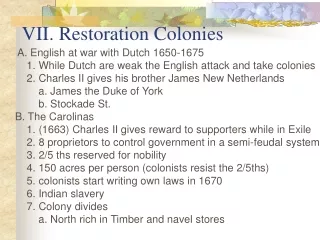
The West Indies – A Way Station to Mainland America • 1607 • A group of small English farmers from the West Indies arrive d in Carolina • Were squeezed out by sugar barons. • Brought a few black slaves and a model of the Barbados slave code with them • Named for King Charles II • The King granted Carolina to 8 supporters [Lord Proprietors] • Hope to use Carolina to supply their plantations in Barbados with food and export wine, silk, and olive oil to Europe.
Colonizing the Carolinas • Carolina developed close economic ties to West Indies • Many Carolinian settlers were originally from the West Indies. • They used local Savannah Indians to enslave other Indians [about 10,000] and send them to the West Indies [and some to New England] • 1707 • Savannah Indians decided to migrate to PA • PA promised better relations with whites. • Carolinians decided to ‘thin’ the Savannahs before they could leave • Bloody raids killed most of them by 1710
Port of Charles Town, SC • Also named for King Charles II of England. • Became the busiest port in the South. • City with aristocratic feel • Religious toleration attracted diverse inhabitants.
Crops of the Carolinas – Rice • The primary export. • Rice was still an exotic food in England. • Was grown in Africa, so planters imported West African slaves. • These slaves had a genetic trait that made them immune to malaria. • By 1710 • Black slaves were the majority in Carolina American Long Grain Rice
Crops of the Carolinas – Indigo • In colonial times, the main use for indigo was a dye for spun cotton threads that were woven into cloth for clothes • Today in the US, the main use for indigo is a dye for cotton work clothes & blue jeans.
Conflict with Spanish Florida • Catholic Spain hated the mass of Protestants on their borders. • Anglo-Spanish Wars • The Spanish conducted border raids on Carolina • Either inciting local Native Americans to attack or attacking themselves • By 1700 • Carolina was too strong to be wiped out by the Spanish!
The Emergence of North Carolina • The Northern part of Carolina shared a border with VA • VA dominated by aristocratic planters who were generally Church of England members • Dissenters from VA moved south the Northern Carolina • Poor farmers with little need for slaves • Religious dissenters • Distinctive traits of North Carolinians • Irreligious & hospitable to pirates • Strong spirit of resistance to authority. • 1712 • NC officially separated from SC
Late Coming Georgia • Founded in 1733 • Last of 13 colonies • Named in honor of King George II • Founded by James Oglethorpe
Georgia –The “Buffer” Colony • Chief Purpose of Creating Georgia: • As a “buffer” between the valuable Carolinas & Spanish Florida & French Louisiana. • Received subsidies from British government to offset costs of defense. • Export silk and wine. • A haven for debtors thrown in to prison. • Determined to keep slavery out! • Slavery found in GA in 1750
The Port City of Savannah • Diverse community • All Christians except Catholics enjoyed religious tolerations. • Missionaries worked among debtors and Indians • Most famous was John Wesley.