Understanding Animal Behavior: Development, Learning, and Genetics
This chapter explores the development and significance of animal behavior, focusing on both innate and learned actions. Ethologists study behavioral patterns, seeking to understand the role of genetics, environmental influences, and evolutionary history in shaping behaviors. Key examples include snakes playing dead, chimpanzees using tools, and the instinctive actions of sea turtles and spiders. The text highlights various learning processes such as habituation, operant conditioning, and classical conditioning, offering insights into how animals adapt to their surroundings and the implications for survival and reproduction.

Understanding Animal Behavior: Development, Learning, and Genetics
E N D
Presentation Transcript
Chapter 44Animal Behavior Section 1 Development of Behavior
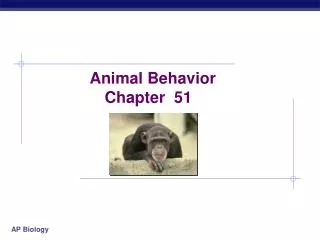
The Study of Behavior • Snakes play dead • Chimpanzee gathers termites on stick • Leaf-cutter ants cut leaves and take bits back to their nest- colony helps load food • Ethologists- biologists who study behavior
The Study of Behavior • Behavior- action or series of actions performed by an organism, usually in a response to a stimulus • To learn more, ethologists ask questions
1. What causes the behavior? What are the mechanisms that respond to a stimuli? • 2. What is the role of genes in the behavior, and how does it develop during an individual’s lifetime? • 3. What is the behavior’s evolutionary history? • 4. How does the behavior affect the organism’s survival and reproduction?
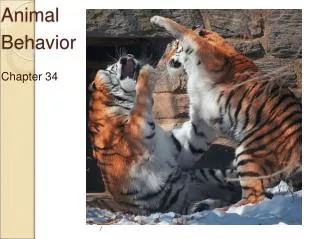
Genes and Behavior • Ethologists ask how much behavior is based on genetics and how much is based on the environment • Example: aggressive animals- snapping turtle vs tiger or bear
Natural Selection & Behavior • Animals promote offspring production by changing their surroundings • Example: new male lion takes over a pride- he kills all young cubs so that he is only the father of all new offspring
Innate Behavior • Innate behavior- instincts- inherited actions that are performed effectively the first time without being taught • Example: spider webs & hatchling sea turtles
Fixed Action Pattern • Fixed action pattern- rigid innate behavior that all members of a species perform the same way each time • Example: eastern hognose snake- spreads its jaws, hisses, and rolls on its back when threatened (plays dead)
Learned Behavior • Actions change with experience • Learning- modification of a behavior based on experience • Simple or complex • What are some examples of learned behavior that you display?
Habituation • Habituation- animal learns to ignore a frequent, harmless stimulus • Example: Sea gulls- shadows from overhead cause them to hide, overtime they learn that small objects (leaf) is not dangerous, but a larger object (hawk) is
Operant Conditioning • Operant conditioning- trial and error learning • Example: dog learns a cat hissing and arched back is dangerous when it gets scratched • Example: B.F. Skinner- rat in box trained to pull level if food came out
Classical Conditioning • Classical conditioning- animals learn to associate a response with a previous stimulus • Example: ringing a bell and a dog salivating
Problem-Solving & Reasoning • Reasoning- type of problem solving- involves the ability to solve a problem not previously encountered by the individual in a way that is not dictated by instinct • Example: chimp using tool to get insects • Other examples?
Genes, Learning, & Behavior • Genes can shape behavior • Behaviors are also shaped by an animal’s experience • But, overall, behavior is shaped by both genes and by experience
Imprinting • Imprinting- form of learning in which young animal forms permanent associations with its environment • Example: geese learn to follow the first thing they see when they hatch (humans) • Example: sea turtles hatch and return to same beach to lay eggs years later
Imprinting • Sensitive period- imprinting occurs during a specific phase in an animal’s development • Example: young children can learn multiple languages
REVIEW!!! • What are four questions that an ethologist might ask when studying behavior? • How is it possible for natural selection to affect an innate behavior? • Describe four types of learned behavior.