
SlideServe
Menu
Préférences
© SlideServe · v2026

He said he was sick.

muniya avatar
7 diapositives · 341 Views · Aug 30, 2014

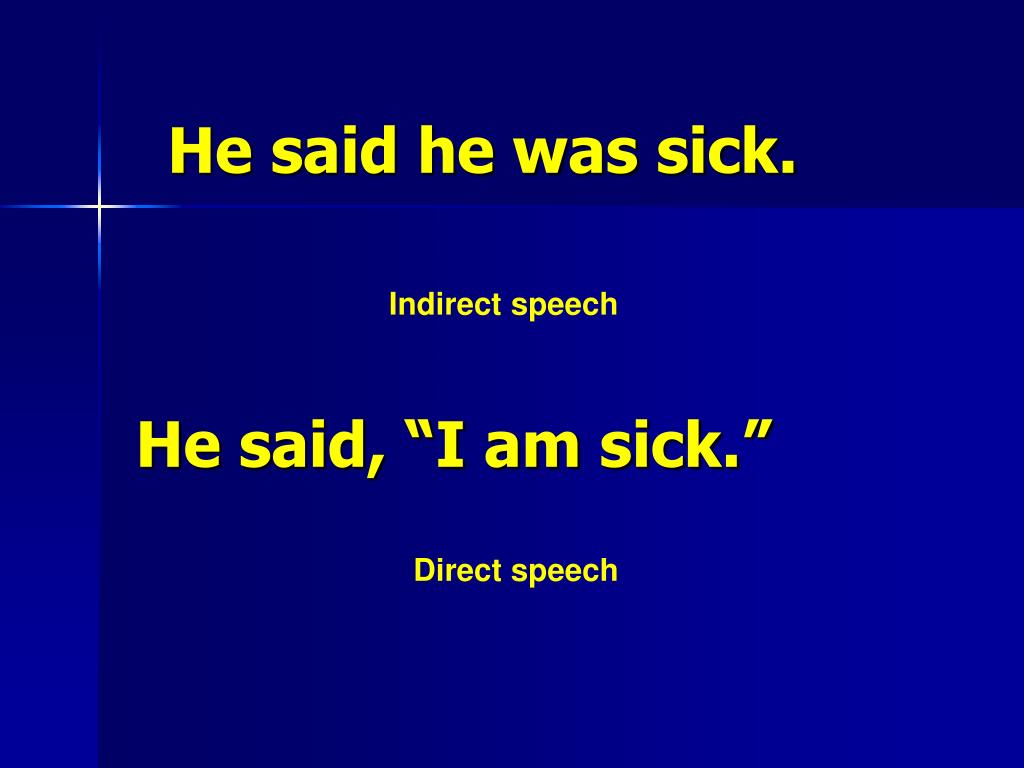
He said he was sick. Indirect speech. He said, “I am sick.”. Direct speech. Put a comma after said Juan said,. Put quotation marks Juan said, “. Capitalize the first word of the quotation Juan said, “Come.
He said he was sick. - slide 1
01 / 7He said he was sick.
1 / 17

Télécharger la présentation

He said he was sick.
Une image / un lien ci-dessous est fourni (tel quel) pour télécharger la présentation

Politique de téléchargement : le contenu du site vous est fourni TEL QUEL pour votre information et votre usage personnel ; il ne peut être vendu, concédé sous licence ni partagé sur d’autres sites sans l’accord de son auteur.Le contenu vous est fourni TEL QUEL, pour votre information et votre usage personnel uniquement. Téléchargez la présentation en cliquant sur ce lien. Lors du téléchargement, si vous ne parvenez pas à télécharger une présentation, l’éditeur a peut-être supprimé le fichier de son serveur.Pendant le téléchargement, si vous ne parvenez pas à obtenir une présentation, le fichier a peut-être été supprimé par l’éditeur.

F I N

Plus de contenu associé

Transcription de la présentation
  1. He said he was sick. Indirect speech He said, “I am sick.” Direct speech

  2. Put a comma after said Juan said, Put quotation marks Juan said, “ Capitalize the first word of the quotation Juan said, “Come Write quotation and put a final period. Juan said, “come with us. Put quotation marks after the period. Juan said, “Come with us.” Direct speech (quoted speech) It tells us the exact words that a speaker used. In writing, put quotation marks before and after the speech. Or When the quotation goes first, write a comma instead of a period and then put quotation marks. “Come with us,” Juan said.

  3. Examples: • He said, “The check is in the mail.” • She told him, “I like that tie.” • Or • “The check is in the mail,” he said. • “I like that tie,” she told him.

  4. Indirect speech (reported speech) • It tells us what the speaker said without using the exact words. • The word that can introduce indirect speech. • Examples: • He said the check was in the mail. • She told him (that) the she liked that tie.

  5. Verb forms • Direct speech He said, “I work hard.” He said (that) he worked hard. He said, “I´m working hard.” He said (that) he was working hard. He said, “I have worked hard.” He said (that) had worked hard. He said, “I am going to work hard.” He said that he was going to work hard. He said, “I will work hard.” He said (that) he would work hard. He said, “I can work hard.” He said (that) he could work hard. He said, “I may work hard.” He said (that) he might work hard. He said, “I have to work hard.” He said (that) he had to work hard. He said, “I must work hard.” He said (that) he had to work hard. He said, “I should work hard.” He said (that) he should work hard. He said, “I worked hard.” He said that he had worked hard.

  6. Exceptions: • In indirect speech the verb tense change is optional when: • Something someone has just said • A: I´m tired of all that shopping. • B: What did you say? • A: I said I´m tired or I said I was tired. • Something that is still true: • Rick said that the bank wants a check. • Or • Rick said that the bank wanted a check. • A general truth or a scientific law: • Mrs. Smith told her students that water freezes at 0 Celsius. • Or • Mrs. Smith told her students that water froze at 0 Celsius.

  7. In indirect speech, make changes in pronouns and possessives to keep the speaker´s original meaning: Rick told Ann, “ I like your dress” Rick told Ann that he liked her dress.