SlideServe
Menu
Préférences
© SlideServe · v2026

Key Performance Indicator Training Courses Malaysia

mupilu21 avatar
3 diapositives · 72 Views · Nov 06, 2017

Key Performance Indicator
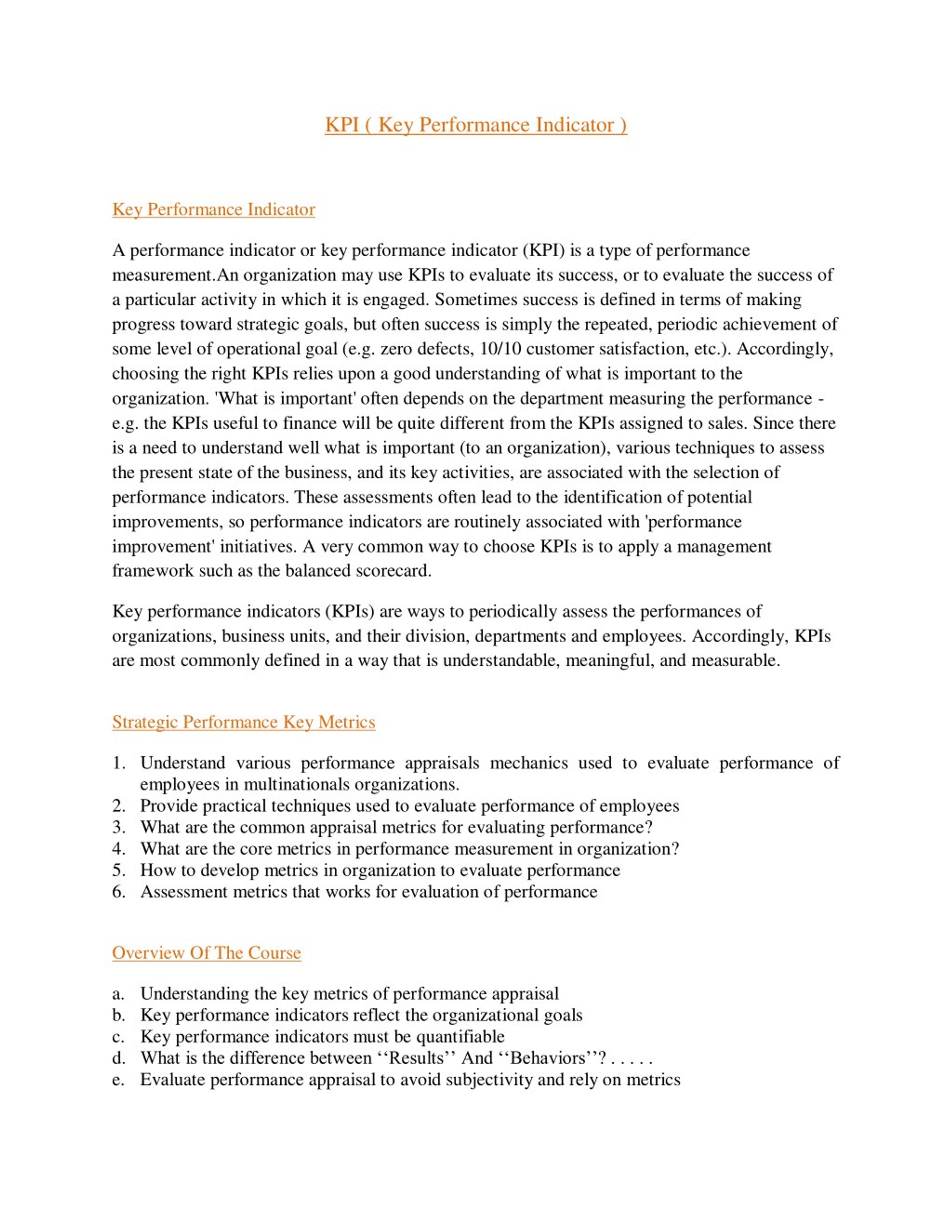
A performance indicator or key performance indicator (KPI) is a type of performance measurement.An organization may use KPIs to evaluate its success, or to evaluate the success of a particular activity in which it is engaged. Sometimes success is defined in terms of making progress toward strategic goals, but often success is simply the repeated, periodic achievement of some level of operational goal (e.g. zero defects, 10/10 customer satisfaction, etc.). Accordingly, choosing the right KPIs relies upon a good understanding of what is important to the organization. \'What is important\' often depends on the department measuring the performance - e.g. the KPIs useful to finance will be quite different from the KPIs assigned to sales. Since there is a need to understand well what is important (to an organization), various techniques to assess the present state of the business, and its key activities, are associated with the selection of performance indicators. These assessments often lead to the identification of potential improvements, so performance indicators are routinely associated with \'performance improvement\' initiatives. A very common way to choose KPIs is to apply a management framework such as the balanced scorecard.
Key performance indicators (KPIs) are ways to periodically assess the performances of organizations, business units, and their division, departments and employees. Accordingly, KPIs are most commonly defined in a way that is understandable, meaningful, and measurable. please visite our website http://www.malaysia-training.com/
Key Performance Indicator Training Courses Malaysia - slide 1
01 / 3Key Performance Indicator Training Courses Malaysia
1 / 17

Télécharger la présentation

Key Performance Indicator Training Courses Malaysia
Une image / un lien ci-dessous est fourni (tel quel) pour télécharger la présentation

Politique de téléchargement : le contenu du site vous est fourni TEL QUEL pour votre information et votre usage personnel ; il ne peut être vendu, concédé sous licence ni partagé sur d’autres sites sans l’accord de son auteur.Le contenu vous est fourni TEL QUEL, pour votre information et votre usage personnel uniquement. Téléchargez la présentation en cliquant sur ce lien. Lors du téléchargement, si vous ne parvenez pas à télécharger une présentation, l’éditeur a peut-être supprimé le fichier de son serveur.Pendant le téléchargement, si vous ne parvenez pas à obtenir une présentation, le fichier a peut-être été supprimé par l’éditeur.

F I N

Plus de contenu associé

Transcription de la présentation
  1. KPI ( Key Performance Indicator ) Key Performance Indicator A performance indicator or key performance indicator (KPI) is a type of performance measurement.An organization may use KPIs to evaluate its success, or to evaluate the success of a particular activity in which it is engaged. Sometimes success is defined in terms of making progress toward strategic goals, but often success is simply the repeated, periodic achievement of some level of operational goal (e.g. zero defects, 10/10 customer satisfaction, etc.). Accordingly, choosing the right KPIs relies upon a good understanding of what is important to the organization. 'What is important' often depends on the department measuring the performance - e.g. the KPIs useful to finance will be quite different from the KPIs assigned to sales. Since there is a need to understand well what is important (to an organization), various techniques to assess the present state of the business, and its key activities, are associated with the selection of performance indicators. These assessments often lead to the identification of potential improvements, so performance indicators are routinely associated with 'performance improvement' initiatives. A very common way to choose KPIs is to apply a management framework such as the balanced scorecard. Key performance indicators (KPIs) are ways to periodically assess the performances of organizations, business units, and their division, departments and employees. Accordingly, KPIs are most commonly defined in a way that is understandable, meaningful, and measurable. Strategic Performance Key Metrics 1.Understand various performance appraisals mechanics used to evaluate performance of employees in multinationals organizations. 2.Provide practical techniques used to evaluate performance of employees 3.What are the common appraisal metrics for evaluating performance? 4.What are the core metrics in performance measurement in organization? 5.How to develop metrics in organization to evaluate performance 6.Assessment metrics that works for evaluation of performance Overview Of The Course a.Understanding the key metrics of performance appraisal b.Key performance indicators reflect the organizational goals c.Key performance indicators must be quantifiable d.What is the difference between ‘‘Results’’ And ‘‘Behaviors’’? . . . . . e.Evaluate performance appraisal to avoid subjectivity and rely on metrics

  2. Key Benefits to Participants Understanding the concepts of metrics Knowledge, skill and attitude are still essential for measuring results Leading in a high performance work environment Bridging greater cooperation hence increasing productivity through human relations with subordinates and superiors Avoiding gut and personalized feelings in appraising and evaluating staff The metrics used in appraising staff in organization The balance scorecard and KPI method approach Handling conflicts in evaluation and appraisal Overall Course Contents 1)Introduce Performance Metrics Concepts 2)Overview Balance Scorecard Process 3)How Balance Scorecard/KPI Works 4)Potential Of KPI Foundation Strategy Focused Organization. 5)Tips Of Building Financial Objectives/Internal/Financial 6)Financial Perceptive, Customer Internal, Internal, Learning Process 7)Basic Terminology 8)Balance Score Card as comparison with Other appraisal system 9)Strategy of KPI in performance Mgt 10)Tips for achieving internal objectives 11) Financial Perspective 12)Customer Perspective 13)Internal Business – Process Perspective 14)Linking Balance Scorecard Measures to your strategy 15)Achieving Strategic Measures From Top to Bottom 16)Measuring Metrics in Balance Scorecard 17) Generating Smart Tools in Measuring Performance 18)Targets, Resource Allocation and Budgets 19)Inventory, Map Prioritize & Initiatives 20)Feedback and the Strategic Learning Process 21)Implementing a KPI Management Program

  3. Who Should Attend Anyone who are involved in the process of Key Performance Indicators and Staff who wish to improve the knowledge on how to do Key Performance Indicators and administrating performance for an organization Methodology Stimulating Lecture Video Shows Experience Sharing Analytical Learning through Case Studies and Exercises Workshop Sessions HRDF CLAIMABLE TRAINING HRDF REGISTERED TRAINING PROVIDER REGISTRATION NO: 690354W Training Inquiries Contact Aaron Suresh Fernandez Training Consultant Email: aaron@malaysia-training.com Key Performance Indicator Training & Consultancy