Understanding Genetic Variation and Natural Selection Mechanisms
Discover the importance of genetic variation for natural selection through mutations, crossing over, and more. Explore balanced polymorphism and neutral variation, and learn how frequency-dependent selection shapes populations. Dive into geographical variation and clinal differences in species’ genotypes.

Understanding Genetic Variation and Natural Selection Mechanisms
E N D
Presentation Transcript
Genetic Variation PACKET #60 CHAPTER #23
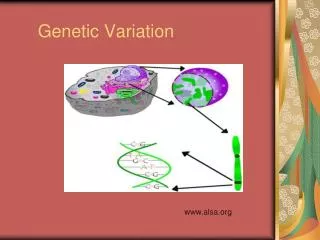
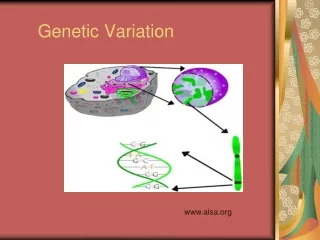
Introduction • Genetic variation is necessary for natural selection • There are multiple reasons for genetic variability in populations • Mutations • Crossing over • Independent assortment • Random fertilization of eggs by sperm
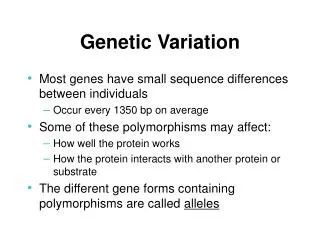
Examination I • One way of evaluating genetic variation is to examine genetic polymorphism. • The presence of two or more alleles for a given locus • To examine genetic polymorphism, biologists compare different forms of a particular protein. • Each form consists of a slightly different amino acid sequence that is coded for by a different allele. • Gel electrophoresis
Balanced Polymorphism • Maintenance in a population of two or more alleles in equilibrium at frequencies too high to be explained, particularly for the rarer of them, by mutation • Balanced polymorphism, a special type of genetic polymorphism, may be a result of natural selection. • The mechanisms that allow balanced polymorphism to exist while allow natural selection to occur is: - • Hetereozygote Advantage • Frequency Dependent Selection.
Hetereozygote Advantage • Hetereozygote exhibits greater “fitness” than either homozygotes. • Example • Hetereozygote carriers of the sickle cell allele. • Provides individuals resistance to malaria. • Allows individuals living in areas where malaria is high to survive.
Frequency Dependent Selection • The “fitness” of a particular phenotype depends on how often it appears within a population. • The ability of a phenotype to be “fit” depends on the how often it appears within a population. • Often a phenotype has a greater selective value when rare then when common in a population. • If a phenotype falls within this category, they lose their selective advantage as they become more common.
Frequency Dependent Selection • Example • Scale-eating cichids • Two forms • Right pointing mouths & left pointing mouths • Right pointing allele is dominant • Get food by biting off the scales of other fish • Those with right pointed mouths attack prey’s left flanks • If the prey is constantly being attacked from a particular side, then they become more wary to such attacks • When the prey become wary, the advantage then swings to those predators that attack from the opposite side • The reason for the frequency of both forms of cichids have osculating over the last 20 – 30 years.
Neutral Variation • Observed in a population where variation does not alter the ability of an individual to survive and reproduce.
Geographic Variation TYPE OF GENETIC VARIATION
Geographic Variation • Genetic variation among individuals of differentpopulations of the same species. • Cline • Type of geographic variation • Gradual change in a species’ phenotype and genotype frequencies through a series of geographically separate populations due to an environmental gradient. • Example • Common Yarrow (Achileamillefolium) • Wild-flower that grows in various North American habitats. • Exhibits clinal variation in height • Due to different climates at different elevations/altitudes. • Could clinal variation result in a new species?