Download
1 / 3
40 likes | 150 Vues
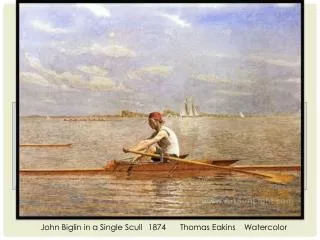
Discover how Thomas Eakins, a master realist painter, skillfully captures the human figure in his iconic watercolor artwork from 1874. Through strong light and shadow play, Eakins directs focus on the central figure with a bold red bandana. Explore the textures and colors that bring this piece to life and learn about Eakins' significant contribution to American art history.

E N D
John Biglin in a Single Scull 1874 Thomas Eakins Watercolor
Artistic Elements • Realism (Sewell) • 2. Illumination(Toogood) • Strong light and shadowed center • Put his head in the center with red bandana to direct attention • 3. Watercolor(Hughes) Eakins is one America’s greatest realists. He dedicated his career to depicting the human figure. He was one of the young artists who shifted the view of American art from landscape to figural subjects.(Toogood) I was drawn to this piece of art because of how the artist depicted the textures and the use of the colors.
Works Cited • Hughes, Robert. American Visions: The Epic History of Art in America. New York: Alfred A. Knopf, 1997. Print. • Sewell, Darrel. "Thomas Eakins: American Realist." Philadelphia Museum of Art. Philadelphia Museum of Art, 2013. Web. 29 Sept. 2013. <http://philamuseum.org/exhibitions/2002/47.html>. • Toogood, James. "Watercolor: Looking at Watercolors: “John Biglin in a Single Scull,” by Thomas Eakins." Artist Daily. Interweave, 2013. Web. 29 Sept. 2013. <http://www.artistdaily.com/blogs/watercolor/archive/2008/08/01/looking-at-watercolors-john-biglin-in-a-single-scull-by-thomas-eakins.aspx>. • Weinberg, Barbara H. "Thomas Eakins (1844–1916): Painting." Metropolitan Museum of Art. Metropolitan Museum of Art, 2000. Web. 29 Sept. 2013. <http://www.metmuseum.org/toah/hd/eapa/hd_eapa.htm>.