Download
1 / 19
190 likes | 281 Vues
This research explores power control MAC protocols in wireless ad hoc networks to improve space-time utilization and reduce interference. It discusses the impact of power control on routing, spatial utilization in various MACs, and presents experimental results supporting the findings. The study outlines the system model, RTS/CTS-based discussions, and optimal transmission floor areas for improved transport throughput. While power control offers benefits, it also increases system complexity and message overhead.

E N D
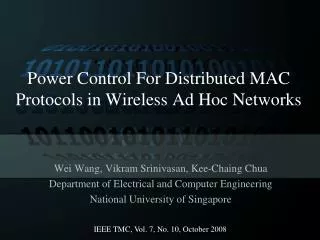
Power Control For Distributed MAC Protocols in Wireless Ad Hoc Networks Wei Wang, Vikram Srinivasan, Kee-Chaing Chua Department of Electrical and Computer Engineering National University of Singapore IEEE TMC, Vol. 7, No. 10, October 2008
Outline • Introduction • RTS/CTS-based system model and discussion • Spatial utilization in other distributed MACs • Experimental results • Conclusions
Introduction • Power control MAC protocols in wireless ad hoc networks • Increasing the efficiency of space-time utilization • Reducing the transmission power • Causing the less interference to nearby receivers Hidden terminal problem 4 way handshake Exposed terminal problem power control
System model • The received power • SINR (β)
RTS/CTS-based discussion • Max tolerated interference i dij j k
Avoid the collision problem • Power level of CTS
The minimum transmission floor RTS i j CTS dij Min TR floor reserved = the union of the area (RTS/CTS) Optimal power control scheme
Impact of the optimal TR on transport throughput • The maximal No. of simultaneous transmission pairs • The maximal transport throughput =
Discussion of power control in routing • Fixed link length • Transport throughput can at most be improved by a constant factor • Heterogeneous link length • Short link • Tolerate the more interference • Increase the simultaneous transmssion
Spatial utilization in other distributed MACs • The power control model work on other MAC protocols • Rate-adaptive MAC • Lower rate, lower interference • Physical carrier sensing • Larger effective range than TR • Busy tone • Higher spatial utilization
Experimental Setting • NS 2.28
Comparison • Power control schemes • NTPC, TPC-O, TPC-L1, TPC-L2, TPC-E • Scenario • String topology • Random topology • 500 m *500 m and 200 nodes
Experiment results • Random Networks
Experiment results • Random Networks for different routing with fixed link length
Experiment results • Random Networks for different routing with heterogeneous link length • 40 - 400 nodes
Conclusions • In distributed MAC systems • Optimal transmission floor area • Improve the transport throughput • The system complexity and massage overhead are higher