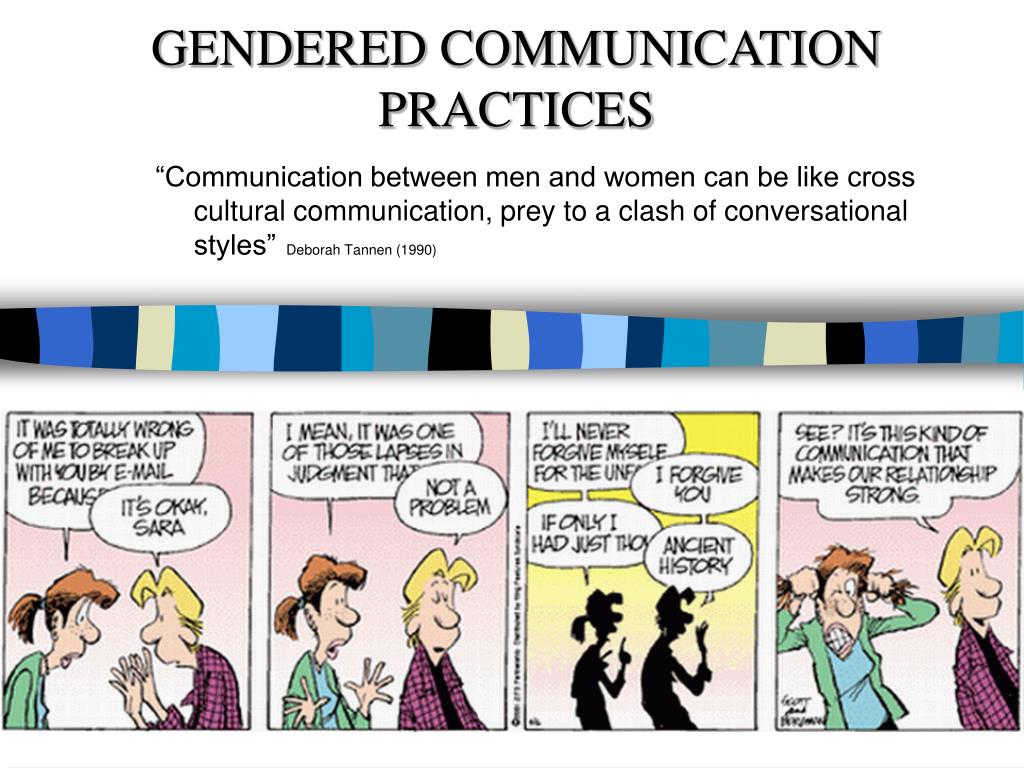
GENDERED COMMUNICATION PRACTICES “Communication between men and women can be like cross cultural communication, prey to a clash of conversational styles” Deborah Tannen (1990)
WOMEN’SSPEECH • For Most Women Communication is: • to establish and maintain relationships • conversation is for sharing and learning about others • Talk is the essence of relationships
EQUALITY • Equality between people is generally important • try and achieve symmetry • often match experiences • “you’re not alone in how you feel • “I’ve done the same thing many times” • respond and build on each other’s ideas • Rather than “you-tell-your-idea-then-I’ll-tell-mine,” voices weave together to create conversations.
SHOWING SUPPORT • Often express understanding & Sympathy • “Oh, you must feel terrible” • “I think you did the right thing” • “I really hear what you are saying”
RELATIONSHIP LEVEL • Focus on feelings • Focus on relationship between communicators rather than content • often probe to understand feelings • “Tell me about what happened?” • “How did you feel when it occurred?” • “Do you think it was deliberate?” • Content is dealt with but also feelings involved.
CONVERSATION MAINTENANCE • Women’s style is conversational maintenance work • efforts to sustain talk • often initiate topics for others • “How was your day” • “Tell me about your meeting” • “Did anything interesting happen on your trip”
INCLUSIVITY • RESPONSIVENESS • usually respond in some fashion • verbally and nonverbally more engaged • make other feel valued and included
PERSONAL, CONCRETE STYLE • Typical of women's conversation are • personal disclosures • details • anecdotes • concrete reasoning
TENTATIVENESS • Verbal Hedges • “I kind of feel you may be overreacting” • Qualifiers • “I’m not the best judge of this, but...” • Keep Talk Provisional, Tag questions that invite response • “That was a pretty good movie, wasn’t it?” • “We should get out this weekend, don’t you think?”
MEN’S SPEECH • Goal of talk is exerting control,preserving independence, and enhancing status. • Conversation is the arena for proving oneself & negotiating prestige.
Men’s Speech • General Tendencies • Use talk to establish and defend personal status and ideas • When comforting, they do so by respecting others independence and avoiding condescending
SHOW KNOWLEDGE, SKILL, OR ABILITY • Avoid disclosing personal information that might appear weak or vulnerable • e.g., someone expresses concern about a relationship with a boyfriend • “The way you should handle that is...” • “Don’t let him get to you.” • “You ought to tell him....”
ADVICE • Tendency to give ADVICE • Instrumental - not feeling, but rather what you should do • Superiority - Maintain control • Men see as “give and take,” Women as lack of concern
INSTRUMENTALITY • Instrumentality - The use of talk to accomplish instrumental objectives • Men socialized to do things, achieve goals • In talk this is expressed as problem-solving, getting information, facts, suggesting solutions • This focus on content works between men • Show support in ways learned to do so - solve the problem.
CONVERSATIONAL DOMINANCE • Men tend to dominate conversations - talk more than women • Talk more frequently • For longer duration • Select topic of talk • Interrupt more • Men interrupt to control conversation • Women interrupt to show interest, affirm
ABSOLUTE, ASSERTIVE TALK • Language tends to forceful, direct, authoritative • Less use of hedges and disclaimers
ABSTRACTTALK • Speak in general terms • Fewer concrete experiences • More distanced from personal feelings • Works best in Public situation where theoretical & conceptual, talk is appropriate
LESS RESPONSIVE • More “minimal response cues” • Less sympathy and self-disclosure • Sympathy seen as sign of condescension • Personal problems seen as vulnerability
Talking about Troubles • Woman disappointed in not getting job • Man says, “You shouldn’t feel bad. Lots of people don’t get jobs they want” • She thinks, he belittles her experience • He thinks, he is showing respect by bolstering her independence
Talking about Troubles, Cont. • Man disappointed is not getting job • Woman says, “Are you okay” What’s bothering you?” • He thinks this points out his vulnerability • She probes to show she cares
WOMEN It’s going fine if there is talk Talk is a process to sustain relationship Talk is a way to show closeness “We need to talk,” to affirm our caring MEN It’s going fine if there is no need to talk Talk is to solve problems Talk indicate a problem Duck when she say, “we need to talk” RELATIONSHIP TALK
GENDERQUESTIONNAIRE • Men talk more than women. T/F • T • Men are more likely to interrupt women than they are to interrupt other men. • T • Women tend to confront problems more directly and are likely to bring up the problem first. • T
Questionnaire, cont. • During conversation men spend more time looking at their partner than women do. • F • Women are more alert to nonverbal cues than men are. • T • Groups that use the male style of sticking to the task get more work done. • F • In general men and women talk about the same things. • F • Women use less personal space than men do. • T • When a man speaks, he is listened to more carefully than a woman, even if the presentation is identical. • T
Questionnaire, cont. • In general women speak in a more tentative style than men do. • T • Women are more likely than men to disclose personal information. • T • In general men smile more often than women. • F • Women are more likely than men to answer questions that are not addressed to them. • F • Women and men are equally emotional when they speak. • T • Men appreciate jokes more than women. • T
THE END Based on Julia Wood’s book Gendered Lives