Solving Quadratic Equations
This guide provides a thorough review of solving quadratic equations in the form ax² + bx + c = 0. It explains how to solve by factoring when possible, using the discriminant (b² - 4ac) to determine factorability. The guide also covers special cases of square trinomials and shows how to utilize perfect square binomials for easy solutions. You'll learn to set equations to zero, factor, and check your answers by substituting back into the original equation. Perfect for students seeking a deeper understanding of quadratic equations.

Solving Quadratic Equations
E N D
Presentation Transcript
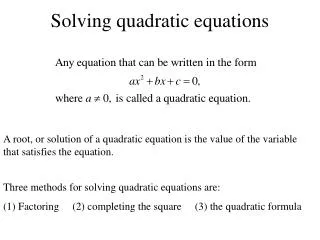
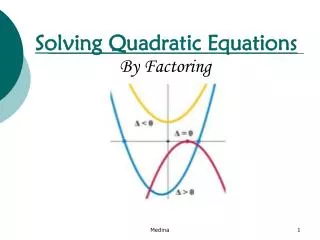
Review of Solving Quadratic Equations ax2 +bx +c = 0 When the equation is equal to zero, solve by factoring if you can. You can test if it can factor by calculating b2 – 4ac
Solve Quadratic Eq. By Factoring Set Eq = 0 Factor Set Each Factor = 0 Check Answers by Putting into Original Eq.
Solving Square Trinomials Equations ax2 +bx +c = Sometimes the equation will factor in a special way: ( + )2 = This can sometimes happen even before you make the equation equal zero.
Solve with Perfect Square Binomial Get Perfect Squares on Both Sides of Equation. Take Square Root of Perfect Squares Solve Positive Number & Neg. Number Check Answers by Putting into Original Eq.
Solve with Perfect Square Binomial Get Perfect Squares Binomial. Take Square Root of Both Sides of Eq Simplify Check Answers by Putting into Original Eq.
How can we recognize these special cases? The coefficient of the quadratic term is square The constant term is square The coefficient of the linear term is double the product of the square root of the coefficient of the quadratic and the square root of the constant term.