Advancements in Shashlyk Calorimeter Design for Enhanced Particle Detection
This document details the development and performance of a shashlyk calorimeter prototype designed for high-radiation environments. It outlines the calorimeter’s radiation and resolution requirements, energy responses, and pion rejection capabilities, achieving rates of 2000 GeV/cm²/s and a 200:1 rejection ratio at energies above 3.5 GeV. Key parameters such as layer configuration, light collection efficiency, and position resolution are discussed. Additionally, the challenges presented by magnetic fields in calorimetry are explored, highlighting areas for further research and implementation.


Advancements in Shashlyk Calorimeter Design for Enhanced Particle Detection
E N D
Presentation Transcript
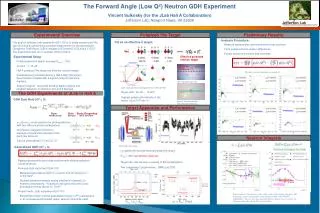
EC Forward Angle Zhiwen Zhao UVa 2011/03/25
Requirement • PVDIS rate 2000GeV/cm2/s, 60krad/year • SIDIS rate 500GeV/cm2/s, 15krad/year • Resultion • Pion rejection 200:1 at E > 3.5 GeV, 100:1 at E > 1.0 GeV • Fast time response, provide a trigger • Good position resolution for tracking
The Menu • Lead glass (can’t hold such radiation) • Shashlyk • SciFI
BaBar field 100g 50g 20g
CDF field 100g 50g 20g
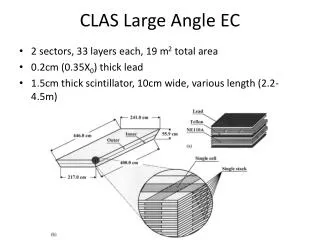
Shashlyk prototype module parameters 9 modules assembled in matrix 3x3 • 380 layers of 0.3-mm lead and 1.5-mm scintillator, total length 680 mm • Transverse size 110x110 mm2 • Effective Moliere radius: RM=59 mm • Effective radiation length: X0=34 mm • Total radiation length: 20X0 • Light collection: 144 (1212) fibers BCF-91A (1.2 mm) • PMT Hamamtsu R5800 as photodetectors Pavel Semenov, INSTR08@BINP, Novosibirsk
Shashlyk modules production Pavel Semenov, INSTR08@BINP, Novosibirsk
Shashlyk prototype pictures 3x3 matrix of shashlyk modules and PMT attached to the modules Pavel Semenov, INSTR08@BINP, Novosibirsk
Minimum ionizing particle peak Pavel Semenov, INSTR08@BINP, Novosibirsk
Energy Resolution dependence on energy Pavel Semenov, INSTR08@BINP, Novosibirsk
Energy Resolution parameterization σE /E = a/E b/√E c [%], E in GeV Experiment data fit: MC data fit: a = 3.5 ± 0.3 a = 0.0 b = 2.8 ± 0.2 b = 3.0 ± 0.3 c = 1.3 ± 0.04 c = 1.1 ± 0.7 Good agreement with MC without noise term. Good agreement with previous studies of similar sampling modules at lower energies (2.9%/ √E at 220-370 MeV: Test beam study of the KOPIO shashlyk calorimeter prototype, G.Atoian, S.Dhawan,V.Issakov et al. CALOR-2004 Proceedings ) Pavel Semenov, INSTR08@BINP, Novosibirsk
Position resolution (center) dependence on energy Pavel Semenov, INSTR08@BINP, Novosibirsk
Position resolution parameterization σx = a/√E b [mm], E in GeV Experiment data fit: MC data fit: a = 17.6 ± 0.9 a = 14.2 ± 0.6 b = 4.6 ± 0.9 b = 5.5 ± 0.9 Worst case – resolution at the module center. Resolution near the module edge is 3 times better Pavel Semenov, INSTR08@BINP, Novosibirsk
Calorimeter in Solenoid Flux Return • How to get the light from the calorimeter to a photosensitive detector? • APD’s • Light Guides out of field region • Use flux return for calorimeter PMT in >10 G Calorimeter
Calorimeter in Solenoid Flux Return PMT in >10 G Calorimeter Open Questions: • What does magnetic field do the shower? • My guess is that charged particles in the EM shower will curl up causing the shower to become shorter and wider • How does magnetic field affect resolution in Energy and in space? Is this a strong function of field strength or direction? • What resolution do we need? [Pb:SciFi at ~1:1 gives 4.5%/sqrt(E)] • Is Iron dense enough? • How does the fiber affect the Magnetic flux return? • My guess is that we use and “effective” μ which is about half that of Fe. Require detailed MC; Have contacted D. Hertzog about simulations. • How do we cost this? • D Hertzog—driving cost is amount of fiber—Fe less dense than Pb thus need more fiber.
Mixture of radiation material and scintillator fiber(glue) g-2 W/SciFi prototype
g-2 prototype test run Data Simulation
Test module simulation • 90cm(height)x32cm(width)x60cm(depth), • material:(fiber+flue)=1:1, • fiber along Z, layer along Y, optional 2T field along Y W/SciFi Fe/SciFi
Test module simulationhit distribution (No Field) W/SciFi Fe/SciFi
Test module simulation resolution Sampling fraction loss noise Stochastic floor
Test module simulationpion response W/SciFi Fe/SciFi
Test module simulationadd 4cm W preshower Fe/SciFi, electron Fe/SciFi, pion
Test module simulationadd 4cm W preshower electron eff 95% pion rejection 50:1
Summary • Shashlykneed more study. • Fe/SciFi seems a promising candidate. Still need more study, particular emerging side about how to implement it into endcup. • Some expertise can be used within Jlab.