Download
1 / 18
180 likes | 291 Vues
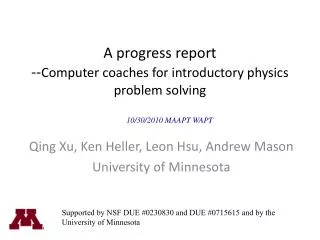
This study explores the usage and usability of online coaching tools in introductory physics courses at the University of Minnesota. Presented at AAPT Summer Meeting 2013, the research focuses on how students interact with these intelligent tutors, particularly their perceptions of usefulness. Data from pre/post-tests, student surveys, and keystroke monitoring reveals differing usage patterns among user subpopulations. The findings will inform the future design of these coaching systems to better serve diverse student needs and improve learning outcomes in physics.

E N D
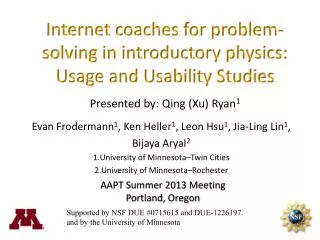
Internet coaches for problem-solving in introductory physics:Usage and Usability Studies Presented by:Qing (Xu) Ryan1 Evan Frodermann1, Ken Heller1, Leon Hsu1, Jia-Ling Lin1, Bijaya Aryal2 1.University of Minnesota–Twin Cities 2.University of Minnesota–Rochester • AAPT Summer 2013 Meeting • Portland, Oregon Supported by NSF DUE #0715615 and DUE-1226197. and by the University of Minnesota
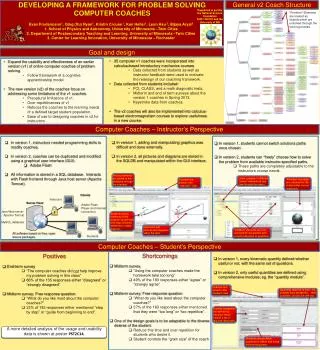
Design components • Software Framework: “Intelligent” Tutors • Pedagogy Framework: Cognitive Apprenticeship • Modeling • Coaching • Fading • Scaffolding • Research Basis: Expert & Novices differences in problem solving
Design Process Cycle Prototypes • Assessment • Usage & Usability Large-scale Implementation
Usage & Usability Studies • Who will naturally use such coaches? • subpopulation characteristics • How do students use them? • usage characteristics • Do the students perceive them as useful? • How to use this information to guide future development ? (Evan’s talk)
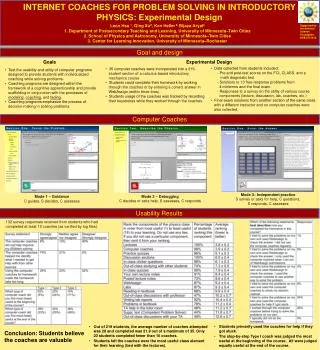
Implementation tests • 35 coached problems were incorporated into 2 sections of calculus-based introductory mechanics course in Spring 2013 (148 students/103 students). • Students were required to complete their homework using WebAssign; coaches were available to help with some problems • Data collected includes: • Pre/post-test scores (FCI/Math/CLASS) • 13 written problem solutions from 4 midterms (2 problems each) and a final exam (5 problems) • Two surveys of student opinions regarding the coaches (mid & end semester) • Keystrokes data monitoring students’ use No credits for using the coaches
User Characteristics • 3 User populations (m:male; f:female) • H group (heavy user): 80-100% (nH=49 (20% of N), 65%m,35%f) • M group (medium user) : 40-60% (nM=38 (15% of N), 55%m,45%f) • L group (Light/Non user) : 0-20% (nL=72 (29% of N), 85%m,15%f) • Entire class (N=251, 70%m,30%f)
Forced ranking Rank the components of the physics class in order from the most useful (10) to least useful (1) to your learning. Do not use any ties. • Top 3: Lectures, homework, Computer coaches (High & Medium Users) • ahead of textbook, labs, and problem-solving discussion sections • Lectures, Discussion, Labs, Computer coaches, Text book, Tutor room, Doing the homework, Clicker questions, The Competent Problem solver, Feedback from WebAssign • (in the order that was given on the survey)
Summary • A significant number of students use the coaches. • Female, less-prepared students, students with less-confidence tend to use the coaches. • Different usage patterns. • We will use this information to adjust the design for next version of computer coaches. (Evan’s Talk--- Coming up next ! )
Thank you! • For further information: • Visit our posters (PST2C14 and PST2C10, 9:15- 10:00 am, Wed 07/17 ) • Visit our website http://groups.physics.umn.edu/physed where you can try working version of the coaches.
End-semester survey A: Strongly agree B: Agree C: Neither D: Disagree E: Strongly disagree
End-semester survey A: Strongly agree B: Agree C: Neither D: Disagree E: Strongly disagree
End-semester survey A: Strongly agree B: Agree C: Neither D: Disagree E: Strongly disagree
Developing version 2 • Better address the needs of the H and M user population • H_ encourage bypassing detailed coaching • M_ adjust decision grain sizes