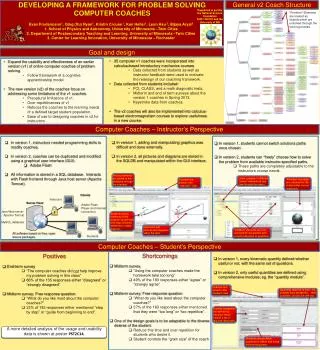
24/7 Computer Coaches for Introductory Physics Problem-Solving
Discover the innovative approach to problem-solving in introductory physics through computer-based coaching available 24/7 online. Join us at the AAPT Summer Meeting in Omaha, NE, to discuss the role of computer coaches in enhancing student understanding of problem-solving frameworks. Engage in group discussions about the challenges students face and evaluate different types of coaches to better fit your curriculum goals. Experience cognitive apprenticeship methods and learn how to modify coaching tools for maximum effectiveness.

24/7 Computer Coaches for Introductory Physics Problem-Solving
E N D
Presentation Transcript
Computer Problem-Solving Coaches for Introductory Physics: Available 24/7 on the Internet 7/30/2011 AAPT Summer meeting Omaha, NE
Introductions: Who are we? • Name • Institution • What do you hope to get out of this workshop?
Motivation • Discuss in groups of 3 or 4 (10 minutes) • Why do you do problem solving in your physics course? • What difficulties do students have with problem solving?
Try some out! • Think about whether the coaches fit your goals and which student difficulties they might address. http://groups.physics.umn.edu/physed/prototypes.html
Which student difficulties do they address? Which do they not?
Theory • Problem solving • Cognitive apprenticeship • Context-rich problems
Try a second type of coach • Think about how the second type might address student difficulties and how the coaches might fit into a curriculum.
Design • Expert-like problem-solving framework • Elaborated using task analyses • Cognitive functions: deciding, implementing, assessing • Instructional method • Reciprocal teaching: Type 1 and type 2 • Learning from well-studied examples: Type 3 • Current status and future developments
Try a sequence of coaches • How might they be used in class? What factors are necessary for making the coaches useful to students?
Modifying the coaches • Changing the problem statement • Changing the questions • Changing the question text • Changing the choices • Changing the feedback • Changing the graphics
19 Make Decisions about which Physics Principle to use
22 Student checks computer’s work (picture)
Student checks computer’s work (algebra)
Coaching • Provide feedback while student is stepping through the task (drill). • Provide feedback while student is practicing the task. • Student provides feedback to other students while practicing the task.
3 types of computer coaches • 1st: Computer coaches the student • computer decides, student implements, computer assesses • 2nd: Student coaches the computer • Student decides, computer implements, student assesses • 3rd: Student works more independently • Computer provides help as necessary
Cognitive apprenticeship (Collins et al. 1990) • An alternative model of instruction that is accessible within the framework of the typical classroom. • 3 main elements: • Modeling (e.g. classroom lecture) • Coaching (e.g. instructor office hours) • Scaffolding (e.g. worksheets) • Fading (e.g. tests)