Sciences and research paradigms
This document explores the nature of science, its role in educational research, and the paradigms that shape scientific inquiry. It examines Newtonian science's key features, including reductionism and dualism, while also introducing new paradigms like complexity science. Key concepts include emergence, auto-generation, and the interdependence of structures in research. Through defined activities, participants engage with the material to foster critical thinking about traditional and modern research approaches, emphasizing the importance of perspective and fluidity in educational inquiry.

Sciences and research paradigms
E N D
Presentation Transcript
Bal Chandra Luitel & Roshan Thapa Sciences and research paradigms
Activity One • What do you mean by science? Why do we refer to science in educational research?
Research and Science • science as a process • science as a basis for systematic inquiry • science as a model for knowledge production • Is there a single science or a single view of science?
Newtonian Science: Key Features • explanatory metaphors: control, manipulation, standardization, replication • process of knowing: structured, isolated, piecemeal, mechanistic approaches
equilibrium as the ‘featuring assumption’ about reality • linearity – singular concept of scientific process... • reality is made up of ‘simples’ (i.e., machine-like objects)
Activity Two • ‘Speaking for a minute’ Activity
Newtonian Science: Logic • logic of reductionism: (i) make your knowledge claims declaratively, (ii) privilege scientific worldview over local worldviews, (iii) choose one of two sometime competing views • logic of dualism: (i) reality is divided into two mutually exclusive entities, (ii) select one of them on the basis of their immediate importance, (iii) privilege one entity over the other
Newtonian Science: Language • third-person writing style (invisible self) • language detached from the context of knowledge generation • propositional, monological, mono-vocal, ‘plain English’...
Newtonian Science: Quality Standards • validity – external and internal validity • reliability – consistency • objectivity – does not contradict with the existing premise, researchers’ self is invisible
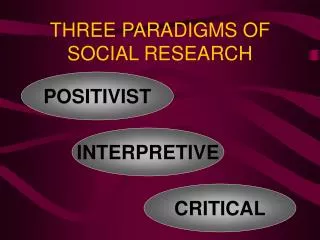
Activity Three • Which research paradigm(s) is/are promoted by Newtonian Science? Why?
New Science(s) • science of emergence – complexity science • reality made up of complexes • multiple sciences: Multi-worldview sciences • dissipative structures, science beyond ‘stable equilibrium’
Complexity Science: Features • Emergence • Auto-generation/production • Fluid structures • Organicism
Emergence • Contingency (as opposed to planned) • Possibility • ‘Emergence’ in educational inquiry • An example of classroom research
Activity • Which educational research paradigm is likely to share the feature of emergence?
Auto-generation/production • Any individual or living system is capable of self-governance • A research participant is capable of forming his/ her own perspectives • This is about acknowledging creative dimension of researchers and their research participants
Activity • Paradigm(s) that share this feature??
Fluid structures/ Dynamic Systems • Social or otherwise structures are dissipative (dissolving, loosened boundaries) • Boundary may exist but it is temporary (e.g., teaching techniques, school and social system) • Examples: A researcher can also become a research participant. A teacher can also be a researcher...
Activity • How can a postmodern research paradigm draw from this feature of complexity science?
Organicism • Interdependence is the key feature of organicism, i.e. one organ depending upon many other organs of the ‘individual or social body’ • Whole is more than sum of its parts • ‘Organic thinking’ as opposed to mechanistic thinking • Example: accounting for feeling, logic, emotions of researcher and research participants
Activity • An example of organicwriting