Historical Trends in Metals and Organic Contaminants from Lake Sediments in the U.S.
This study focuses on reconstructing historical trends of metals and hydrophobic organic contaminants in U.S. lakes through the analysis of sediment cores collected between 1996 and 2007. The primary objectives include identifying trends in contaminant concentrations, understanding their relationships with land use changes and environmental regulations, and quantifying key urban sources of these pollutants. Findings reveal the complexity of contaminant deposition, with notable trends since the 1970s and significant atmospheric deposition impacts in urban areas.

Historical Trends in Metals and Organic Contaminants from Lake Sediments in the U.S.
E N D
Presentation Transcript
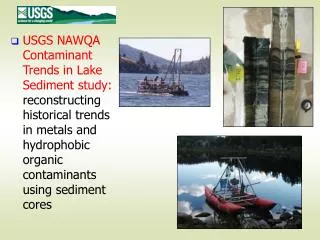
USGS NAWQA Contaminant Trends in Lake Sediment study: reconstructing historical trends in metals and hydrophobic organic contaminants using sediment cores
NAWQA Trends: Objectives Identify trends in metals and organic compounds in U.S. surface waters, Characterize relations between the trends and changes in land use and environmental regulations, Improve our understanding of transport processes and fate of contaminants in aquatic sediment, Identify and quantify major urban sources of contaminants transported to lakes. CTLS: http://tx.usgs.gov/coring/index.html
Paleolimnology core
Standard Analyses Metals OCs PAHs Rads • Arsenic* • Cadmium* • Chromium • Copper • Mercury* • Nickel • Lead* • Zinc • DDT* • DDE* • DDD* • Total PCBs* • Dieldrin* • Chlordane* • Naphthalene • Fluorene • Phananthrene • Anthracene • Fluoranthene • Pyrene • Benz[a]anthracene • Chrysene • Benzo[a]pyrene* • Total PAH* • 137Cs • 210Pb • 226Ra *EPA/ATSDR top 20 priority pollutant
Emerging Contaminants • Nonylphenols (surfactants, emulsifiers) • Tri (…) phosphates (flame retardants) • AHTN, HHCB (fragrances (musk)) • PFOS (stain guard, teflon) • PCNs (plastics, industrial apps.) • Pharmaceuticals • Anthraquinone (pulp and paper, dye) • Indole (fragrance, inert ingredient) • Cholesterol • Phenol, p-cresol (inert ingredients, industrial apps.) • Triclosan (anti-bacterial) • PBDEs (flame retardants)
Decrease in releases decreasing trends Trends since the 1970s
Mixed Signals And a signal of concern
The “urban airshed” and atmospheric deposition of contaminants
Atmospheric deposition of Hg and PAHs is 8 times greater in Boston (SRV) than 200 km north (CRK) SRV:CRK 8:1
Atmospheric versus local urban sources SRV MYS SRV MYS
Fluvial inputs swamp out atmospheric deposition, even when atmospheric deposition is large MYS:SRV 30:1
Determining atmospheric fallout rates: Dual-core mass-balance model Relations between concentration and mass flux in cores can tell us where contaminants came from Van Metre and Fuller, in review, ES&T
Current funded 2009 workplan for California • Two reference lakes • Sierras • Bay Area • E vs W • Potential Bay Area add-ons: • 1 urban lake • 1 add’l reference lake
What are we looking for in a lake? • Requirements • Freshwater • Lake or reservoir (reservoir 40+ yrs old) • Access • Undisturbed sediment record • No water diverted in or away • Reference lake • Pristine watershed • Small DA:SA • Urban lake • Large watershed with mixed residential and commercial land use
Urban lakes? Lake Merced • 100-yr history • Large urban watershed • Hasn’t been dredged • No water diverted in • BUT most storm runoff diverted to CSOsocean