The Power of Chemical Bonds Explained
Learn about ionic and covalent bonding, ions, molecules, compounds, and how to write chemical formulas with examples and practice problems. Understand valence numbers and naming compounds in a simple and clear way.

The Power of Chemical Bonds Explained
E N D
Presentation Transcript
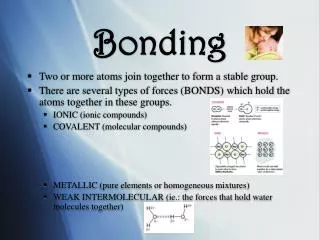
A chemical bond is a force that holds atoms together.
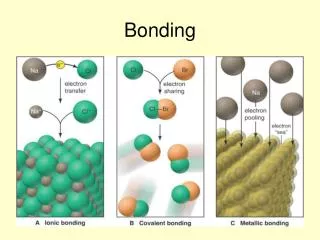
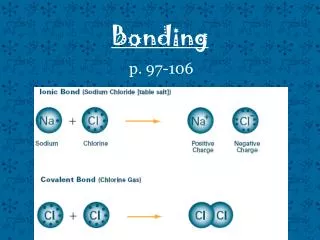
Two Types of Bonds 1. Ionic Bond – the attraction between two oppositely charged ions. An ionic bond is formed when atoms gain or lose electrons. Ionic bonds form compounds.
Ion – an atom or group of atoms that has become electrically charged. It is a charged particle.When an atom loses an electron, it loses a negative charge and becomes a positive ion.When an atom gains an electron, it gains a negative charge and becomes a negative ion.
Atoms that gain electrons have a negative valence. (charge)Atoms that lose electrons have a positive valence. (charge)
2. Covalent Bonding – A type of bonding in which electrons are shared.When covalent bonding occurs, molecules are formed.
Molecule – a particle made of 2 or more atoms covalently bonded together.Compound – two or more elements chemically combinedby gaining, losing, or sharingelectrons.
Chemical formulas – a shorthand way to represent a compound. ( H2O)In a chemical formula, the element with the positive charge is always written first.
Valence number – The number of electrons an atom needs to gain, lose, or share to become stable. (Gain electrons – negative valence)(Lose electrons – positive valence.)
Subscript – the number that shows how many atoms of an element are in the compound.
How to Write Formulas • 1. Write the symbol correctly for both elements. • 2. Write the valence number above each symbol. Make sure you have a positive first, and then a negative. • 3. Criss-cross valences to make a subscript. • 4. NEVER write 1 as a subscript. (It is understood to be 1 if there is no number.) • 5. Reduce to lowest terms.
Examples • Sodium Chloride Aluminum Oxide • Copper (I) Sulfide Iron (III) Iodide
Practice Problems • Aluminum Bromide • Calcium Iodide • Copper (I)Chloride • Hydrogen Oxide • Magnesium Nitride • Potassium Sulfide • Barium Fluoride • Lead Bromide
Calcium Sulfide 2. Copper (I)Iodide 3. Potassium Chloride 4. Iron(III) Bromide 5. Sodium Nitride 6. Antimony (V) Oxide
Binary Compound – a compound composed of 2 elements. Polyatomic Ion- a group of positively or negatively charged covalently bonded atoms.
Calcium Phosphate Tin (V) Chromate Ammonium Oxide Magnesium Sulfate
Naming compounds – change the ending of the second element to – “ide”.(Do not change the names of polyatomic ions.)Ex: NaCl - Sodium Chloride Ba3N2 – Barium nitride Fe2O3 – Iron (III)Oxide