
Understanding Double Integrals and Volume Calculation in a Rectangular Region
This text explores the concept of double integrals and their application in calculating the volume under a function ( f(x, y) ) over a specified rectangular region ( R ) in the xy-plane. It details the partitioning of the rectangle to form sub-rectangles, establishing minimum and maximum values of the function within each sub-rectangle. The relationship between the area of sub-rectangles and the volume under the function is emphasized, particularly in the context of integrable functions and examples illustrating these principles.

Understanding Double Integrals and Volume Calculation in a Rectangular Region
E N D
Presentation Transcript
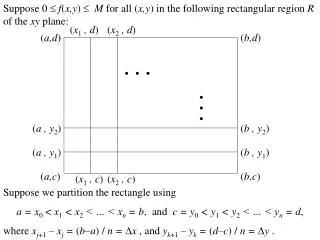
Suppose 0 f(x,y) M for all (x,y) in the following rectangular region R of the xy plane: (x1 , d) (x2 , d) (a,d) (b,d) (a , y2) (b , y2) (a , y1) (b , y1) (a,c) (b,c) (x1 , c) (x2 , c) Suppose we partition the rectangle using a = x0 < x1 < x2 < … < xn = b, and c = y0< y1 < y2 < … < yn = d, where xj+1 – xj = (b–a) / n=x , and yk+1 – yk = (d–c) / n=y .
We let Rjk be the sub-rectangle [xj , xj+1][yk , yk+1], and we let mjk and Mjk respectively be minimum and maximum values of f on the sub-rectangle. Then, x y = A is the area of each sub-rectangle, and if we let Vjk be the volume under f(x,y) over the sub-rectangle Rjk , then mjkA Vjk MjkA . If we let V be the volume under f(x,y) over the rectangle R , then n–1 n–1 n–1 n–1 mjkA V MjkA . j=0 k=0 j=0 k=0 If the limit as n exists (and equals V) for both double sums (which will be true for continuous functions), then we say that f is integrable over R; the volume V is f(x,y) dx dy = f(x,y) dA . RR
Example If R is a plate defined by 1 x 2 and 0 y 1 measured in centimeters, and the mass density is described by f(x,y) = yexy , integrate f over R to find the mass of the plate. 1 2 yexydx dy =yexydx dy = R 0 1 1 2 exydy = x=1 0 1 1 (e2y – ey) dy = e2y/2 – ey = e2/2 – e + 1/2 y = 0 0
If f(x,y) is a bounded function on rectangle R (i.e., |f(x,y)| M) and is continuous except possibly for discontinuities along a finite number of continuous curves, then f is integrable on R. See Figure 5.2.4 (page 330). Consider the properties of the double integral stated on page 331. Example 3 on page 338 illustrates a double integral where f(x,y) is not always positive.