Advanced Computational Modeling of Interdiffusion Microstructures in High-Temperature Alloys
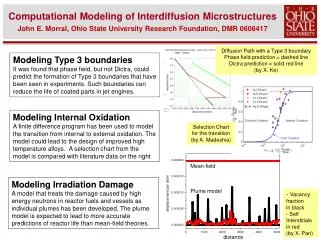
This research, led by John E. Morral from Ohio State University, focuses on the computational modeling of interdiffusion microstructures, particularly in high-temperature environments like jet engine coatings. Utilizing phase-field models, it successfully predicts the formation of Type 3 boundaries, which traditional models like Dictra miss, impacting the lifespan of coated components. Additionally, a finite difference program models the transition from internal to external oxidation and develops a plume model to enhance understanding of irradiation damage in reactor materials. Findings may inform the design of improved alloys for crucial applications.

Advanced Computational Modeling of Interdiffusion Microstructures in High-Temperature Alloys
E N D
Presentation Transcript
distance Computational Modeling of Interdiffusion MicrostructuresJohn E. Morral, Ohio State University Research Foundation, DMR 0606417 Diffusion Path with a Type 3 boundary Phase field prediction = dashed line Dictra prediction = solid red line (by X. Ke) Modeling Type 3 boundaries It was found that phase field, but not Dictra, could predict the formation of Type 3 boundaries that have been seen in experiments. Such boundaries can reduce the life of coated parts in jet engines. Modeling Internal Oxidation A finite difference program has been used to model the transition from internal to external oxidation. The model could lead to the design of improved high temperature alloys. A selection chart from the model is compared with literature data on the right Selection Chart for the transition (by A. Madeshia) Mean-field Modeling Irradiation Damage A model that treats the damage caused by high energy neutrons in reactor fuels and vessels as individual plumes has been developed. The plume model is expected to lead to more accurate predictions of reactor life than mean-field theories. Plume model - Vacancy fraction in black - Self Interstitials in red (by X. Pan)
Computational Modeling of Interdiffusion MicrostructuresJohn E. Morral, Ohio State University Research Foundation, DMR 0606417 • Research and Education Activities • Technical presentations • 2009 MS&T • 2010 TMS Annual Meeting, • NIST Diffusion WorkshopMeeting organization • Lead organizer of the PSKD symposium for 2010 MS&T • Co-Organizer of Joint AFRL/LLNL Workshop on Nucleation during Solid State Processing • Collaborations: • University of Pennsylvania • University of Connecticut • Aix-Marseille University - France • Royal Inst.Tech.(KTH) – Sweden • Xiamen University – China • CompuTherm • Air Force Materials Laboratory • Training: • Two graduate students (Ke and Madeshia) Lunch with John Cahn and his former students at TMS 2010 Results of NSF sponsored research on multicomponent diffusion in ASM Handbook Vol. 22A Xiaoqin Ke