Acids and Bases
240 likes | 355 Vues
This overview of acids and bases covers their properties, behaviors, and definitions. Acids taste sour and react with metals, releasing hydrogen gas, while bases feel slippery and taste bitter. The Arrhenius and Bronsted-Lowry models are discussed, highlighting the definitions of acids and bases, conjugate pairs, and the role of water as both an acid and a base. The strength of acids and bases is explained, alongside the pH scale, which helps categorize solutions as acidic, neutral, or basic. Understanding these concepts is crucial in chemistry and various applications.


Acids and Bases
E N D
Presentation Transcript
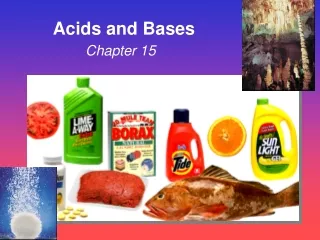
Properties of Acids and Bases • Acids taste sour • Bases feel slippery and taste bitter • Acids react with metals to form H2 gas and a salt ( Mg + 2HCl MgCl2 + H2) • Metal carbonates react with acids to produce CO2 (limestone (CaCO3) +HCl) • Bases turn litmus paper blue, acids turn litmus paper red
Ions in Solution • All water solutions contain hydronium(H3O+ or H+) and hydroxide (OH— ) ions • The relative amounts of the two ions determines whether the solution is basic, acidic, or neutral • Acidic solutions H3O+ > OH— • Basic solutions H3O+ < OH— • Neutral solutions H3O+ = OH—
Arrhenius Model of Acids and Bases • Acid is a substance that contains hydrogen and ionizes to produce or hydrogen ions in aqueous solutions • A base is a substance that contains a hydroxide group and ionizes to produce a hydroxide ion in aqueous solution • HCl(g) H+(aq) + Cl— (aq) • NaOH(s) Na+ (aq) + OH— (aq) • Some drawbacks exist with this model. NH3 does not have hydroxide but produces OH— in solution • A better model is needed • This leads us to Bronsted-Lowry Model
Bronsted-Lowry Model of Acids and Bases • An acid is a hydrogen ion (proton) donor and a base is a hydrogen ion (proton) acceptor • In this example X and Y represent nonmetals or negative polyatomic ions • HX(aq) + H2O H3O+ (aq) + X— (aq)
Conjugates • In Bronsted-Lowry model acids and bases can be labeled as conjugate pairs • HX(aq) + H2O H3O+ (aq) + X— (aq) • Conjugate base – results when an acid donates its proton • Conjugate acid- results when base accepts the proton • Conjugate pairs = HX, X— and H2O, H3O+ acid base Conjugate acid Conjugate base
Conjugate pairs • HF + H2O H3O+ + F— • Conjugate pairs= HF, F— and H2O, H3O+ • What about ammonia? Does Bronsted Lowry define why ammonia (NH3) is a base? base Conjugate base Conjugate acid acid
Ammonia • NH3(aq) + H2O NH4+ (aq) + OH— (aq) • We can see from the examples that substances classified as acids and bases by Arrhenius model are classified as acids and base by Bronsted Lowry model • We also can see some substances NOT classified as bases by Arrhenius model ARE classified as bases by Bronsted Lowry model (NH3 for example) • Water is amphoteric. It can sometimes act as a base and sometimes as an acid base acid Conjugate acid Conjugate base
Monoprotic and Polyprotic Acids • Some acids (HF, HCl, HNO3 for example) have only one hydrogen to donate • These acids are called monoprotic acids • Diprotic acids have 2 hydrogens to donate (H2SO4 for example) • Triprotic acids have 3 hydrogens to donate (H3PO4 for example) • Any acid with 2 or hydrogens to donate can be called polyprotic
Anhydrides • Oxides that can become acids or base when added to water • CO2 (g) + H2O(l) H2CO3 (aq) • CaO(s) + H2O (l) Ca+2 (aq) + 2OH— (aq) • Oxides of metallic elements usually form basic solutions • Oxides of nonmetallic elements (C, S, N) usually produce an acid in aqueous solutions
Strengths of Acids • Strong acids are defined as acids that completely ionize when mixed with water • Strong acids = HCl, HBr, HI, HClO4 , HNO3, and H2SO4 • HCl + H2O H3O+ + Cl— • Weak acids ionize only partially in water • H2C2H3O2 + H2O H3O+ + C2H3O2—
Strengths of Acids Continued • Strong acids are good conductors of electricity because they ionize in water • Weak acids are poor conductors because they don’t ionize in water
Strengths of Bases • Same rules apply to base as acids • Bases that ionize completely in water are strong bases (NaOH, KOH, RbOH, CsOH, Ca(OH)2 , Ba(OH)2 ) • NaOH Na+ + OH— • Strong bases are good conductors and weak bases are not
pH • In pure water,the concentration of H3O+(H+) ions is equal to OH— ions. • [H3O+] = [OH—] ( [ ] is short for concentration) • An important mathematical property of water is that the product of the H3O+ and OH— concentrations is always a constant • We call this the ion product constant for water(Kw) • [H+] x [OH—] = (1.0 x10—7 )x (1.0 x10—7 ) = Kw = 1.0 x 10—14
pH continued • Remember that ……. • Acidic solutions [H+] > [OH—] • Basic solutions [H+] < [OH—] • Neutral solutions [H+] = [OH—] • Regardless of the concentrations of each, the product always equals (1.0 x 10—14 )
pH scale • Since H+ and OH— concentrations deal with such small numbers, scientists came up with scale that is easier to read (pH scale) • pH is the negative log of the H+ concentration (pH = -log[H+]) • pH range goes from 0 to 14
pH scale continued • 0-6.99 = acidic • 7.00 = neutral • 7.01 –14.00 = basic • Remember that a change of 1 on the pH scale is a change in 10 times the concentration of H+ ions (pH 4 pH 3)
pOH Scale • Sometimes its easier for scientists to analyze using the OH— concentration instead of the H+ concentration • This scale is the pOH scale: • 0-6.99 = basic • 7.00 = neutral • 7.01 –14.00 = acidic • The pOH is negative log of the OH—concentration (pOH = -log[OH—] ) • Another helpful conversion is pH + pOH = 14.00
Calculating pH and pOH • Calculate the pH for the following • pH = -log[H+] • [H+] = 3.6 x 10—9 M pH = • [H+] = .025 M pH = • Calculate the pOH for the following • pOH = -log[OH—] • [OH—] = 6.5 x 10—4 MpOH = 8.44 basic 1.60 acidic 3.19 basic
Calculating H+ and OH— Concentrations • To go from pH [H+] Take the antilog of the negative pH (antilog(-pH) = [H+] ) • To go from pOH[OH—] Take the antilog of the negative pOH (antilog(-pOH)=[OH—]) • pH = 4.56 [H+] = • pH = 11.05 [H+] = • pOH = 1.23 [OH—] = • pOH = 9.87 [OH—] = 2.8 x 10—5 M 8.9 x 10—12 M .059 M 1.3 x 10—10 M
Neutralization Reactions • Rxn in which base and an acid in solution react to form a salt and water • A salt is defined as an ionic compound formed from the cation off the base and the anion off the acid • Always a double replacement rxn • NaOH + HCl(aq) NaCl(aq) + H2O (l) base acid a salt water
Acid/Base Indicators • Many methods are used to measure pH • Limus paper, pH paper, pH meter • Acid/ base indicators are chemical dyes whose colors are affected by acidic and basic solutions • Many are listed on pg 619 along with their range
Buffers • Solutions that resist changes in pH • Added to aquariums to keep water at safe pH • The body has natural buffers to keep your blood at or around 7.4 • Because the scale for pH is exponential, a change of .3 either direction can be fatal to your body