
210 likes | 346 Vues
This study explores the complex relationship between Active Galactic Nuclei (AGN) and cooling flows in galaxy clusters. We propose a working model where AGN inflates bubbles that efficiently deposit energy within the Intracluster Medium (ICM). Key questions include the self-regulated nature of AGN activity, potential universal applicability across clusters, and the mechanisms governing heat sources and accretion rates. Our analysis of turbulence, resonant scattering, and energy dissipation reveals important implications for understanding AGN's role in regulating gas cooling within clusters.
E N D
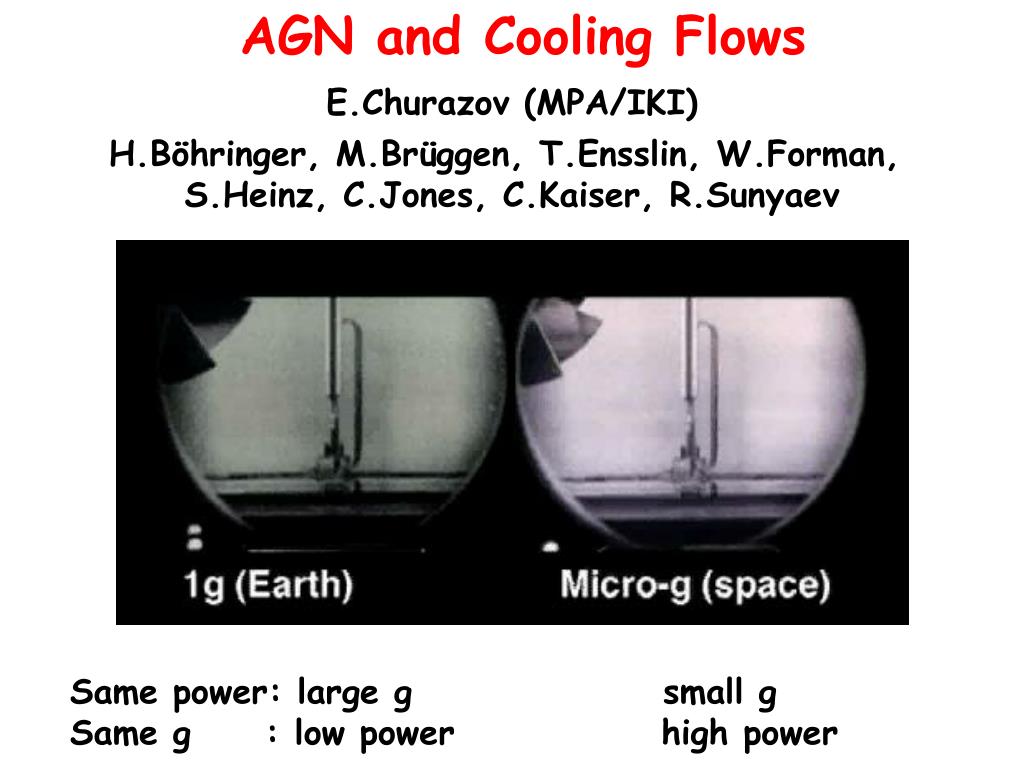
AGN and Cooling Flows E.Churazov (MPA/IKI) H.Böhringer, M.Brüggen, T.Ensslin, W.Forman, S.Heinz, C.Jones, C.Kaiser, R.Sunyaev Same power: large g small g Same g : low power high power
Possible working model • AGN inflates bubbles (large power) • Bubbles deposit energy to ICM (efficient, distributed) • AGN activity is self-regulated (e.g. Bondi accretion) • Universal for all clusters? • The only source of heat (Lx=Ljet)? • What sets Tmin (gravitational potential)? • Quasi-steady / strongly variable? • Is Bondi accretion rate sufficient? • Actual dissipation process • Abundance gradients to be preserved • Accretion modes • Black hole / galaxy mass correlation (ellipticals)
Owen, Eilek, Kassim, 2000 => <= Gull & Northover, 1973
Self-regulation • SMBH is at the bottom of the potential • Lowest entropy gas sinks to the bottom If cooling dominates => entropy goes down => accretion rate goes up => heating increases => entropy goes down
Bubbles energy losses • Supersonic expansion => strong shocks => heating • Subsonic expansion => PdV, but no heating • Excited during bubble rise • Trapped in the central region (Balbus & Soker, 90; Lufkin et al. 95) • Distribute energy over 4 • Losses occur when bubble rises • Depends on the nature of friction force • High viscosity => dissipation • Low viscosity => • turbulence • internal waves • sound waves • Efficiency is high (~50%)
Impact of resonant scattering on the line flux Turbulence > broader lines > lower depth; M ~ 0.5
Dissipation of turbulent motions If 10 kpc
Fe 6.7 keV line: Equivalent width and abundance Abundance Equivalentwidth
Abundance gradients, turbulent transport • Forced convection • Turbulence in stratified gas (collapses to 2D?) • Internal waves
Radio power in galactic BHC Fender et al.
Cooling rate Cooling rate Weak No BH growth QSO BH growth
Conclusions • AGN may prevent gas from cooling • Main source of heat? In every cluster? • Self-regulation is possible • Efficient and distributed dissipation is possible • Many interesting implications • Low frequency radio observations are very important • Velocity field / spatial scales (ASTRO-E2)
Time scales • Cooling time: few 100 Myr • Relativistic electrons • X-ray holes