Understanding Network Security and Authentication Mechanisms
This chapter delves into key concepts of network security, focusing on the importance of authentication and the principles of cryptography. It explores protocols allowing entities (like Alice) to prove their identities to others (like Bob), highlighting potential failures such as identity spoofing and replay attacks. Various authentication scenarios are outlined, including the use of IP addresses, passwords, and nonces, alongside the vulnerabilities associated with each approach. The discussion extends to public key cryptography methods and the implications of man-in-the-middle attacks, emphasizing the necessity for secure communications.

Understanding Network Security and Authentication Mechanisms
E N D
Presentation Transcript
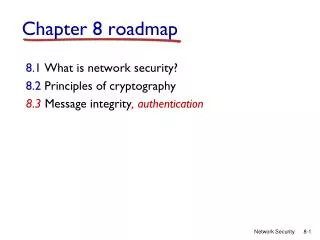
Chapter 8 roadmap 8.1 What is network security? 8.2 Principles of cryptography 8.3 Message integrity, authentication Network Security
Authentication Goal: Bob wants Alice to “prove” her identity to him Protocol ap1.0:Alice says “I am Alice” “I am Alice” Failure scenario?? Network Security
Authentication Goal: Bob wants Alice to “prove” her identity to him Protocol ap1.0:Alice says “I am Alice” in a network, Bob can not “see” Alice, so Trudy simply declares herself to be Alice “I am Alice” Network Security
Alice’s IP address “I am Alice” Authentication: another try Protocol ap2.0: Alice says “I am Alice” in an IP packet containing her source IP address Failure scenario?? Network Security
Alice’s IP address “I am Alice” Authentication: another try Protocol ap2.0: Alice says “I am Alice” in an IP packet containing her source IP address Trudy can create a packet “spoofing” Alice’s address Network Security
Alice’s password Alice’s IP addr “I’m Alice” Alice’s IP addr OK Authentication: another try Protocol ap3.0: Alice says “I am Alice” and sends her secret password to “prove” it. Failure scenario?? Network Security
Alice’s password Alice’s IP addr “I’m Alice” Alice’s IP addr OK Authentication: another try Protocol ap3.0: Alice says “I am Alice” and sends her secret password to “prove” it. Alice’s password Alice’s IP addr “I’m Alice” playback attack:Trudy records Alice’s packet and later plays it back to Bob Network Security
encrypted password Alice’s IP addr “I’m Alice” Alice’s IP addr OK Authentication: yet another try Protocol ap3.1: Alice says “I am Alice” and sends her encryptedsecret password to “prove” it. Failure scenario?? Network Security
encrypted password Alice’s IP addr “I’m Alice” Alice’s IP addr OK Authentication: yet another try Protocol ap3.1: Alice says “I am Alice” and sends her encryptedsecret password to “prove” it. encrypted password Alice’s IP addr “I’m Alice” record and playback stillworks! Network Security
K (R) A-B Authentication: yet another try Goal: avoid playback attack nonce: number (R) used only once-in-a-lifetime ap4.0: to prove Alice “live”, Bob sends Alice nonce, R. Alice must return R, encrypted with shared secret key “I am Alice” R Alice is live, and only Alice knows key to encrypt nonce, so it must be Alice! Failures, drawbacks? Network Security
- K (R) A + + K K A A - - + (K (R)) = R K (K (R)) = R A A A Authentication: ap5.0 ap4.0 requires shared symmetric key • can we authenticate using public key techniques? ap5.0: use nonce, public key cryptography “I am Alice” Bob computes R and knows only Alice could have the private key, that encrypted R such that “send me your public key” Network Security
- - K (R) K (R) A T + + K K A T - - + + m = K (K (m)) m = K (K (m)) + + A T A T K (m) K (m) A T ap5.0: security hole man (or woman) in the middle attack: Trudy poses as Alice (to Bob) and as Bob (to Alice) I am Alice I am Alice R R Send me your public key Send me your public key Trudy gets sends m to Alice encrypted with Alice’s public key Network Security
ap5.0: security hole man (or woman) in the middle attack: Trudy poses as Alice (to Bob) and as Bob (to Alice) difficult to detect: • Bob receives everything that Alice sends, and vice versa. (e.g., so Bob, Alice can meet one week later and recall conversation!) • problem is that Trudy receives all messages as well! Network Security
End-point authentication • want to be sure of the originator of the message – end-point authentication • assuming Alice and Bob have a shared secret, will MAC provide end-point authentication? • we do know that Alice created message. • … but did she send it? Network Security
Transfer $1M from Bill to Trudy Transfer $1M from Bill to Trudy MAC MAC Playback attack MAC =f(msg,s) Network Security
Transfer $1M from Bill to Susan MAC Defending against playback attack: nonce “I am Alice” R MAC =f(msg,s,R) Network Security
K (R) A-B End-point authentication w/ nonce Nonce: number (R) used only once –in-a-lifetime How to prove Alice “live”: Bob sends Alice nonce, R. Alice must return R, encrypted with shared secret key “I am Alice” R Alice is live, and only Alice knows key to encrypt nonce, so it must be Alice! Network Security
Chapter 8 roadmap 8.1 What is network security? 8.2 Principles of cryptography 8.3 Message integrity, authentication Network Security
cryptographic technique analogous to hand-written signatures: sender (Bob) digitally signs document, establishing he is document owner/creator. verifiable, nonforgeable:recipient (Alice) can prove to someone that Bob, and no one else (including Alice), must have signed document Digital signatures Network Security
simple digital signature for message m: Bob signs m by encrypting with his private key KB, creating “signed” message, KB(m) - K B Digital signatures - - - Bob’s private key Bob’s message, m (m) m,K B Dear Alice Oh, how I have missed you. I think of you all the time! …(blah blah blah) Bob Bob’s message, m, signed (encrypted) with his private key Public key encryption algorithm Network Security
Alice thus verifies that: Bob signed m no one else signed m Bob signed m and not m‘ non-repudiation: Alice can take m, and signature KB(m) to court and prove that Bob signed m Digital signatures - • suppose Alice receives msg m, with signature: m, KB(m) • Alice verifies m signed by Bob by applying Bob’s public key KB to KB(m) then checks KB(KB(m) ) = m. • If KB(KB(m) ) = m, whoever signed m must have used Bob’s private key. - - + + - + - Network Security
computationally expensive to public-key-encrypt long messages goal: fixed-length, easy- to-compute digital “fingerprint” apply hash function H to m, get fixed size message digest, H(m). Hash function properties: many-to-1 produces fixed-size msg digest (fingerprint) given message digest x, computationally infeasible to find m such that x = H(m) Message digests large message m H: Hash Function H(m) Network Security
Internet checksum: poor crypto hash function Internet checksum has some properties of hash function: • produces fixed length digest (16-bit sum) of message • is many-to-one But given message with given hash value, it is easy to find another message with same hash value: ASCII format message ASCII format message I O U 9 0 0 . 1 9 B O B 49 4F 55 39 30 30 2E 31 39 42 D2 42 I O U 1 0 0 . 9 9 B O B 49 4F 55 31 30 30 2E 39 39 42 D2 42 B2 C1 D2 AC B2 C1 D2 AC different messages but identical checksums! Network Security
Digital signature = signed message digest H: Hash function H: Hash function large message m large message m + - digital signature (encrypt) digital signature (decrypt) K K B B encrypted msg digest encrypted msg digest + - - KB(H(m)) KB(H(m)) H(m) H(m) Bob sends digitally signed message: Alice verifies signature, integrity of digitally signed message: H(m) Bob’s private key Bob’s public key equal ? Network Security
MD5 hash function widely used (RFC 1321) computes 128-bit message digest in 4-step process. arbitrary 128-bit string x, appears difficult to construct msg m whose MD5 hash is equal to x SHA-1 is also used US standard [NIST, FIPS PUB 180-1] 160-bit message digest Hash function algorithms Network Security
- - K (R) K (R) A T + + K K A T - - + + m = K (K (m)) m = K (K (m)) + + A T A T K (m) K (m) A T Recall: ap5.0 security hole man (or woman) in the middle attack: Trudy poses as Alice (to Bob) and as Bob (to Alice) I am Alice I am Alice R R Send me your public key Send me your public key Trudy gets sends m to Alice encrypted with Alice’s public key Network Security
Public-key certification • motivation: Trudy plays pizza prank on Bob • Trudy creates e-mail order: Dear Pizza Store, Please deliver to me four pepperoni pizzas. Thank you, Bob • Trudy signs order with her private key • Trudy sends order to Pizza Store • Trudy sends to Pizza Store her public key, but says it’s Bob’s public key • Pizza Store verifies signature; then delivers four pepperoni pizzas to Bob • Bob doesn’t even like pepperoni Network Security
+ + digital signature (encrypt) K K B B K CA Certification authorities • certification authority (CA): binds public key to particular entity, E. • E (person, router) registers its public key with CA. • E provides “proof of identity” to CA. • CA creates certificate binding E to its public key. • certificate containing E’s public key digitally signed by CA – CA says “this is E’s public key” Bob’s public key CA private key certificate for Bob’s public key, signed by CA - Bob’s identifying information Network Security
+ + digital signature (decrypt) K K B B K CA Certification authorities • when Alice wants Bob’s public key: • gets Bob’s certificate (Bob or elsewhere). • apply CA’s public key to Bob’s certificate, get Bob’s public key Bob’s public key CA public key + Network Security
Network Security (summary) basic techniques…... • cryptography (symmetric and public) • message integrity • end-point authentication …. used in many different security scenarios • secure email • secure transport (SSL) • IP sec • 802.11 operational security: firewalls and IDS Network Security