Comprehensive Overview of Internet Routing Protocols and Router Architecture
This chapter delves into the critical concepts of network routing, focusing on various routing protocols and router functionalities within the context of the Internet. It covers foundational routing principles, hierarchical routing structures, and specifics on intra-AS (RIP, OSPF) and inter-AS (BGP) routing methods. The chapter further explores the architecture of routers, detailing their roles and interactions in managing data flows across autonomous systems. Key terms and mechanisms such as link-state, distance vector protocols, and router advertisements are explained, providing a thorough understanding of modern networking.

Comprehensive Overview of Internet Routing Protocols and Router Architecture
E N D
Presentation Transcript
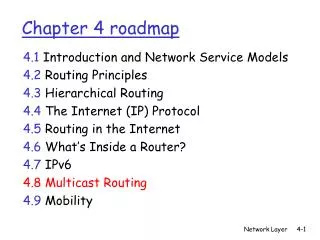
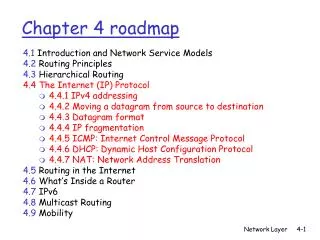
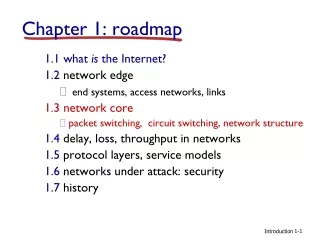
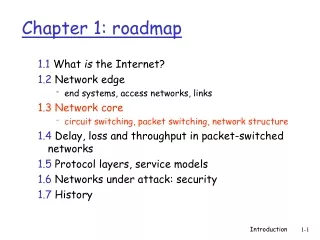
Chapter 4 roadmap 4.1 Introduction and Network Service Models 4.2 Routing Principles 4.3 Hierarchical Routing 4.4 The Internet (IP) Protocol 4.5 Routing in the Internet • 4.5.1 Intra-AS routing: RIP and OSPF • 4.5.2 Inter-AS routing: BGP 4.6 What’s Inside a Router? Network Layer
Routing in the Internet • The Global Internet consists of Autonomous Systems (AS) interconnected with each other: • Stub AS: small corporation: one connection to other AS’s • Multihomed AS: large corporation (no transit): multiple connections to other AS’s • Transit AS: provider, hooking many AS’s together • Two-level routing: • Intra-AS: administrator responsible for choice of routing algorithm within network • Inter-AS: unique standard for inter-AS routing: BGP Network Layer
Internet AS Hierarchy Intra-AS border (exterior gateway) routers Inter-ASinterior (gateway) routers Network Layer
Intra-AS Routing • Also known as Interior Gateway Protocols (IGP) • Most common Intra-AS routing protocols: • RIP: Routing Information Protocol • OSPF: Open Shortest Path First • IGRP: Interior Gateway Routing Protocol (Cisco proprietary) • IS-IS: Intermediate System to Intermediate System Network Layer
RIP ( Routing Information Protocol) • Distance vector algorithm • Included in BSD-UNIX Distribution in 1982 • Distance metric: # of hops (max = 15 hops) • Distance vectors: exchanged among neighbors every 30 sec via Response Message (also called advertisement) • Each advertisement: list of up to 25 destination nets within AS Network Layer
RIP: Example z w x y A D B C Destination Network Next Router Num. of hops to dest. w A 2 y B 2 z B 7 x -- 1 …. …. .... Routing table in D Network Layer
z w x y A D B C RIP: Example Dest Next hops w - - x - - z C 4 …. … ... Advertisement from A to D Destination Network Next Router Num. of hops to dest. w A 2 y B 2 z B A 7 5 x -- 1 …. …. .... Routing table in D Network Layer
RIP: Link Failure and Recovery If no advertisement heard after 180 sec --> neighbor/link declared dead • routes via neighbor invalidated • new advertisements sent to neighbors • neighbors in turn send out new advertisements (if tables changed) • link failure info quickly propagates to entire net • poison reverse used to prevent ping-pong loops (infinite distance = 16 hops) Network Layer
routed routed RIP Table processing • RIP routing tables managed by application-level process called route-d (daemon) • advertisements sent in UDP packets, periodically repeated Transprt (UDP) Transprt (UDP) network forwarding (IP) table network (IP) forwarding table link link physical physical Network Layer
RIP Table example (continued) Router: giroflee.eurocom.fr Destination Gateway Flags Ref Use Interface -------------------- -------------------- ----- ----- ------ --------- 127.0.0.1 127.0.0.1 UH 0 26492 lo0 192.168.2. 192.168.2.5 U 2 13 fa0 193.55.114. 193.55.114.6 U 3 58503 le0 192.168.3. 192.168.3.5 U 2 25 qaa0 224.0.0.0 193.55.114.6 U 3 0 le0 default 193.55.114.129 UG 0 143454 • Three attached class C networks (LANs) • Router only knows routes to attached LANs • Default router used to “go up” • Route multicast address: 224.0.0.0 • Loopback interface (for debugging) Network Layer
Weaknesses of RIP • INFINITY defined as 15, thus RIP cannot be used in networks where routes are more than 15 hops • Difficulty in supporting multiple metrics (default metric: # of hops) • the potential range for such metrics as bandwidth, throughput, delay, and reliability can be large • thus the value for INFINITY should be large; but this can result in slow convergence of RIP due to count-to-infinity problem Network Layer
OSPF (Open Shortest Path First) • “open”: publicly available • Uses Link State algorithm • LS packet dissemination • Topology map at each node • Route computation using Dijkstra’s algorithm • OSPF advertisement carries one entry per neighbor router • Advertisements disseminated to entire AS (via flooding) • Carried in OSPF messages directly over IP (rather than TCP or UDP Network Layer
OSPF “advanced” features (not in RIP) • Security: all OSPF messages authenticated (to prevent malicious intrusion) • Multiple same-cost paths allowed (only one path in RIP) • For each link, multiple cost metrics for different TOS (e.g., satellite link cost set “low” for best effort; high for real time) • Integrated uni- and multicast support: • Multicast OSPF (MOSPF) uses same topology data base as OSPF • Hierarchical OSPF in large domains. Network Layer
Hierarchical OSPF Network Layer
Hierarchical OSPF • Two-level hierarchy: local area, backbone. • Link-state advertisements only in area • each nodes has detailed area topology; only know direction (shortest path) to nets in other areas. • Area border routers:“summarize” distances to nets in own area, advertise to other Area Border routers. • Backbone routers: run OSPF routing limited to backbone. • Boundary routers: connect to other AS’s. Network Layer
Inter-AS routing in the Internet: BGP Network Layer
Internet inter-AS routing: BGP • BGP (Border Gateway Protocol):the de facto standard • Path Vector protocol: • similar to Distance Vector protocol • each Border Gateway broadcast to neighbors (peers) entire path (i.e., sequence of AS’s) to destination • BGP routes to networks (ASs), not individual hosts • E.g., Gateway X may send its path to dest. Z: Path (X,Z) = X,Y1,Y2,Y3,…,Z Network Layer
Internet inter-AS routing: BGP Suppose: gateway X send its path to peer gateway W • W may or may not select path offered by X • cost, policy (don’t route via competitors AS), loop prevention reasons. • If W selects path advertised by X, then: Path (W,Z) = w, Path (X,Z) • Note: X can control incoming traffic by controlling it route advertisements to peers: • e.g., don’t want to route traffic to Z -> don’t advertise any routes to Z Network Layer
BGP: controlling who routes to you • A,B,C are provider networks • X,W,Y are customer (of provider networks) • X is dual-homed: attached to two networks • X does not want to route from B via X to C • .. so X will not advertise to B a route to C Network Layer
BGP: controlling who routes to you • A advertises to B the path AW • B advertises to X the path BAW • Should B advertise to C the path BAW? • No way! B gets no “revenue” for routing CBAW since neither W nor C are B’s customers • B wants to force C to route to w via A • B wants to route only to/from its customers! Network Layer
BGP operation Q: What does a BGP router do? • Receiving and filtering route advertisements from directly attached neighbor(s). • Route selection. • To route to destination X, which path )of several advertised) will be taken? • Sending route advertisements to neighbors. Network Layer
BGP messages • BGP messages exchanged using TCP. • BGP messages: • OPEN: opens TCP connection to peer and authenticates sender • UPDATE: advertises new path (or withdraws old) • KEEPALIVE keeps connection alive in absence of UPDATES; also ACKs OPEN request • NOTIFICATION: reports errors in previous msg; also used to close connection Network Layer
Why different Intra- and Inter-AS routing ? Policy: • Inter-AS: admin wants control over how its traffic routed, who routes through its net. • Intra-AS: single admin, so no policy decisions needed Scale: • hierarchical routing saves table size, reduced update traffic Performance: • Intra-AS: can focus on performance • Inter-AS: policy may dominate over performance Network Layer
BGP fragility • BGP can contribute to lot of the routing instability in the internet • Interactions between IGPs & EGPs poorly understood (OSPF timeouts etc.) • Incorrect information being fed from an IGP to an EGP (and vice versa) can result in catastrophic meltdown • BGP route flaps and associated dampening introduces more complexity than before • A routing protocol that does not work in the simple case?! Network Layer