Understanding Ionic and Metallic Bonding: Valence Electrons and Structure
140 likes | 246 Vues
This chapter explores the concepts of ionic and metallic bonding, detailing the role of valence electrons in atom bonding and activities. It covers electron dot notation, cations, anions, and polyatomic ions like hydroxide and nitrate. The chapter also discusses ionic compounds, their crystalline structure, and properties such as high melting/boiling points and electrical conductivity when molten or dissolved. Moreover, it explains metallic bonding, characterized by a "sea of electrons." Finally, it delves into the properties of metals and the characteristics of alloys.


Understanding Ionic and Metallic Bonding: Valence Electrons and Structure
E N D
Presentation Transcript
Ionic and Metallic Bonding Chapter 7
Valence Electrons • The _______________in an atom • Their arrangement determines the bonding __________and activities of an atom • S-Block– they are the same as the group number Na= 1 valence electron • P-Block– They are the group number- 10 C= 4 valence electrons F= 7 valence electrons Iodine… 7 valence electrons
Electron Dot Notation: Instead of drawing the orbital diagram, which can be long & complex, there is an easier way to represent the atoms. _______________________:is an electron notation in which only the _______________are shown, and are represented by dots around the element’s symbol. Lots and lots of examples… Valence electrons Dot notation
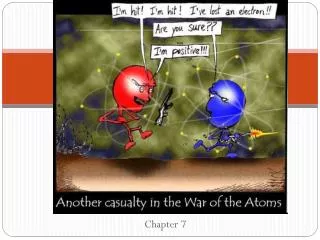
Ions Ion:______________________________ Cation: atom that has a +ve charge (A+). i.e. missing an e- Anion: atom that has a –ve charge (X-). i.e. has an extra e- Do the Lewis structure for Cl, Cl-, Na, Na+
Polyatomic Ions • An ion that consist of____________, covalently bonded together and carrying a charge. • Common Examples… • OH- (Hydroxide) • NO3- (Nitrate) • SO42- (Sulfate) • PO43- (phosphate) (draw their Lewis structures)
Ionic Bonding Most of Earth’s rocks & minerals are made up of compounds held together by ionic bonds. ________________:consists of positive (cat) & negative (an) ions that are combined such that the # positives = # negatives. e.g. Na -> Na+ + e-&Cl + e- -> Cl- Na++Cl-->NaCl(#+’s = #-’s) e.g.2. Mg & Cl
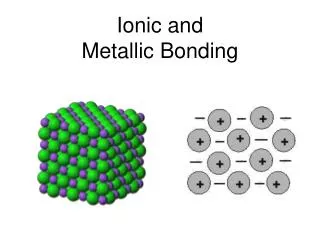
Most ionic compounds exist as a ______________of alternating +’ve & -’ve ions (NaCldia) (Screen 3.9 Coulomb’s law, 3.10 NaCl, 3.10.SB KBr)
Ionic Compounds: Molecular arrangement _________________: is the simplest collection of atoms from which an ionic compounds formula can be established. Ionic compounds can be represented by Electron Dot diagrams. e.g. NaCl
Ionic Solid Structure • Ionic crystals combine in an orderly arrangement known as a _________________ • Crystalline solids at room temperature Rutile (crystal and model of lattice)
Ionic Solids: Characteristics -high melting/boiling pts -_______________ -when molten (or dissolved in H2O) they become good_________________________
Metallic Bonding: • Metals have few valence e-’s (1,2or3) which roam freely as a “sea of electrons” throughout the metal. They do not belong to any particular atom • The atoms themselves are arranged in a______________________________. • The bonding between the metal atoms & this sea of electrons is called_______________. • It is NOT bonding between different types of metal atoms.
Metal Solids Metals can only come together when they are in their molten state.A mixture of 2 or more metals called an alloy. Characteristics: • highly conductive: electrical & heat • ___________ • ___________ • ___________
Alloys ____________________: some of the host metal atoms are replaced by other similar sized metal atoms. E.g’s: Brass: Copper (~2/3) & Zinc (~1/3) Bronze: Copper (~80%) & Tin (~20%) Sterling Silver: Silver (93%) & Copper (7%) 24 Karat Gold: Gold (100%) 18 Karat Gold: Gold (18/24 = 75%) & Silver
_______________: some of the holes (interstices) between the metal atoms are filled with small atoms. Makes the metal harder, tougher and more durable… better for building E.g’s: Steel: Iron & Carbon (small %)