The French and Indian War: Colonial Self-Government and Early Alliances
This lesson focuses on the pivotal events leading up to the French and Indian War, emphasizing the importance of colonial self-government and the strategic alliances formed during this critical period. Students will explore key topics, including the roles of significant figures, critical locations like the Ohio Valley, and the contrasting advantages of French and English forces. Activities include analyzing political cartoons and answering warm-up questions related to historical events and figures. A foldable project will help students engage creatively with the content.

The French and Indian War: Colonial Self-Government and Early Alliances
E N D
Presentation Transcript
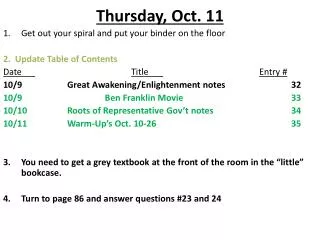
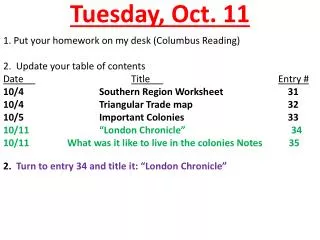
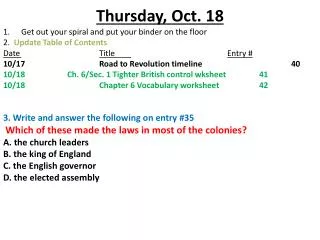
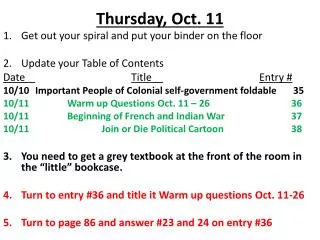
Thursday, Oct. 11 • Get out your spiral and put your binder on the floor • Update your Table of Contents Date Title Entry # 10/10 Important People of Colonial self-government foldable 35 10/11 Warm up Questions Oct. 11 – 26 36 10/11 Beginning of French and Indian War 37 10/11 Join or Die Political Cartoon 38 • You need to get a grey textbook at the front of the room in the “little” bookcase. • Turn to entry #36 and title it Warm up questions Oct. 11-26 • Turn to page 86 and answer #23 and 24 on entry #36
Songs • You will have 5 minuets to get ready • You will be receiving a grade both on the lyrics and participation (in your group and in the audience!!!)
Foldable • Title: People Important to the development of Self-Government in the colonies
French and Indian WarPreview http://teachertube.com/viewVideo.php?video_id=58909
Beginning of the French and Indian War I. European Rivals in *England, France, Netherlands, and Spain competed for trade N. America and land
Beginning of the French and Indian War I. European Rivals in *England, France, Netherlands, and Spain competed for trade N. America and land all around the world *France was England's biggest threat in N. Am.
Beginning of the French and Indian War I. European Rivals in *England, France, Netherlands, and Spain competed for trade N. America and land all around the world *France was England's biggest threat in N. Am. *Conflict in the Ohio Valley -English traders were crossing the Appalachians in search of furs. -Tried to take over French trade with Natives -Ohio River was important to France b/c (linked Canada with French settlements along the Mississippi R.)
Beginning of the French and Indian War I. European Rivals in *England, France, Netherlands, and Spain competed for trade N. America and land all around the world *France was England's biggest threat in N. Am. *Conflict in the Ohio Valley -English traders were crossing the Appalachians in search of furs. -Tried to take over French trade with Natives -Ohio River was important to France b/c (linked Canada with French settlements along the Mississippi R.) *Natives choose sides -Didn’t want to give up any land to either England or France -Chose sides to protect ways of life
Beginning of the French and Indian War • French Advantages *Didn’t destroy the land (hunted and trapped) *Adopted Indian ways and married Native women *Alliances with the Algonquin and Huron
Beginning of the French and Indian War • French Advantages *Didn’t destroy the land (hunted and trapped) *Adopted Indian ways and married Native women *Alliances with the Algonquin and Huron • English Advantages *Alliance with the Iroquois who were enemies of the Algonquin and Huron *charged lower prices for trade goods
Beginning of the French and Indian War • French Advantages *Didn’t destroy the land (hunted and trapped) *Adopted Indian ways and married Native women *Alliances with the Algonquin and Huron • English Advantages *Alliance with the Iroquois who were enemies of the Algonquin and Huron *charged lower prices for trade goods • Beginning *George Washington sent out to Ohio Valley to build a fort
Beginning of the French and Indian War • French Advantages *Didn’t destroy the land (hunted and trapped) *Adopted Indian ways and married Native women *Alliances with the Algonquin and Huron • English Advantages *Alliance with the Iroquois who were enemies of the Algonquin and Huron *charged lower prices for trade goods • Beginning *George Washington sent out to Ohio Valley to build a fort *Surrendered to the French and returned to VA
Beginning of the French and Indian War • French Advantages *Didn’t destroy the land (hunted and trapped) *Adopted Indian ways and married Native women *Alliances with the Algonquin and Huron • English Advantages *Alliance with the Iroquois who were enemies of the Algonquin and Huron *charged lower prices for trade goods • Beginning *George Washington sent out to Ohio Valley to build a fort *Surrendered to the French and returned to VA V. Albany Plan of Union *Representatives from the colonies and Iroquois met in NY
Beginning of the French and Indian War • French Advantages *Didn’t destroy the land (hunted and trapped) *Adopted Indian ways and married Native women *Alliances with the Algonquin and Huron • English Advantages *Alliance with the Iroquois who were enemies of the Algonquin and Huron *charged lower prices for trade goods • Beginning *George Washington sent out to Ohio Valley to build a fort *Surrendered to the French and returned to VA V. Albany Plan of Union *Representatives from the colonies and Iroquois met in NY *Franklin suggested the colonies band together for defense
Beginning of the French and Indian War • French Advantages *Didn’t destroy the land (hunted and trapped) *Adopted Indian ways and married Native women *Alliances with the Algonquin and Huron • English Advantages *Alliance with the Iroquois who were enemies of the Algonquin and Huron *charged lower prices for trade goods • Beginning *George Washington sent out to Ohio Valley to build a fort *Surrendered to the French and returned to VA V. Albany Plan of Union *Representatives from the colonies and Iroquois met in NY *Franklin suggested the colonies band together for defense *Colonial legislatures said no