Enhancing Research Visibility through Citation Analysis and Data Visualization Techniques
This project aims to enhance the visibility of research areas in institutions by utilizing citation analysis to identify hot topics, emerging research fronts, and collaborative networks. By mapping co-authorship and collaboration using the university's publication database, we address challenges in clustering methods and improve data coverage. We also explore natural language processing to formulate new classification schemes using titles, abstracts, and full texts. Furthermore, the effort includes enriching the publication database with data from external sources to optimize visualization and classification efforts.

Enhancing Research Visibility through Citation Analysis and Data Visualization Techniques
E N D
Presentation Transcript
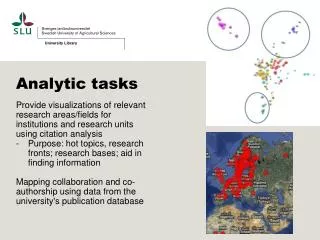
Analytic tasks Provide visualizations of relevant research areas/fields for institutions and research units using citation analysis Purpose: hot topics, research fronts; research bases; aid in finding information Mappingcollaboration and co-authorshipusing data from the university'spublicationdatabase
Most challenging problems Evaluatingand findingadequatemethods for clustering (average, ward…) Coverage in WOS varies within institutions and between research areas Using natural language processing in order to create new classification schemes, different levels - title, abstract, full text. • Using the university’s publication database for data visualization. Many documents in it are not indexed by WOS. • Enriching the university’s publication database with data from new web services like f1000 • how can these be used to improve classification and visualization
Bio & picture. Pär Sundling 2012. Librarian, Scientific Communication & Evaluation, SLU Library 2012. Master’sdegree. Library and Information Science, Umeå University 2008. Bachelor’sdegree. Historyof Science and Ideas, Umeå University