Download
1 / 6
60 likes | 178 Vues
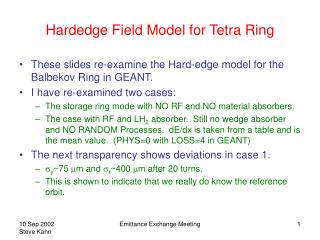
This presentation re-examines the Hard-edge model for the Balbekov Ring within the GEANT framework. The analysis focuses on two specific cases: the storage ring mode without RF and material absorbers, and the configuration that includes RF and LH2 absorbers. Key outcomes include the measurement of deviations observed after 20 turns, with emittance parameters indicating stable reference orbit knowledge. The study emphasizes the significance of understanding energy correlation with electric fields in the context of emittance exchange meetings.

E N D
Hardedge Field Model for Tetra Ring • These slides re-examine the Hard-edge model for the Balbekov Ring in GEANT. • I have re-examined two cases: • The storage ring mode with NO RF and NO material absorbers. • The case with RF and LH2 absorber. Still no wedge absorber and NO RANDOM Processes. dE/dx is taken from a table and is the mean value. (PHYS=0 with LOSS=4 in GEANT) • The next transparency shows deviations in case 1. • y~75 m and r~400 m after 20 turns. • This is shown to indicate that we really do know the reference orbit. Emittance Exchange Meeting
Case 1: Storage Ring Mode No RF, No Material Emittance Exchange Meeting
Case 2: RF and Material but no Random Processes Emittance Exchange Meeting
Case 2: Correlation of Energy with E field Emittance Exchange Meeting
Following One Turn of the Reference Particle Emittance Exchange Meeting
Variations in Timing Emittance Exchange Meeting