Searching for Kuiper Belt Objects
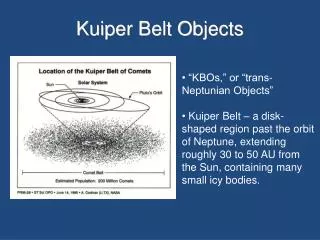
This study focuses on the search for Kuiper Belt Objects (KBOs), which are rocky and icy bodies located approximately 30-50 AU from the Sun. As remnants from the era of planet formation, around 1,000 KBOs have been identified, with only a few dozen observed beyond an R magnitude of 24. Utilizing a 6.5-meter telescope equipped with a 36 CCD mosaic camera (MEGACAM), we explore optimal methods for identifying multiple KBOs within a single observation. This research is supported by a team of mentors and funding from NASA and the Arizona Space Grant Consortium.

Searching for Kuiper Belt Objects
E N D
Presentation Transcript
Searching for Kuiper Belt Objects Deborah L. Hamm Mentors David Trilling, Cesar Fuentes, Michael Mommert, Paulo Penteado
Kuiper Belt Objects (KBOs) • Rocky, icy bodies • Located ~ 30-50 AU • Remnants of the era of planet formation • ~1000 known • Only a few tens @ R > 24
Instruments / Data • 6.5 meter telescopes • 36 CCD mosaic camera MEGACAM • 36 Fields • R magnitude limiting depth of ~25.2
MEGACAM Mosaic 36 CCDs 9 X 4 array FOV: 24’ X 24’ .16 deg2 FOV (1 CCD): 160’’ X 360’’ Gaps ~6’’
Expectations • Expectations based on previous studies • 4 KBOs in a single pointing • 3-5 arcseconds/hr for a KBO @ 30 AU
Next Steps • Search algorithm • Gif files • Run dataset
Thank You • Mentors: David Trilling, Cesar Fuentes, Michael Mommert, Paulo Penteado • NASA Space Grant • Arizona Space Grant Consortium • Northern Arizona University • University of Arizona