Invisible Computing: Enhancing Everyday Objects through Web Services
Invisible Computing aims to integrate computation and communication into everyday objects, making them smarter and easier to use without user intervention. By leveraging XML Web Services, devices remain out of sight while facilitating seamless connectivity and communication. Our approach achieves robust interoperability, security, and real-time performance on low-cost embedded systems. This presentation will outline our methods including table-driven serialization and component-based real-time operating systems. We’ll explore diverse applications, from home automation to medical devices, showcasing the future of ubiquitous computing.


Invisible Computing: Enhancing Everyday Objects through Web Services
E N D
Presentation Transcript
XML Web Services for Invisible Computing Johannes Helander Researcher Microsoft Research
Outline • The goals of Invisible Computing • Why Web Services? • Our approach • Table driven serialization • Distributed real-time • Trust and secure discovery • Componentized RTOS • Real-time C# • Developing code for small devices • Educational & research opportunities • Availability
Why Invisible Computing? • The computers stay out of sight and do their job. • No setup hassles • Make everyday objects better by adding computation and communication • Natural user interface – not screen and mouse • Rudimentary autonomous operation – added value from services • Incremental deployment • Devices communicate with each other • Devices communicate with big computers as needed
Sample Applications • Home appliances, security, lighting • Medical electronic devices • Wearable Computers • Robotics, Industrial Control, National Infrastructure • Sensor networks • Wireless communication gadgets • Audio Net • Disaggregated PC, smart I/O cards • Toys
Hardware trends • 32 bit microcontrollers are as cheap and power efficient as 8 bit MCUs • Single chip computer is a reality • Cost close to $5 (“Home depot” price point) • No need to aim at lowest point sweet spot • Aggregate of medium volume market is huge Partially reconfigurable hardware • Make hardware easy for software people
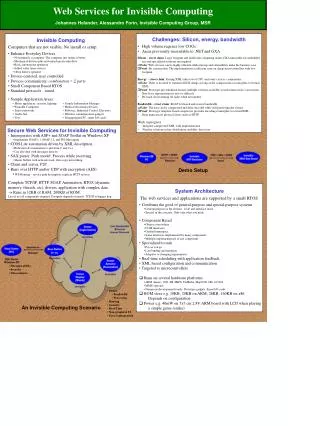
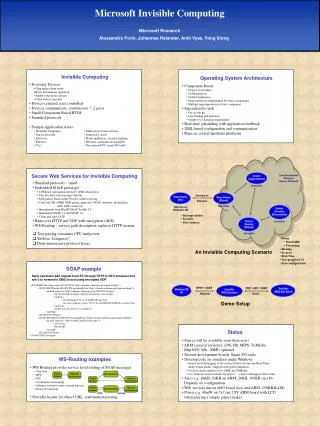
[VCR] XP Embedded [Pacemaker] • Interoperability • Security • Data analysis [watch] • Power • Bandwidth • Processing • Routing • Security • Real-Time • Non-graphical UI • Zero-configuration An Invisible Computing Scenario
What are Web Services? • The general-purpose solution to communication, in XML • Convergence of EDI, RPC, MSMQ, app specific protocols and formats Agnostic to underlying transport • All about interoperation. Allows partial understanding • Across-the-board presentation layer • Common protocols obviate need for proxies • Builds on critical mass and momentum
Do they Scale? • XML Web Services conceived to solvee-business interop problem • Implementations geared towards high-end computers • The same interop problem is the crux of Ubiquitous computing • Critical mass required in any business • Resource constraints: • Silicon – footprint • Energy – parsing overhead • Bandwidth – size of messages Efficient implementation and compression
SOAP example "Add" request, from PC to NTU simulator, via HTTP then forward to EB63 via encrypted UDP <soap:Envelope xmlns:soap=http://schemas.xmlsoap.org/soap/envelope/ > <soap:Header soap:encodingStyle=http://schemas.xmlsoap.org/soap/encoding/ > <rp:path xmlns:rp=http://schemas.xmlsoap.org/ws/2002/05/routing > <rp:fwd> <rp:via >http://172.31.46.26/COB/calc.cob </rp:via> <rp:via reservation=“sensor/button">x-udp-aes-soap://172.31.41.244/COB/calc.cob</rp:Via> </rp:fwd> <rp:rev><m:via vid="1"/></rp:rev> </rp:path> </soap:Header> <soap:Body soap:encodingStyle=http://schemas.xmlsoap.org/soap/encoding/ > <m:Add xmlns:m=http://tempuri.org/Calc/message/ > <A>14</A> <B>28</B> </m:Add> </soap:Body> </soap:Envelope> The calculator is a popular interop test
Yes, it Works! Implementation shows you can successfully: • Realize web services on small low-cost devices, providing good interoperability with PCs and other devices • Achieve a high level of security and privacy on those devices • Integrate security, discovery, and functional assignment into a hassle-free user experience • Setup your home completely independently, yet securely federate with external entities such as e-business • Use web services for real-time tasks Demoed at booth #31
Microsoft Invisible Computing A software platform for low cost embedded systems that communicate with each other and with big computers • Flexible development for multiple platforms • Interoperation with small and big computers • Web services and .NET • Security and privacy • Real-Time • Energy aware • Low parts cost (targeted for <= $5 computer) • Sweet spot: enough for real use and critical mass but no frills • XML Web Services: interoperability, tuned for performance • Component Based RTOS • Standard protocols: TCP/IP, SOAP, PKCS#1, etc. • .NET virtual machine for C# games or other extensions
Invisible continued • Interoperates with ASP+ and SOAP Toolkit on Windows XP • Client and server, P2P • Complete TCP/IP, HTTP, SOAP, Automation, discovery, trust & security, RTOS (dynamic memory, threads, etc), drivers, application with complex data. Runs in computer with 32KB of RAM, 256KB of ROM. Fewer components smaller footprint. TCP/IP is biggest hog. Crypto not optimized for size.
Outline • The goals of Invisible Computing • Why Web Services? • Our approach • Table driven serialization • Distributed real-time • Trust and secure discovery • Componentized RTOS • Real-time C# • Developing code for small devices • Educational & research opportunities • Availability
Table Driven Serialization • Processes messages automatically according to description • XML metadata description • Compiled offline into compact description • Extensible at runtime • Process while receiving • Zero copy networking • Serializer & parser share buffers with network stack & crypto • COM-Lite automation • Turns messages into object calls • Multiple methods in one message • Multiple transports and encodings • UDP, HTTP, Encryption, Compression • Routing, roles, and conversion
Scheduling Scheduling Sampling Sensor readings Distributed Real-Time • Experiment in distributed scheduling • Real-time data-flow Instigator Producer Consumer
Real-Time continued • Serialize scheduling trees into XML • Reservations pre-declare future activity at each node • Instigator of activity orchestrates and tunes reservations based on feedback samples • Worker nodes accept/reject schedules Merge of trees. Location independent. Could write scheduler in XSL. • Coordinated schedules allow shared resource scheduling. Could turn off radio. • Statistical decision making • Confidence test, quality control sampling schedules, probability based admission control • Concept demo shown at booth #31
Real-Time continued Serialized reservation example <rs:task xmlns:rs=http://tempuri.org/X-Reservation name=“sense1”> <rs:reservation name=“producer” deadLine=“2004-12-31T00:00:00.5Z“ tolerance="P456S“ duration="P0.1S"> <rs:resource name=“cpu"> <rs:quantity>2000</rs:quantity> </rs:resource> <rs:resource name=“RF-transmitter-1"> <rs:quantity>77</rs:quantity> </rs:resource> </rs:reservation> <rs:reservation name=“consumer" deadLine="2004-12-31T00:00:00.2Z“ tolerance="P82S" duration="P0.1S"> <rs:resource name=“RF-receiver"> <rs:quantity>100</rs:quantity> </rs:resource> </rs:reservation> </rs:task> Triggers, sub-reservations, resource estimates, tolerances
Setting up a Secure Home • Create house authority, e.g. usbkey • Touch each device once with usbkey • Admits device into trust domain • Determines functional relationships heuristically • Discovery process finds device with desired function + does key exchange • House authority can be offline • RSA + AES • Write hash of house authority’s key on check to establish trust with bank Federation of independent trust domains
Trust and Discovery • Simple SOAP based trust and service discovery for ad hoc networks • Integrate trust and functional setup • Integrate key exchange with discovery • Simple user interaction • No external CA required • Use Global XML Architecture when infrastructure present • Optimized for cluster of nodes. Base station (PC) deals with global issues • PKI works on small devices(but can be boosted) • 13s RSA decrypt, 0.03s AES on 25MHz Arm7 • FPGA takes times down by factors of 3000 and 10000 (3ms & 2µs) • Strong crypto necessary for marketability • Would people buy surveillance equipment against themselves?
RTOS Architecture Support for web services on a chip • General purpose in the abstract. Code and interface reuse. • Special in the concrete. Only take what you need. • Component Based • Objects everywhere • COM interfaces • Unified namespace • Same interfaces implemented by many components • Multiple implementations of any component • Specialized to task • Pay as you go • Late binding and mutation • Adaptive to changing requirements • Real-time scheduling with application feedback • XML based configuration and communication
RTOS continued • Hardware platforms • ARM (many), i386, H8, MIPS, TriMedia, Map1000, 68k, eCOG1 • Numerous development boards. Prototype gadgets. Smart I/O cards • Can be compiled with numerous compilers • ROM sizes e.g. 10KB, 20KB, 200KB on ARM; 26KB, 240KB on x86 • Power e.g. 40mW on 5x7 cm 2.8V ARM board with LCD when playing a simple game (snake)
It Still Has to be Small! WinXp Invisible
Real-Time C# • CLR desirable option for embedded systems • Great for extensions, games, apps • Not practical as the exclusive solution in embedded systems • Our real-time scheduling extensions • Prototype API implemented • Work Item Scheduler allows mixing native and managed threads • Native execution stacks are multiplexed
Outline • The goals of Invisible Computing • Why Web Services? • Our approach • Table driven serialization • Distributed real-time • Trust and secure discovery • Componentized RTOS • Real-time C# • Developing code for small devices • Educational & research opportunities • Availability
Developing Code for embedded systems using Microsoft Invisible Computing • Start with emulation, then simulation, and finally real hardware • Debugging on real embedded h/w painful minimize time spent on this • All MS Invisible Computing environments have the same interfaces and basic configurations • Winbig • NTU • Giano • Boards
1 – Winbig • Runs on Windows XP • Uses XP sockets, threads, files • i386 binaries • Pleasant development underVisual Studio • Smallest SOAP stack for Windows XP • “big” is the configuration where everything is linked together usually used for ROM images
2 – NTU • Runs on Windows with i386 binaries • Implements its own threads and scheduling, etc. • Closer to real thing • One thread for “CPU”, one for “timer chip” • Enables debugging network stack and scheduler under Visual Studio
3 – Giano • Hardware simulator • Interprets ARM instruction set • FPGA simulation enables hardware- software co-design work • Easy to add new “hardware” peripherals • 14 MHz eb63 board on fast PC • Easier to work with than real boards • Extremely close to real hardware,except for real-world interactions (e.g. no A/D pins)
4 – Boards • Real boards test actual hardware– reality check • Development boards still not exactly the same as a real product Another step closer • Instrumentation and monitoring through FPGA co-board • JTAG debugging, still unpleasant • Most software development done in simulators – very little left to do here
Education and Research • Microsoft Invisible Computing is a research prototype • Experiments in seamless computing through embedded web services • Has been used by academia • Steve Liu at Texas A&M • Open invitation to participate
Availability • http://research.microsoft.com/invisible • Community Source License allows research and education use with few strings attached • New code will be added periodically • No support available at this time • The work presented in this talk was contributed by the MSR Invisible Computing Group Alessandro Forin, Johannes Helander,Behnam Neekzad, Stefan SigurdssonSpecial thanks: Paul Pham, Yong Xiong