Download
1 / 19
200 likes | 328 Vues
This presentation discusses the challenges and advancements in weather forecasting at McMurdo Station, focusing on the scarcity of data and its impact on meteorological operations. It highlights the integration of satellite data and modeling support to improve operational forecasts despite limitations. Key developments include the use of new generation satellites such as NPOESS, enhanced atmospheric sounding techniques combining Leo satellites and GPS, and innovative applications like 3-D visualization and assimilating Doppler radar data. Join us to explore cutting-edge techniques for better weather predictions.

E N D
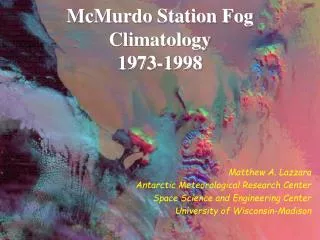
McMurdo Station Weather Office Presentation
Scarcity of data 1036 compared to 29
MET Operations From Raw Data to Operational Forecasts
Modeling Support 90km 10km 30km
Modeling Support Graphics provided by Mark W. Seefelt
Developmental Applications Increased Upper Atmospheric Data Adaptation - Microwave (SSMI) - Radar - Laser Lidar COSMIC
Developmental Applications Leo satellite combined with GPS to produce global atmospheric sounding information
Developmental Applications • NEW Generation: • NPOESS • Greater Resolution • Broader Swath • Greater Capabilities
Developmental Applications • NEW Generation: NPOESS • 3-D visualization
Developmental Applications • Assimilating Doppler Radar Data for model initialization
“Everyone talks about the weather but no one does anything about it.” Mark Twain Questions?