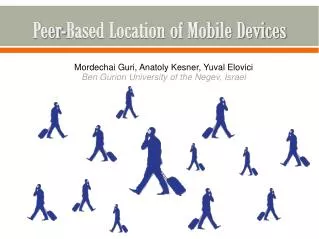
Peer-Based Location of Mobile Devices
100 likes | 281 Vues
Peer-Based Location of Mobile Devices. Mordechai Guri , Anatoly Kesner , Yuval Elovici Ben Gurion University of the Negev, Israel. Concept. Many web services use the user's location as input These services are becoming popular with the rise of smartphone popularity


Peer-Based Location of Mobile Devices
E N D
Presentation Transcript
Peer-Based Location of Mobile Devices Mordechai Guri, Anatoly Kesner, Yuval Elovici Ben Gurion University of the Negev, Israel
Concept • Many web services use the user's location as input • These services are becoming popular with the rise of smartphone popularity • The services trust the location reported by the user, which can be faked! • Solution: Validatethe user's location using trusted physically-nearby peers(other users) and stationary devices (e.g. Wi-Fi- routers)
Current Scheme Service provider asks for user location User computes location and sends result Service trusts the user's response to indicate the true location
Motivation • Location authentication for area-based coupons • Avoid feeding fabricated data to collective services, confusing traffic report services (e.g. Waze) • Reliable detection of phone/car/child location • A device without GPS capabilities will be able to locate itself using the assistance of nearby peers whose locations are known • In closed places such as buildings, or where GPS signals are blocked, device can utilize the peer-based technique to receive location information
Basic Algorithm • Basic Algorithm • - Service provider (SP) sends location request to client C who asks to be served • - The client then broadcasts location request (L) paired with temporary request code which distinguishes it from other requests from same or other devices, using a wireless interface • - Location request is received by surrounding devices (validators) • - Each validator estimates its own location, and sends the pair <code,location> to the requesting client • - Client calculates its location based on the received pairs and sends it back to the service
Secure Algorithm • Secure algorithm • - Devices Vi register as a validator and receives a unique ID and an encryption key (Dk) • - Client device C broadcasts a validation request containing a code, through short-range communication (e.g. WiFi, Bluetooth) • - Each Vi sends an encrypted response Rcontaining its self-estimated location and a timestamp • - Cpacks all validator responses and sends the package to the service provider • - Service provider decrypts the package, reliably identifies validators, validates their reports and deduces C's location according to them • - Cis now allowed to use the service
Implementation and Technology • Can be applied by: • Google Maps • iTunes • Waze • Foursquare • Much more... • Can use smartphone technologies: • Wi-Fi Direct • Wi-Fi Tethering • Wi-Fi networks: • Through wireless routers • Through wireless access points • Typical range of Bluetooth is too short
Current/Future Work • Implementing the validators on • Routers • Laptops • Portable devices • Wide range of mobile phone • Mathematical Analysis • Distribution Analysis • Security enhancements
Results: Network of devices and sensors, reliably serving as clients and as validators TRUSTED PEER-LOCATION SCHEME