Understanding the Use of Colons in Writing: Grammar Mini-Lesson #32
This mini-lesson on the colon explains its primary function of introducing explanatory elements, such as lists. A colon is used correctly when it follows a complete sentence and replaces phrases like "such as" or "for example." It is essential to avoid using a colon with linking verbs or incomplete sentences to maintain clarity and correctness in writing. Examples illustrate proper and improper uses of the colon to help learners grasp its application effectively.

Understanding the Use of Colons in Writing: Grammar Mini-Lesson #32
E N D
Presentation Transcript
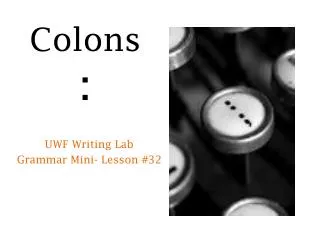
Colons: UWF Writing Lab Grammar Mini- Lesson #32
The colon is often used to introduce explanatory elements, often in the form of a list. The colon takes the place of such as, namely,or for example.
The colon must be preceded by a complete sentence. • Correct: I hate this one course: English. • Notice the full sentence before the colon. • Note that your list may include only one word. • Incorrect: One course that I hate: English is the course I am failing. • The statement preceding the colon is not a full sentence.
The colon takes the place of the following phrases: such as, for example, namely. Do not use these phrases in combination with the colon. Incorrect: Some mammals have no hair: namely, whales, porpoises, and bottle-nosed dolphins. Correct: Some mammals have no hair, namely, whales, porpoises, and bottle-nosed dolphins.
Do not use a colon after a linking verb, which connects the subject to the complement. Incorrect:The three parts of a chemistry course are: lecture, recitation, and laboratory. Correct: There are three parts to the chemistry course: lecture, recitation, and laboratory.