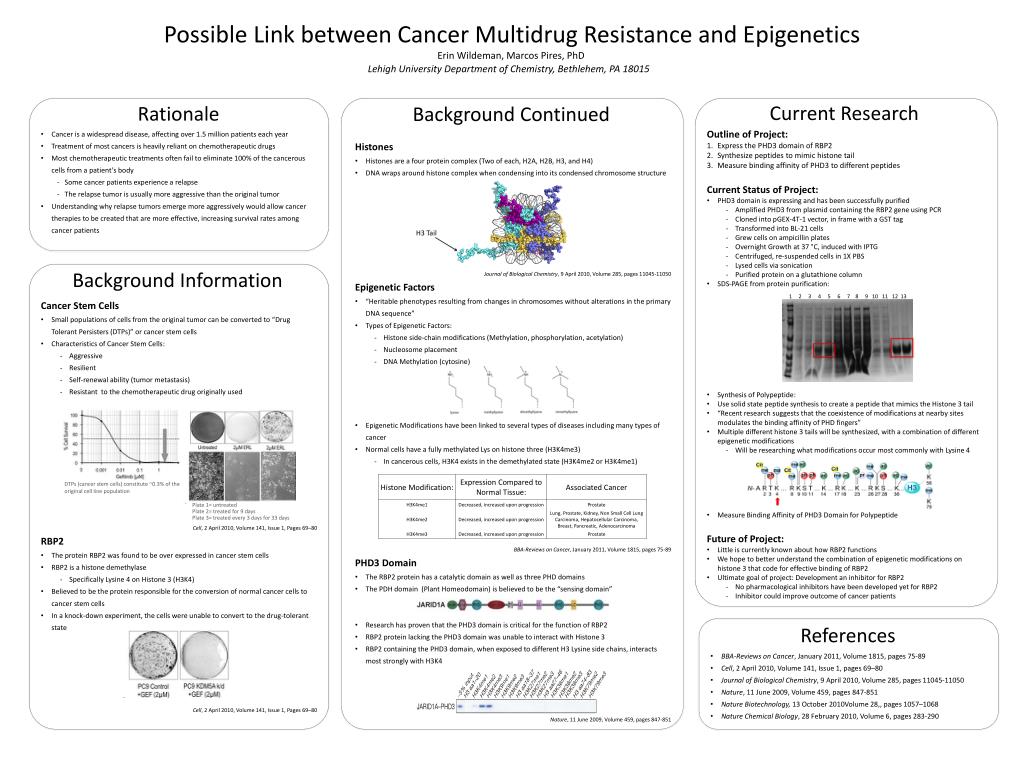
Possible Link between Cancer Multidrug Resistance and Epigenetics Erin Wildeman, Marcos Pires, PhD Lehigh University Department of Chemistry, Bethlehem, PA 18015 Current Research Background Continued Rationale Background Information • Outline of Project: • Express the PHD3 domain of RBP2 • Synthesize peptides to mimic histone tail • Measure binding affinity of PHD3 to different peptides • Current Status of Project: • PHD3 domain is expressing and has been successfully purified • - Amplified PHD3 from plasmid containing the RBP2 gene using PCR • - Cloned into pGEX-4T-1 vector, in frame with a GST tag • - Transformed into BL-21 cells • - Grew cells on ampicillin plates • - Overnight Growth at 37 °C, induced with IPTG • - Centrifuged, re-suspended cells in 1X PBS • - Lysed cells via sonication • - Purified protein on a glutathione column • SDS-PAGE from protein purification: • Synthesis of Polypeptide: • Use solid state peptide synthesis to create a peptide that mimics the Histone 3 tail • “Recent research suggests that the coexistence of modifications at nearby sites modulates the binding affinity of PHD fingers” • Multiple different histone 3 tails will be synthesized, with a combination of different epigenetic modifications • - Will be researching what modifications occur most commonly with Lysine 4 • Measure Binding Affinity of PHD3 Domain for Polypeptide • Future of Project: • Little is currently known about how RBP2 functions • We hope to better understand the combination of epigenetic modifications on histone 3 that code for effective binding of RBP2 • Ultimate goal of project: Development an inhibitor for RBP2 • - No pharmacological inhibitors have been developed yet for RBP2 • - Inhibitor could improve outcome of cancer patients • Cancer is a widespread disease, affecting over 1.5 million patients each year • Treatment of most cancers is heavily reliant on chemotherapeutic drugs • Most chemotherapeutic treatments often fail to eliminate 100% of the cancerous cells from a patient’s body • - Some cancer patients experience a relapse • - The relapse tumor is usually more aggressive than the original tumor • Understanding why relapse tumors emerge more aggressively would allow cancer therapies to be created that are more effective, increasing survival rates among cancer patients • Histones • Histones are a four protein complex (Two of each, H2A, H2B, H3, and H4) • DNA wraps around histone complex when condensing into its condensed chromosome structure • H3 Tail • Journal of Biological Chemistry, 9 April 2010, Volume 285, pages 11045-11050 • Epigenetic Factors • “Heritable phenotypes resulting from changes in chromosomes without alterations in the primary DNA sequence” • Types of Epigenetic Factors: • - Histone side-chain modifications (Methylation, phosphorylation, acetylation) • - Nucleosome placement • - DNA Methylation (cytosine) • Epigenetic Modifications have been linked to several types of diseases including many types of cancer • Normal cells have a fully methylated Lys on histone three (H3K4me3) • - In cancerous cells, H3K4 exists in the demethylated state (H3K4me2 or H3K4me1) • BBA-Reviews on Cancer, January 2011, Volume 1815, pages 75-89 • PHD3 Domain • The RBP2 protein has a catalytic domain as well as three PHD domains • The PDH domain (Plant Homeodomain) is believed to be the “sensing domain” • Research has proven that the PHD3 domain is critical for the function of RBP2 • RBP2 protein lacking the PHD3 domain was unable to interact with Histone 3 • RBP2 containing the PHD3 domain, when exposed to different H3 Lysine side chains, interacts most strongly with H3K4 • Nature, 11 June 2009, Volume 459, pages 847-851 • Cancer Stem Cells • Small populations of cells from the original tumor can be converted to “Drug Tolerant Persisters (DTPs)” or cancer stem cells • Characteristics of Cancer Stem Cells: • - Aggressive • - Resilient • - Self-renewal ability (tumor metastasis) • - Resistant to the chemotherapeutic drug originally used • Cell, 2 April 2010, Volume 141, Issue 1, Pages 69–80 • RBP2 • The protein RBP2 was found to be over expressed in cancer stem cells • RBP2 is a histone demethylase • - Specifically Lysine 4 on Histone 3 (H3K4) • Believed to be the protein responsible for the conversion of normal cancer cells to cancer stem cells • In a knock-down experiment, the cells were unable to convert to the drug-tolerant state • Cell, 2 April 2010, Volume 141, Issue 1, Pages 69–80 References • BBA-Reviews on Cancer, January 2011, Volume 1815, pages 75-89 • Cell, 2 April 2010, Volume 141, Issue 1, pages 69–80 • Journal of Biological Chemistry, 9 April 2010, Volume 285, pages 11045-11050 • Nature, 11 June 2009, Volume 459, pages 847-851 • Nature Biotechnology, 13 October 2010Volume 28,, pages 1057–1068 • Nature Chemical Biology, 28 February 2010, Volume 6, pages 283-290 DTPs (cancer stem cells) constitute ~0.3% of the original cell line population Plate 1= untreated Plate 2= treated for 9 days Plate 3= treated every 3 days for 33 days 1 2 3 4 5 6 7 8 9 10 11 12 13