Download
1 / 28
280 likes | 405 Vues
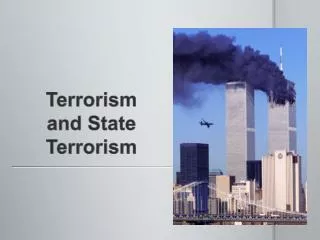
The terror attacks of September 11, 2001, profoundly transformed American law and government policies, particularly in the context of national security. In response to the threat of terrorism, President Bush and Congress enacted the USA PATRIOT Act, which expanded the powers of agencies like the CIA and FBI to conduct surveillance and detain suspects. This legislation raised critical questions about the balance between security and civil liberties, prompting challenges from civil rights groups. The events of 9/11 have ignited debates on how much freedom Americans are willing to sacrifice for security.

E N D
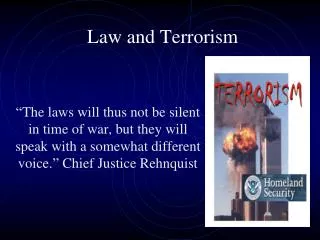
Chapter 17 Law and Terrorism
Introduction: The terror attacks of 9-11 change America
Introduction: The terror attacks of 9-11 change America • President Bush/Congress passed laws & policies to respond to the threat of terror
Introduction: The terror attacks of 9-11 change America • President Bush/Congress passed laws & policies to respond to the threat of terror • CIA, FBI, other agencies have become involved in the “War on Terror”
Introduction: The terror attacks of 9-11 change America • President Bush/Congress passed laws & policies to respond to the threat of terror • CIA, FBI, other agencies have become involved in the “War on Terror” • Civil liberties groups have challenged many of these acts and Presidential actions
Introduction: The terror attacks of 9-11 change America • President Bush/Congress passed laws & policies to respond to the threat of terror • CIA, FBI, other agencies have become involved in the “War on Terror” • Civil liberties groups have challenged many of these acts and Presidential actions • Sometimes in a free society, things get a bit messy
I. The Law in times of War • USA Patriot Act (2001); intended to combat terrorism by tracing the sources of money that fund terrorism
I. The Law in times of War • USA Patriot Act (2001); intended to combat terrorism by tracing the sources of money that fund terrorism • finding and detaining terrorists
I. The Law in times of War • USA Patriot Act (2001); intended to combat terrorism by tracing the sources of money that fund terrorism • finding and detaining terrorists • intercepting communications among terrorist groups
I. The Law in times of War • USA Patriot Act (2001); intended to combat terrorism by tracing the sources of money that fund terrorism • finding and detaining terrorists • intercepting communications among terrorist groups • Expanded the power of the CIA, FBI, Department of Justice
I. The Law in times of War • USA Patriot Act (2001); intended to combat terrorism by tracing the sources of money that fund terrorism • finding and detaining terrorists • intercepting communications among terrorist groups • Expanded the power of the CIA, FBI, Department of Justice • enabled agencies to track communications on the internet, install phone/computer wiretaps, access personal, medical, financial information
Patriot Act raised certain questions • How much freedom are we willing to give up in return for increased security?
Patriot Act raised certain questions • How much freedom are we willing to give up in return for increased security? • Does the Patriot Act infringe on civil rights guaranteed in the Constitution?
Patriot Act raised certain questions • How much freedom are we willing to give up in return for increased security? • Does the Patriot Act infringe on civil rights guaranteed in the Constitution? • Civil War; Lincoln suspends writ of habeas corpus
Patriot Act raised certain questions • How much freedom are we willing to give up in return for increased security? • Does the Patriot Act infringe on civil rights guaranteed in the Constitution? • Civil War; Lincoln suspends writ of habeas corpus • WWII, Japanese are interred as war fears rise
Patriot Act raised certain questions • How much freedom are we willing to give up in return for increased security? • Does the Patriot Act infringe on civil rights guaranteed in the Constitution? • Civil War; Lincoln suspends writ of habeas corpus • WWII, Japanese are interred as war fears rise • WWI, US restricts American’s free speech and forbids criticizing US government
Questions for you… • Is the war on terrorism similar to other wars when rights have been restricted? How is it different? • Assume you were the President on 9-11, What special powers would you want? • Assume you were the leader of a civil liberties organization. What civil rights would you fight hardest to protect?
II. Surveillance and Searches • Since 9-11, US has more power to conduct searches and surveillance
II. Surveillance and Searches • Since 9-11, US has more power to conduct searches and surveillance • Passengers in airports subject to more detailed searches
II. Surveillance and Searches • Since 9-11, US has more power to conduct searches and surveillance • Passengers in airports subject to more detailed searches • broader power to intercept Internet/phone communications it believes to be engaged in terror related activities
Foreign Intelligence Surveillance Act Court • Everything is kept secret
Foreign Intelligence Surveillance Act Court • Everything is kept secret • can authorize wire taps, even if there isn’t probable cause
Foreign Intelligence Surveillance Act Court • Everything is kept secret • can authorize wire taps, even if there isn’t probable cause • Originally set up in 1978 to gather foreign intelligence - not for domestic crimes
Foreign Intelligence Surveillance Act Court • Everything is kept secret • can authorize wire taps, even if there isn’t probable cause • Originally set up in 1978 to gather foreign intelligence - not for domestic crimes • Supreme Court has ruled evidence gathered as a result of this court’s authorization to be used in criminal trials
Foreign Intelligence Surveillance Act Court • Everything is kept secret • can authorize wire taps, even if there isn’t probable cause • Originally set up in 1978 to gather foreign intelligence - not for domestic crimes • Supreme Court has ruled evidence gathered as a result of this court’s authorization to be used in criminal trials • In some cases (under the Patriot Act) the government can postpone notifying people whose premises has been searched until after the search
Problem 17-3 • On a scale of 1 to 5 (1=strongly agree), indicate where you stand on the following • “In a time of heightened concern about domestic terrorism and national security, the government should be allowed to do whatever it believes is necessary to uncover and arrest terrorists • Same scale, answer the following… • Look at everyone’s email at work…home • Install surveillance cameras on the street • Check travel records of people coming into the country
The End Chapter 17, part 1