Enhancing Urban Planning Participation: Insights from Brussels Neighborhood Contracts
140 likes | 262 Vues
This report explores innovative strategies for fostering citizen involvement in urban planning through neighborhood contracts in Brussels. It highlights the initial proposals and indispensable adjustments needed for effective public participation. The focus is on identifying the needs of both citizens and planners, refining local partnerships, and developing learning materials to facilitate engagement. By utilizing diverse approaches such as digital city modeling and interactive design, the report aims to promote a more inclusive and flexible urban development process that emphasizes collaboration and effective communication between community stakeholders.


Enhancing Urban Planning Participation: Insights from Brussels Neighborhood Contracts
E N D
Presentation Transcript
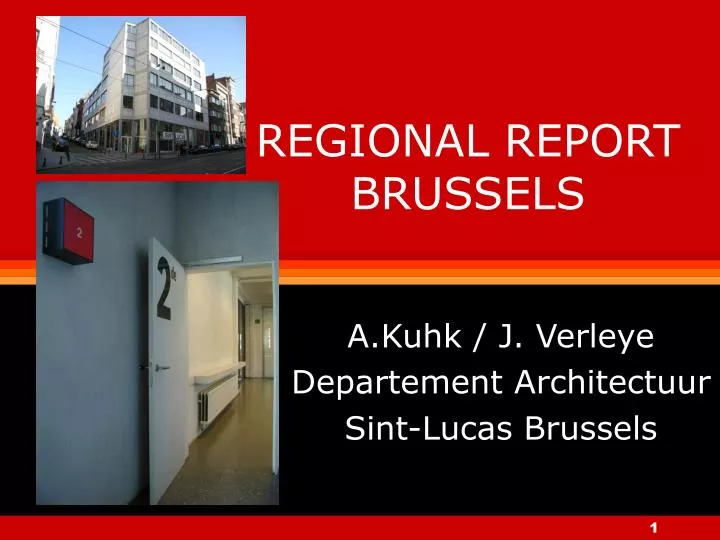
REGIONAL REPORTBRUSSELS A.Kuhk / J. Verleye Departement Architectuur Sint-Lucas Brussels
introduction • Neighbourhood contracts • The initial proposal • Indispensableadjustments
topics of discussion • theme / local pilot project selection • review of public theory and practice • identification of citizens and planners needs for public participation • revision/consolidation of local partnerships • development of learning material • preparation of LCC set-up
theme / local pilot project selection • Different options: • Neighbourhood contracts • Sites of regional importance • (“lever zones”) • Sites under dispute • Solution: pilot and test-cases
neighbourhood contracts • Housing and real estate • Public Spaces • Social Action shared investments (municipality, region, state, PPS)
review of public theory and practice Theory and practice of participation in urban planning: • cyclical, not necessarily cumulative, • empowerment, advocacy, social learning, comunicative action….mostly bottom-up approaches, • main focus: citizens and planners, • interesting: degrees of participation. [Phd A.Kuhk Co-production in urban planning: Metropolitan Governance in BCR]
participants in urban planningin BCR [Phd A.Kuhk Co-production in urban planning: Metropolitan Governance in BCR]
citizens and planners needs Municipality Réseau Habitat PSAC Others Minimal composition of LCID: inhabitants (8) different associations and voluntary groups (2) representatives of municipal administrations (3) Public Social Assistance Centre (C.P.A.S./O.C.M.W.). (1) representatives of regional administrations (2) various local actors (4) and representatives of communities (2) Local Commission for integrated Development French speaking Flemish Inhabitants Municipality Actors of local development : inhabitants, traders, associations, ...
citizens and planners needs A brief reaction on the questionnaires: • frame for respondents • selection of respondents • translation and local differencesdefining key concepts • questions(answers according to social desirability, motivation and backgrounds, specification, questions about alternative tools) • control questions as check-up of understanding
revision/consolidationof local partnerships Particular attention is drawn to questions of: • Involvement of umbrella organisations, • Involvement of municipal and regional authorities, • Continuous involvement of citizens, • Non-organised inhabitants and different ethnic groups (different language groups also), • Changes of the planning team in different phases of case development.
development oflearning material • Tool development: 3D CAAD models, web and projector applications, • Training development: Distance learning modules, direct evaluation from citizens and planners, info-participation centres and self-management in connection to LCC and community centres • Relevance: innovative tool development more flexible urban debate higher acceptance of design solutions
How to communicate design for neighbourhoods in change? Combine available techniques: digital city modelling, GIS information projection, rapid prototyping scale models, interaction and interface design, multimedia links and connection to image-databases With attention for following requirements: reliable, accessible, easy to learn and non-intimidating. relating the people to important proposed changes in their everyday surroundings, pulling down knowledge boundaries Resulting in a double interface: web and projector application for private and public use PROTOTYPE DEVELOPMENT [M. Stellingwerff, Involving the end-user through low threshold interactive design presentation]
Concluding [Development: Dag Boutsen and Annette Kuhk]