Exploring Geologic Time and the Fascinating World of Fossils
Discover the intricate world of fossils, preserved remains of living organisms found in sedimentary rocks. From petrified specimens to carbon films and trace fossils, each type reveals unique insights into Earth's history and biodiversity. Learn about the role of paleontologists in studying these ancient records and how fossils provide evidence of life's evolution, past climates, and chronological geological events. Understand methods like relative and absolute dating, including the law of superposition and radioactive dating, to uncover the ages of rocks and fossils.

Exploring Geologic Time and the Fascinating World of Fossils
E N D
Presentation Transcript
Fossils • Preserved remains of living things • Formed in sedimentary rock • Paleontologist – One who studies fossils hms-beagle.com
Kinds of Fossils • Petrified • Mold and Cast • Carbon Film • Trace Fossil • Preserved Remains topnews.in
Petrified • Organism dies and is covered by sediment • Water with minerals seep into space • Minerals replace all or part of organism statesymbolsusa.org
More Petrified Samples pdphoto.org
Mold and Cast • Most common type of fossil • Two part process Mold then Cast • Mold • Organism dies and is covered by sediment • Hollow area created where organism was • Cast • Minerals or sediment fill mold of organism and solidify • Copy of shape of organism
Mold and Cast petrifiedwoodmuseum.org
Carbon Film • Organism dies, covered by sediment • Thin coating of carbon left on rock • Finely detailed biosci.ohio-state.edu
Trace Fossil • Evidence of organisms activities • Not actual organism • Examples • Footprints • Burrow • Trail http://www.pdphoto.org
Preserved Remains • Organism is preserved in some material • Tar • Rancho La Brea Tar Pits • Amber • Hardened sap from tree • Frozen • Woolly Mammoth found in glacier http://www.dailytelegraph.com.au
Uses for Fossils • Evidence of history of life on Earth • What appeared when/chronological record • Evidence for how life has changed over time • How organisms evolved • Evidence of past climate • What was Earth’s climate like and how has it changed
Aging Rocks • Relative Age • A comparative age between other known ages • Relates to age of surrounding rocks • Younger than, older than, etc. • Absolute Age • Indicates the number of years since rocks formation • Based off age of radioactive isotopes and their half lives
Clues to Ages of Rocks • Law of superposition • Igneous rock • Faulting • Index Fossils prehistoricplanet.com
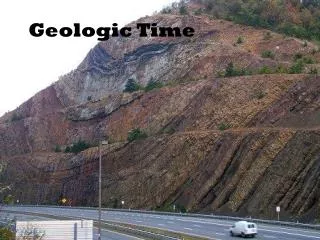
Law of Superposition • Horizontal sedimentary rock • Oldest rock at the bottom • Each higher layer younger cosscience1.pbworks.com
Igneous Rock • Intrusion • Hardens underground • Younger than rock around or beneath it • Rock around it had to be there already to form • Extrusion • Hardens on the surface • Rock below extrusion is older • Rock had to be there already to form on
Which is Oldest/Newest? en.wikibooks.org
Index Fossil • Helps determine relative age of rock • Widely distributed organism • Organism existed for a short duration • Match rock layers geology.ohio-state.edu
Gaps in Geologic Record • Unconformity • Gap in geologic record • Older layer touches newer layer where middle layers are missing • Does not conform to the law of superposition lams.slcusd.org
Radioactive Dating • Using radioactive decay of material to determine age of material • Only good on igneous rock, why? • Unstable atoms decompose to form new atoms of different element • Carbon – 14 Nitrogen – 14 • Potassium 40 Argon - 40
Half Life • Rate at which radioactive elements decay • Amount of time for half of atoms to decay visionlearning.com
Age of the Earth • 4.6 Billion Years Old • Based off of Earth and Moon being roughly same age • Moon rock age at 4.6 byo • Oldest Earth rock known ~ 4 billion years old
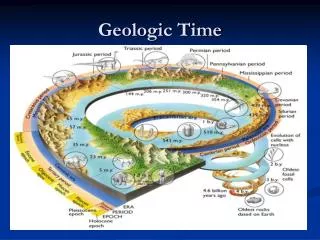
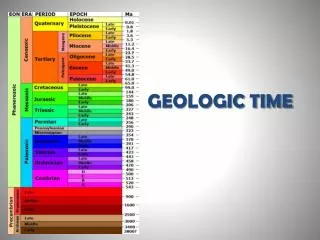
Geologic Time Scale • Divide geologic time into units • Precambrian time and 3 Eras • Eras are divided into periods • Periods are divided into epochs
Precambrian Time 544 mya – 4.6 bya • 3.5 bya earliest fossils of life • Single-celled organisms similar to bacteria • 2.5 bya earliest photosynthesis • Produce atmosphere of oxygen sleepingdogstudios.com
Paleozoic Era 245 mya – 544 mya • Paleo = ancient or early • Zoic = life • Life explodes in Cambrian Period (invertebrates) • Life reaches land • Silurian Period – plants • Devonian Period – animals • Mass extinction 95% life in oceans disappeared • Do not know cause http://www.palaeos.org
Mesozoic Era 66.4 mya – 245 mya • Meso = middle • Age of the dinosaur • Mammals appear • Pangaea begins to break up • Land organisms diversify • Flying reptiles • Flowering plant • Mass extinction at end • Meteor hits Earth at Yucatan Peninsula dinosaurland.com
Cenozoic Era present – 66.4 mya • Ceno = recent • Age of mammals • With dinosaur extinction rapid radiation of mammals occupying new niches • Earth’s climate was warm then cooled (Ice age) • Homo sapiens ~100,000 years ago oceanleadership.org