Cloning
Cloning, a biological process, produces genetically identical individuals naturally, seen in asexual reproduction of various organisms like bacteria, insects, and plants. In biotechnology, cloning involves creating copies of DNA fragments, cells, or entire organisms. The first mammal cloned from an adult cell was Dolly the Sheep, a Finn Dorsett ewe, born in 1996. Human cloning refers to making identical copies of humans, typically discussed in terms of therapeutic and reproductive cloning. This overview explores the scope of cloning in nature and technology.

Cloning
E N D
Presentation Transcript
Cloning Created by Maria Babkova 11 A form 2009
What is cloning? Cloning in biology is the process of producing populations of genetically-identical individuals that occurs in nature when organisms such as bacteria, insects or plants reproduce asexually. Cloning in biotechnology refers to processes used to create copies of DNA fragments (molecular cloning), cells (cell cloning), or organisms. More generally, the term refers to the production of multiple copies of a product such as digital media or software.
More generally, the term refers to the production of multiple copies of a product such as digital media or software.
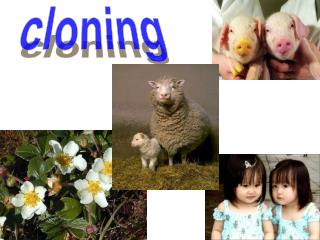
Dolly the Sheep Dolly (1996-07-05 – 2003-02-14), a Finn Dorsett ewe, was the first mammal to have been successfully cloned from an adult cell, though the first actual thing to be cloned was a tadpole in 1952[1].
She was cloned at the Roslin Institute in Scotland and lived there until her death when she was six. On 2003-04-09 her stuffed remains were placed at Edinburgh's Royal Museum, part of the National Museums of Scotland.
Human cloning Human cloning is the creation of a genetically identical copy of an existing or previously existing human. The term is generally used to refer to artificial human cloning; human clones in the form of identical twins are commonplace, with their cloning occurring during the natural process of reproduction. There are two commonly discussed types of human cloning: therapeutic cloning and reproductive cloning.