Importance of Formality in Ontological Foundations for Semantic Medicine Web
This workshop discussed the relevance of formal correctness and ontological precision in developing the Semantic Web for Medicine. Examples using standards like OWL-DL and OBO were explored, highlighting the importance of clear definitions and accurate inferences. The session emphasized the need for a strong ontological foundation to avoid unintended models and inadequate machine reasoning.

Importance of Formality in Ontological Foundations for Semantic Medicine Web
E N D
Presentation Transcript
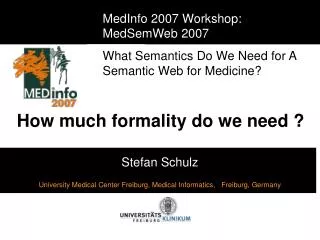
MedInfo 2007 Workshop: MedSemWeb 2007 What Semantics Do We Need for A Semantic Web for Medicine? How much formality do we need ? Stefan Schulz University Medical Center Freiburg, Medical Informatics, Freiburg, Germany
Example • Using Semantic Web standards (OWL-DL) • Using Biomedical Ontology standards (OBO) • Terminological Inference
Classes • Amino Acid • Protein • Aminoaciduria • Proteinuria
Relations (OBO RO) • hasPart / partOf(parthood in a broad sense):relates continuants • hasLocation / locationOfrelates continuants or occurrents with continuants • transitive, reflexive, antisymmetric
Description Logic • Subsumption ⊑ • Equivalence ≡ • Existential quantification • Conjunction ⊓ • transitive roles
Axioms • Protein⊑hasPart.AminoAcid • Aminoaciduria≡Disorder ⊓ • hasLocation.(Body ⊓ • hasPart.(PortionOfUrine ⊓ • hasPart.AminoAcid)) • Proteinuria≡Disorder ⊓ • hasLocation.(Body ⊓ • hasPart.(PortionOfUrine ⊓ • hasPart.Protein))
false! Inference Proteinuria⊑Aminoaciduria (since Proteins have Amino Acids as parts, and partOf is transitive) • Is this error due to formal underspecification ? • Is hasPart not always transitive?
Formal correctnessbut ontological sloppyness AminoAcid: hidden ambiguity: • AminoAcidSingleMolecule • AminoAcidResidue • AminoAcidSingleMoleculeCollection • AminoAcidSingleMoleculeCollectionLowConc • AminoAcidSingleMoleculeCollectionHighConc
Corrected Axioms • Aminoaciduria≡Disorder ⊓ • hasLocation.(Body ⊓ • hasPart.(PortionOfUrine ⊓ • hasPart.AminoAcidSingleMoleculeCollectionHighConc)) • Proteinuria≡Disorder ⊓ • hasLocation.(Body ⊓ • hasPart.(PortionOfUrine ⊓ • hasPart.ProteinMoleculeCollectionHighConc))
Formal Correctness assures consistency Ontological Correctness assures adequacy Two sides of the same coin
Conclusion • Even little formality must be rooted in a correct ontological foundation to prevent unintended models with inadequate inferences • If we do not know exactly what we are formalizing we cannot rely on machine reasoning. In this case we should give preference to informal, thesaurus-like knowledge representations