Analyzing Telecommunications Antenna Design for Spacecraft Missions
This report discusses the telecommunications requirements for a spacecraft, focusing on the design and analysis of a conical log spiral antenna. Key parameters include a receive band of 7.2 GHz (X-band) and transmit frequency of 8.5 GHz. The comparison between solid-state amplifiers (SSA) and traveling wave tube amplifiers (TWTA) highlights the benefits of SSA, including lower mass, reliability, and reduced voltage requirements. The total mass for telecommunications equipment is 9.988 kg, with a power consumption of 66.3 W, and field of view considerations for star tracker antennas.

Analyzing Telecommunications Antenna Design for Spacecraft Missions
E N D
Presentation Transcript
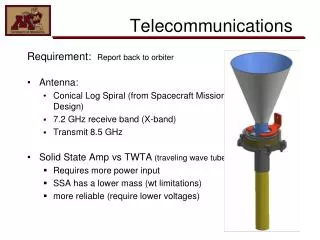
Telecommunications Requirement: Report back to orbiter • Antenna: • Conical Log Spiral (from Spacecraft Mission Analysis and Design) • 7.2 GHz receive band (X-band) • Transmit 8.5 GHz • Solid State Amp vs TWTA (traveling wave tube amp): • Requires more power input • SSA has a lower mass (wt limitations) • more reliable (require lower voltages)
Telecommunications Total Mass: 9.988 kg Total Power: 66.3W
Field of View Star Tracker Antenna 0.60m apart 0.30 + 0.27 = 0.57m