Download
1 / 41
410 likes | 554 Vues
This piece explores the continuous reinforcement of Western ideologies and power of capital in the decisions made by the International Monetary Fund (IMF), World Bank (WB), and World Trade Organization (WTO). It discusses the origins, structure, and functions of these Bretton Woods institutions, particularly their voting systems favoring wealthier nations. It examines the criticisms of their neoliberal policies and the implications for developing countries. The impact of the 2008 financial crash on development strategies is also analyzed, highlighting the need for reforms to support equitable global development.

E N D
World System Theory: • WST argument: • AIC’s ideology and power of capital are continually being reinforced in the decisions of the IMF, WB and WTO in order to maintain their core status. • http://www.youtube.com/watch?v=tiav0V_F0bk • On song dynamite
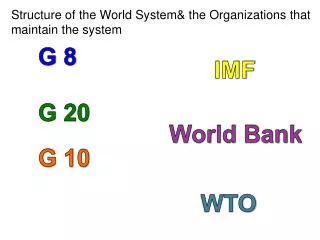
Bretton Woods Institutions: 1944 • Multilateral bodies: • IMF • World Bank (IBRD)
What is IMF expected to establish globally? • Global: • monetary cooperation • exchange rate stability • trade expansion as lender of last resort • - Lends to correct balance of payment deficits
From where does IMF get its money? • Subscriptions from member countries ‘Quota’ (capital) that they pay when they join the IMF • What do Quotas determine? • Countries’ payments • Voting power • How much they can borrow • e.g.: U.S. has 16.76 %, Seychelles is 0.03 % of quotas (2011) http://www.imf.org/external/np/sec/memdir/members.aspx, oct 22, 2011
Who are IMF’s members? • 188 countries (2012) - 44 original members. • http://www.imf.org/external/about/members.htm • Why are Western countries more powerful in IMF? • Western powers control through their voting majority in the Executive Board (EB). • EB members have larger monetary share. • EB votes affirming the will of the US or Europeans.
8 In 2012 http://www.imf.org/external/about/members.htmaccessed Oct 2011
http://www.imf.org/external/np/sec/memdir/eds.aspx (Oct 22, 2011) Appointed IMF Executive Directors and Voting Power - Top 5 members in voting power :
Criticisms of IMF & WB: Washington Consensus and neoliberal policies imposed on DW by IMF & WB have been discredited (#7 Birdsall & Fukuyama). To remedy the impact of 2008 global financial crash on developing countries, UN and development economists have offered policies that have been misdirected (DW #8 Easterly) Although the West’s influence is diminishing (DW#6:Mahubani), the status quo is maintained in development policies due to the disproportionate power of Rich countries in WTO, IMF & WB.
Some countries in IMF Executive Board & their voting power: % SDR Quota % of Votes USA 17.09 16.77 Japan 6.576.24 China 4.003.81 Canada2.68 2.56 India 2.45 2.34 Mexico 1.521.47 SDR: Special Drawing Rights "http://www.imf.org/external/np/sec/memdir/members.htm#3", IMF. Retrieved on 2011 -Oct 22
% Gains in Quota for EMCs http://www.imf.org/external/mmedia/view.asp?eventID=1153 (accessed 16 Oct 2009) http://www.imf.org/external/mmedia/view.aspx?vid=79161031001accessed oct 22 2011 Video on voting structure
Susan George: http://www.youtube.com/watch?v=NQ952ba75Yk&feature=related 7min 2011
Bretton Woods Institutions: 1944 • Multilateral bodies: • IMF • World Bank (IBRD group)
The World Bank: a Bretton Woods institution (1944) • Original aim: post-war reconstruction of Europe • First loan of $250 million was to France (1947) • What is its aim today? • Reconstruction is WB’s important focus • Natural disasters, • Humanitarian emergencies • Post-conflict rehabilitation needs.
The World Bank • Owned by member countries • Voting power related to members’ capital subscriptions • Quota is based on a country’s relative economic strength • Raises most funds in financial markets • IBRD sells AAA rated bonds and other debt • securities • Charges interest that reflects its low-cost borrowings in capital markets
IBRD: 188 members (2012) • World Bank provides long-term development loans to LDCs • IBRD’s Board : 24 Executive Directors. • 5 Exec Directors: appointed by the 5 largest shareholders (the US, Japan, Germany, France and the UK). • 19 Exec Directors : elected by the Bank's other members.
The “World Bank Group” 1966 1944 1960 1956 1988
International Development Association (IDA) • Established 1960 to provide concessional assistance to countries unable to borrow at commercial rates • What does IDA do? (March 2011) • Gives grants and interest free loans • Borrowers pay 1% administration fee • 52 countries contribute to funding ($49.3bil) • $12.6 billion – grants and loans to Africa and South Asia, in education, health, social services, water and sanitation. • http://www.worldbank.org/ida/ida-factsheet.pdfoct 22, 2011
source for WB info: Check out this Link for WB & IDA www.fieo.org/uploads/files/file/FIEOAug3020121.ppt
Mission Help developing countries and their people reach the Millennium Development Goals by working with our partners to alleviate poverty.
New IDA Lending by Region: • Sub-Saharan Africa...........43%South Asia...........................39%East Asia/Pacific..................10%Europe/Central Asia...............4%Latin America/Caribbean........3%Middle East/North Africa.........1% http://www.worldbank.org/ida/ida-financing.html
WTO: AICs commercial interests are embodied in the rules global trade, aid and loan imposed on the LDCs : • WTO works on power-based bargaining • Neoliberal policies • Washington consensus • SAP • Conditionality • MFN
Wto p1 6.36 min http://www.youtube.com/watch?v=aOE7Ve06tXA&feature=fvwrel http://www.youtube.com/watch?NR=1&v=HbwZhCfO2GQ&feature=fvwp wto p 2 6.45 min
World Trade Organization (WTO) • ( for expanding free trade) • It oversees and regulates: • Global trade balance • Monetary stability
WTO works on power-based bargaining • What do poor countries face? • Agricultural Protectionism • High Tariffs on Labour intensive goods • Anti-dumping • What do Rich countries reject? • Opening AICs’ agri market • Access to cheaper medicines • Lowering industrial tariff
WTO (cont’d) • From 1995-2010, declarations of WTO have not advanced the trade related development in LDCs • AICs rejected G-21 demand to cut their agri subsidies/ tariff barriers • Widening disagreements between the rich and poor countries
Subsidies per Head per Year (in U.S. $) 2006 http://www.foreignpolicy.com/story/cms.php?story_id=3547&page=5
Unequal trade relations: • Tariff barriers • Non Tariff barriers
Burkina Faso Cotton Production: Shares of Farmers Unions, French Holding company & the State
Burkina Faso cotton growers protest low prices, Apr 28, 2011 http://af.reuters.com/article/topNews/idAFJOE73R06L20110428
Davos: • World Economic Forum (WEF) – founded in 1971 by K.M. Schwab, a Swiss prof. • Annual meetings in Davos, Switzerland • Membership: top leaders in business & politics: Presidents, PMs, Trade Ministers - a business forum - the richest businesses negotiate deals and lobby powerful politicians • What would be their real objective? • profit-making? • or • solving economic problems such as poverty?
WTO: AICs commercial interests are embodied in the rules global trade, aid and loan imposed on the LDCs : • WTO works on power-based bargaining • Neoliberal policies • Washington consensus • SAP • Conditionality • MFN
What are the Neoliberal policies? DOPE LD • Liberalize trade • Deregulate finance/currency • Open up for foreign investment, • Privatize economy • Deregulate commercial activity • Ensure property protection
WTO: AICs commercial interests are embodied in the rules global trade, aid and loan imposed on the LDCs : • WTO works on power-based bargaining • Neoliberal policies • Washington consensus • SAP • Conditionality • MFN
WASHINGTON CONSENSUS • Liberalization • Austerity • Privatization • De-regulation • LAPDog
WTO: AICs commercial interests are embodied in the rules global trade, aid and loan imposed on the LDCs : • WTO works on power-based bargaining • Neoliberal policies • Washington consensus • SAP • Conditionality • MFN
How does Structural Adjustment Program (SAP) affect the Developing countries? • Impact: • Balancing the government budget • Weakening the Labour • Deregulating the economy • Reducing the State • BLeeDS • IMF’s imposition of SAP on Asian countries created a financial crisis of economic contraction and depression.
WTO: AICs commercial interests are embodied in the rules global trade, aid and loan imposed on the LDCs : • WTO works on power-based bargaining • Neoliberal policies • Washington consensus • SAP • Conditionality • MFN
Conditionality: • Conditions placed on loans to LDCs • Conditions imposed to make aid effective in a recipient country – in reality could hurt the country’s economy or the country’s political stability
WTO: AICs commercial interests are embodied in the rules global trade, aid and loan imposed on the LDCs : • WTO works on power-based bargaining • Neoliberal policies • Washington consensus • SAP • Conditionality • MFN
Most favored nation status (MFN) • An agreement between two nations to levy tariffs on each other at rates as low as those levied on any other country. • If one of these nations reduces tariffs on a third country, all of that nation's MFN partners also receive that lower tariff rate.