### The Restoration Era: Civil War, Cromwell, and the Rise of the Stuarts (1660-1798) ###
The Restoration Era (1660-1798) marks a pivotal period in English history, characterized by the return of Charles II after a decade of Puritan rule under Oliver Cromwell. Rising tensions during Charles I's reign led to civil war and Cromwell’s authoritarian governance. Following Cromwell's death, Charles II ascended the throne, ushering in a more relaxed and vibrant England, restoring the Anglican Church as the state religion. This period also saw significant events such as the Great Plague of 1665 and the Great Fire of 1666, shaping the future political landscape with evolving power struggles between monarchy and Parliament. ###

### The Restoration Era: Civil War, Cromwell, and the Rise of the Stuarts (1660-1798) ###
E N D
Presentation Transcript
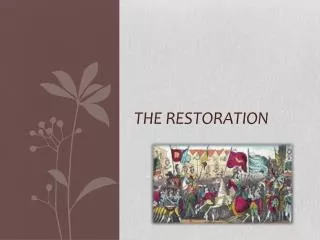
The Restoration 1660-1798
Charles I • Previous religious tensions worsen when King James’ son, Charles I, takes the throne. • People were hostile toward Charles I due to his: • Contempt for Parliament • Belief in the divine right of kings • Extravagance with money
Parliament • Charles dismissed Parliament in 1629 and did not summon them again for 11 years. • During the 11 years without Parliament, he took strong measures against his political opponents which led to more unrest. • Thousands of English citizens who were unhappy with Charles’ rule, emigrated to North America.
Parliament • When Scotland was in open rebellion against King Charles I, he had to summon Parliament in order to raise the money needed to address the situation. • Parliament used the meeting to strip him of much of his power. He resisted and the country was thrown into civil war.
Civil war • Royalists (support the monarchy) versus the Puritans (support the Parliament) • Puritans defeated the Royalists in 1645 and the king surrendered a year later (king was executed) • Oliver Cromwell (leader of the Puritans) was named ‘Lord Protector’ for life and ran the country much like a king
England under cromwell • Very strict rules • Theatres were closed • Most recreation was suspended • Sunday was a day of prayer – even a walk for pleasure was forbidden • Cromwell’s son, Richard, takes over after his death in 1658. • In1660 a new Parliament put Charles II in control. His rise to power begins The Restoration.
The monarchs of the restoration Stuarts and Hanovers
The restoration 1660-1798 • End of grim Puritan rule (Cromwell) and on to a more fun, relaxed England with the Stuart court (King James’ bloodline) • England returns the Anglican church as the state religion • Understanding that monarchs must share their power with Parliament
Charles ii • Major events that led to the people of England winning more power in the government: • Great plague of 1665 • Great fire of 1666
Great Plague of 1665 • Early spring in 1665 showed a rise in plague deaths in poor sections – authorities ignored • By the hot summer it was so bad people were panicking. • Called the Black Death due to the black sores • Also called Bubonic Plague • Came from fleas on rats but people believed in came from cats and dogs • Around 65,000-100,000 died in and around London • Anyone who could flee London, fled; many were not allowed without a certificate of health
Great Fire of 1666 • Began in a bakeshop and spread rapidly though the city • 80% of the city was destroyed • Plague diminished because so many rats died
Political factions • Tories - support royal authority • Whigs – want to limit royal authority
Glorious/Bloodless Revolution • Charles was succeeded by his brother, James II, in 1685. • James II was disliked for many reasons, one being that he wanted to restore England to the Catholic church. • People were very suspicious of the Catholics – believed they started the Great Fire • He was replaced with his daughter, Mary, and her husband, William of Orange.
King William • James had supporters in Ireland but they were defeated by William’s military. • King William began a series of wars with France in order to keep the French from expanding their territory to Holland.
Queen anne • Anne, daughter of James II, succeeded William and united England with Scotland to form Great Britain. • War with France continues although Anne opposed it. • Anne was generally considered a bit dull and uninteresting but was a stable ruler. • Anne is the last of the Stuart house.
House of hanover • Sometimes called the Georgian Era because the first four were named George • George I, distant cousin to Anne, takes the throne in 1714. • George was German and did not speak English. • He relied heavily on his advisors, specifically Robert Walpole, who was eventually the first to hold the title Prime Minister.
labels of this period • The Restoration • The Enlightenment • The Age of Reason • The Augustan Age • The Neoclassical Period
enlightenment/ age of reason • Philosophical movement • Order, balance, logic, reason, factual information, science - main ideas • People strongly believed in approaching all issues –everything from politics to farming-logically and with reason. • With this mindset, religion became a less emotional issue.
neoclassical • People were generally more familiar with classic Latin literature than with modern English literature • Many writers of this time period modeled their writing after ancient Roman literature • Neoclassic means ‘new classics’
Neoclassic writers • Stressed reason and common sense • Wrote about objective issues that concerned society as a whole such as politics and religion • Maintained traditional standards • Followed formal rules and diction in poetry • Focused on adult concerns – primarily of the upper class
Neoclassical poets • Looked at poetry in a very realistic, practical way – wrote from their heads, not their hearts • Poetry was carefully and artificially constructed with exact meter and rhyme and fit perfectly into the type of poem the poet was focusing on • Avoided emotion and spontaneity – every word was carefully chosen
Neoclassical poets • Elegy – said only nice things about a person who passed away • Ode – dignified, serious poem written for a certain occasion or object • Satire – makes fun of a person, event, idea using exaggeration (LOTS more about this later)
literature • Experimenting with novels ‘something new’ • Satire • Journalism
theatres • When Charles II came into power, he reinstated the theatres. • Women were allowed to be actresses on stage • Plays were witty and focused on the lives of the upper class.