Exploring Properties of Parallelograms: Sides, Angles, and Diagonals
90 likes | 237 Vues
This lesson focuses on understanding the relationships among the sides, angles, and diagonals of parallelograms. Students will learn key properties such as the congruence of opposite sides and angles, the bisecting nature of diagonals, and the implications of parallel lines with transversals. Interactive examples will guide learners through calculations involving consecutive angles and diagonal relationships, enhancing their comprehension of geometric concepts. Assignments will reinforce these principles through various practice problems.


Exploring Properties of Parallelograms: Sides, Angles, and Diagonals
E N D
Presentation Transcript
LESSON 6.2 PROPERTIES OF PARALLELOGRAMS OBJECTIVE: Use relationships among sides and among angles of parallelograms Use relationships involving diagonals or parallelograms and transversals Slide Courtesy of Miss Fisher Modified 1/28/08
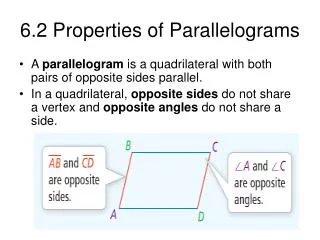
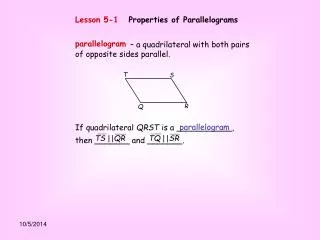
Definitions Check for Understanding: Starting with K move counterclockwise around JKLM to name pairs of consecutive angles. Consecutive angles of a polygon ____________________ share a common side. In JKLM, J and M are consecutive angles, as are J and ___. J and ___ are ____________ angles. K L opposite Slide Courtesy of Miss Fisher Modified 1/28/08
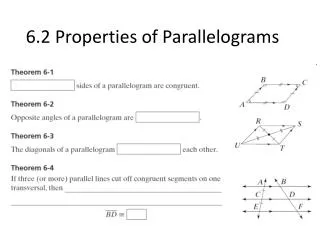
Theorems Check for Understanding: If RT and US bisect one another at point M, name two pairs of segments. Theorem 6.1 ___________ sides of a parallelogram are . Theorem 6.2 Opposite angles of a parallelogram are ____. Theorem 6.3 The diagonals of a parallelogram _________ each other. Opposite bisect Slide Courtesy of Miss Fisher Modified 1/28/08
Theorems Con’t Theorem 6.4 If three (or more) parallel lines cut off congruent segments on one transversal, then _____________________________ _________________________________ _________ they cut off congruent segments on every transversal. BD DF Slide Courtesy of Miss Fisher Modified 1/28/08
EXAMPLE #1 Find the value of x in ABCD. Then find mA. Opposite angles of a parallelogram are _________ so, mB = x + 15 = 60 + 15 congruent = 75 x + 15 = 135 - x 2x + 15 = 135 *mA + mB = 180 2x = 120 mA + 75 = 180 x = 60 mA = 105 *Recall, consecutive angles in a parallelogram are supplementary, since __________________________. // lines same-side int. s supp. Slide Courtesy of Miss Fisher Modified 1/28/08
EXAMPLE #2 Find the values of x and y in KLMN. Diagonals of a parallelogram ______ each other, so bisect Substitute 7y -16 for x in the second equation. x = 7y – 16 and 2x + 5 = 5y x = 7(3) – 16 2(7y–16) + 5 = 5y x = 21 – 16 14y – 32 + 5 = 5y x = 5 14y – 27 = 5y -27 = -9y Substitute 3 for y in the first equation. 3 = y Slide Courtesy of Miss Fisher Modified 1/28/08
EXAMPLE #3 In the figure DH || CG || BF || AE, Find EH. If three (or more) parallel lines cut off congruent segments on one transversal, then __________________________________________________________________ they cut off congruent segments on every transversal, so EF = FG = GH. EH = EF + FG + GH EH = 2.5 + 2.5 + 2.5 EH = 7.5 units Slide Courtesy of Miss Fisher Modified 1/28/08
Assignment: pg 297 #2-16, even, 17, 19, 22, 34-35, 39-41 Slide Courtesy of Miss Fisher Modified 1/28/08