Properties and Theorems of Parallelograms Explained
100 likes | 284 Vues
This text outlines essential properties and theorems related to parallelograms, a type of quadrilateral. Key points covered include the congruence of opposite sides and angles, the supplementary nature of consecutive angles, and the fact that diagonals bisect each other. Theorems 6.2 to 6.5 provide fundamental insights into the characteristics of parallelograms, including practical examples for finding angle measures and unknown lengths. This concise guide serves as a resource for learning and applying the properties of parallelograms in geometry.


Properties and Theorems of Parallelograms Explained
E N D
Presentation Transcript
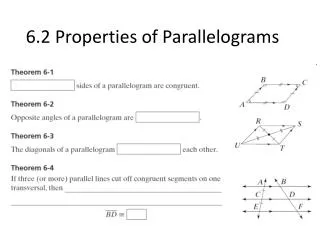
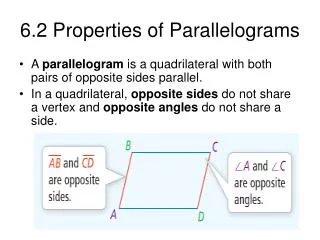
Q R P S Q R P S Q R P S Q R P S Theorem 6.2 If a quadrilateral is a parallelogram, then its opposite sides are congruent. PQ = RS and SP = QR Theorem 6.3 If a quadrilateral is a parallelogram, then it opposite angles are congruent. <P = < R and < Q = < S Theorem 6.4 If a quadrilateral is a parallelogram, then its consecutive angles are supplementary. m<P + m<Q = 180o, m<Q + m<R = 180o m<R + m<S = 180o, m<S + m<P = 180o Theorem 6.5 If a quadrilateral is a parallelogram, then its diagonals bisect each other. QM = SM and PM = RM _ _ _ _ ~ ~ ~ ~ _ _ _ _ ~ ~ Properties of Parallelograms
Theorems • 6.2 If a quadrilateral is a parallelogram, then its opposite sides are congruent. • 6.3 If a quadrilateral is a parallelogram, then its opposite angles are congruent. Q R S P
Theorems • 6.4 If a quadrilateral is a parallelogram, then its consecutive angles are supplementary. m<P + m<Q = 180° m<Q + m<R = 180° m<R + m<S = 180° m<S + m<P = 180° Q R S P
Using Properties of Parallelograms • PQRS is a parallelogram. Find the angle measure. • m< R • m< Q Q R 70 ° + m < Q = 180 ° m< Q = 110 ° 70° P S
3 3 Using Algebra with Parallelograms • PQRS is a parallelogram. Find the value of h. 3h + 120 = 1800 - 120 -120 3h = 60 P Q h = 20 3h 120° S R
Theorems • 6.5 If a quadrilateral is a parallelogram, then its diagonals bisect each other. R Q M P S
Using properties of parallelograms • FGHJ is a parallelogram. Find the unknown length. • JH • JK 5 3 5 F G 3 K J H
Examples • Use the diagram of parallelogram JKLM. Complete the statement. LM K L NK <KJM N <LMJ NL MJ J M
Find the measure in parallelogram LMNQ. • LM • LP • LQ • QP • m<LMN • m<NQL • m<MNQ • m<LMQ 18 8 L M 9 110° 10 10 70° 9 P 8 70 ° 32° Q N 110 ° 18 32 °