Comprehensive Strategies for Large-Scale Phosphoproteomic Analyses
10 likes | 128 Vues
This guide outlines effective methodologies for conducting large-scale phosphoproteomic analyses. It emphasizes the use of automated and semi-automated software for spectral inspection, validation of post-translational modifications (PTMs), and detection of phosphate fingerprints. Key techniques such as TiO2, SIMAC, and IMAC are discussed for sample conditioning and phosphoenrichment. Additionally, strategies are provided for optimizing phospho-digestions, avoiding phospho-artefacts, and recovering a high number of phosphorylated peptides and proteins, ensuring thorough analysis in bioinformatics.


Comprehensive Strategies for Large-Scale Phosphoproteomic Analyses
E N D
Presentation Transcript
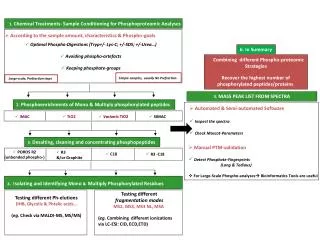
5. MASS PEAK LIST FROM SPECTRA • Automated & Semi-automated Software • Inspect the spectra • CheckMascot-Parameters • Manual PTM-validation • Detect Phosphate-Fingerprints • (Long & Tedious) • For Large-Scale Phospho-analyses Bioinformatics Tools are useful • Variants TiO2 • SIMAC • IMAC • TiO2 1. Chemical Treatments- Sample Conditioning for Phosphoproteomic Analyses • According to the sample amount, characteristics & Phospho-goals • Optimal Phospho-Digestions (Tryp+/- Lys-C; +/-SDS; +/-Urea…) • Avoiding phospho-artefacts • Keeping phosphate-groups 6. In Summary • Combining different Phospho-proteomic • Strategies • Recover the highest number of • phosphorylated peptides/proteins Simple samples,usually No Prefraction Large-scale, Prefraction steps 2. Phosphoenrichments of Mono & Multiply phosphorylated peptides 3. Desalting, cleaning and concentrating phosphopeptides • POROS R2 • (unbonded phospho-) • R3 • &/or Graphite • C18 • R3 -C18 4. Isolating and Identifying Mono &Multiply Phosphorylated Residues Testing different fragmentation modes MS2, MS3, MS3 NL, MSA (eg. Combining different ionizations via LC-ESI: CID, ECD,ETD) Testing different Ph-elutions DHB, Glycolic & Phtalic acids… (eg. Check via MALDI-MS, MS/MS)